


What Makes the Short-Circuit-Proof NSGAFÖU Rubber-Sheathed Single-Core Cable Special
What’s the deal with the NSGAFÖU and why has it been the first choice for control cabinet construction for decades? Keep reading to learn more about this robust, rubber-sheathed single-core cable and why it’s so popular.

The rubber-sheathed NSGAFÖU single-core cable is one cable with many different strengths, which make it especially popular for control cabinet construction. At the same time, it can be found in buses, railway vehicles, or on construction sites.
That’s because this cable is capable of handling many different common challenges present in these kinds of applications. The NSGAFÖU is so commonly used in control cabinets because it’s short-circuit-proof and flexible. It’s also resistant to heat and oils, flame retardant, and operates continuously with a high degree of reliability in harsh conditions.
What is the NSGAFÖU rubber-sheathed single-core cable?
Anyone who has wired a control cabinet is most likely also familiar with the NSGAFÖU rubber-sheathed single-core cable. It’s stable construction makes it a real all-rounder—especially in demanding or extraordinary applications.
If installed with protection, the NSGAFÖU is both short-circuit and ground-fault-proof up to 1,000 volts. This is why the cable is typically installed in control cabinets. Thanks to its high current carrying capacity, it can also be used as a control cable in buses or railway vehicles.
What does NSGAFÖU mean?
The cable’s name isn’t just a random assortment of letters. The real characteristics and functions of the cable are hiding behind each letter.
- N = Standardised cable
- S = Specialty cable
- G = Rubber insulation
- A = Sheathed single-core cable
- F = Flexible conductor (class 5)
- Ö = Oil resistant
- U = Flame retardant acc. to VDE 0482-332-1-2/IEC 60332-1-2
Seven letters come together to create a precise product designation.
What are short-circuit-proof cables?
Short-circuit-proof cables are specifically designed so that, should a short-circuit occur, no neighbouring cables and wires are damaged. They are especially well insulated which prevents fire or neighbouring cables from melting.
This plays a huge role in control cabinet construction where cables are run before the main switch, meaning that, even when the systems are turned off, the cables are still carrying current. For these applications, short-circuit-proof cables are a requirement that protects both the system itself, as well as the people who work with it.
What are NSGAFÖU cables used for?
When other cables just can’t cut it, the NSGAFÖU is often just the solution you need. Some of its typically applications include:
- Control cabinets and substations: short-circuit and earth-fault-proof cabling up to 1,000 volts
- Buses and railway vehicles: as a robust control and power cable
- Cranes: for reliable power supply under continuous loads
- Construction sites: where cables are subjected to heavy mechanical loads and harsh environmental conditions
Why is the NSGAFÖU available in black and orange?
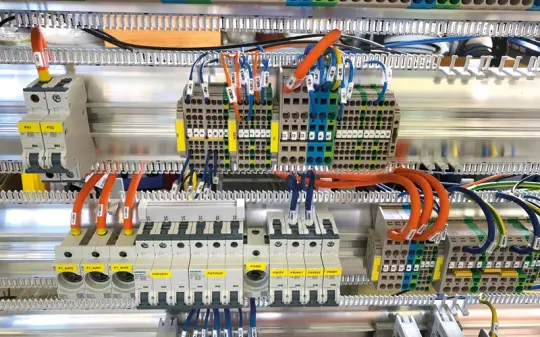
In control cabinet construction, there is one simple rule: Cables run before the main switch—and therefore carry current even when the system is turned off—must be labelled. This is why these cables are often coloured orange. In contrast, cables after the main switch are typically black. This way, technicians and engineers can tell which cable is which at a glance.
In order to colour these cables and wires orange, control cabinet builders often use shrink tubing or wraps. However, these take time to install, and ferrules can be damaged during the shrinking process. At HELU, we solve these issues by simply offering the NSGAFÖU in orange.
For the user, the advantages are:
- Time savings: no time-consuming shrinking or wrapping
- Reduced stock items: no separate shrink tubing or wrappings required
- Reduced outer diameter: makes installation in cable organisers easier
- No wrinkling: for a clean and orderly control cabinet
- No risks for ferrules: no hot air guns to cause potential damage
- Better optics: uniform cabling without improvisation