


How do I choose the right conductor material for cables and wires?
Copper, aluminium, or fibre optics? Find out which conductor material is best suited for cables and wires and what you should look out for when making your choice.

The conductor material is the heart of a cable or wire. It forms the conductor and ensures efficient transmission of energy, signals, or data. Depending on the application, the right choice is crucial for the reliability, service life, and performance of a cable.
Theoretically, many materials can be considered. In practice, however, copper and aluminum are the most commonly used conductor materials. There are good reasons for this: both metals offer high electrical conductivity as well as different advantages and disadvantages. Optical fibers (fiber optics) have also become an indispensable part of modern data transmission.
In this article, we explain which properties distinguish a good conductor material and which factors play a role in the selection process.
Table of Contents
- What properties make a good conductor material?
- Copper—the standard for electrical conductors
- Aluminum—light and economical
- Silver, gold or steel: What can be used as a conductor material?
- CCA—copper-coated aluminum: A good compromise?
- Fiber optics: High-speed data transmission
- Which conductor material is the best?
What properties make a good conductor material?
The conductor material determines how efficiently a cable can transmit electrical energy, signals, or data. Simply put, the higher the conductivity, the lower the electrical resistance and the lower the energy loss during transmission.
But other properties also play an important role in selecting the right conductor material:
- Mechanical resilience
- Flexibility
- Weight
- Price
Depending on where the cable is used and the application, these factors may be weighted differently, for example, in moving applications, long cable runs, or particularly high current loads.
Copper—the standard for electrical conductors
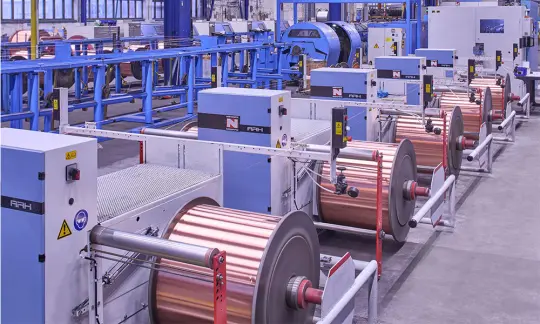
Copper is the most commonly used conductor material worldwide. The metal has very good electrical conductivity. Copper is characterized by low electrical resistivity and thus enables efficient current transmission.
In addition, copper offers many other advantages:
- Mechanical strength: Copper has high ductility and toughness, which makes it easy to deform without breaking even under mechanical stress. This property enables the production of both solid and highly flexible conductors and contributes to the high bending and fatigue strength of cables and wires.
- High temperature resistance: Copper can withstand high temperatures without losing its mechanical and electrical properties.
- Flexibility: Copper is a relatively soft metal and can be used and processed in a variety of ways.
- Sustainability: Copper can be recycled and reused several times.
Because of these properties, copper is suited for a wide range of applications in industry, building technology, mobility, and energy supply. For special applications, copper cables can also be tinned, nickel-plated, or silver-plated. This allows individual properties to be specifically adapted to the respective requirements.
Aluminum—light and economical
Aluminum is the second most common conductor material after copper. Compared to copper, aluminum only has a conductivity of about 63 percent. Nevertheless, aluminum offers two main advantages.
- Weight: Aluminum is about 30 percent lighter than copper.
- Cost: Aluminum is much less expensive than copper.
For these reasons, aluminum is often used when weight and material costs play a particularly important role, for example in the energy sector, long power lines, or medium-voltage cables. Since the conductivity is lower, larger cross sections (cross section factor approx. 1.6) must be used to achieve the same current-carrying capacity.
At the same time, aluminum has some limitations compared to copper. The material is more brittle, more susceptible to corrosion, and less mechanically resilient. Therefore, its use requires special expertise as well as suitable connection technology and tools.

Any questions? We are happy to help you.
Silver, gold or steel: What can be used as a conductor material?
Silver has the highest electrical conductivity of all metals. However, it is very expensive: the cost is many times higher than copper. For this reason, silver is usually only used for special applications where high performance and efficiency are required, such as in the high-end audio sector.
Often, silver is not used as a solid conductor, but as a coating on copper conductors. Silver-plated copper conductors also exhibit impressively high conductivity and corrosion resistance.
Gold, on the other hand, is not used as a conductor material. In addition to its high price, it also has lower conductivity than silver or copper.
Steel also has significantly lower conductivity compared to copper or aluminum, which is why it is not very suitable as a conductor material at first glance. However, steel has other advantages: it is an extremely strong and durable material. This is why steel is often used in military applications and aerospace, usually in combination with other materials such as aluminum.
CCA—copper-coated aluminum: A good compromise?
CCA stands for "Copper Clad Aluminum". These conductors consist of an aluminum conductor surrounded by a thin layer of copper.
Originally, this technology came from antenna manufacturing. There, it was developed as a cost-effective alternative to high-frequency lines. The reason for this lies in the so-called skin effect, whereby at high frequencies (>= 10 kHz), the current flows predominantly on the surface of the conductor.
In the electrical sector, however, CCA should be viewed critically, as the conductivity is significantly lower than that of pure copper. Nevertheless, CCA cables are increasingly being offered in the low-price segment, especially by Asian manufacturers.
Typical examples are:
- Speaker cables
- Power cable for car hi-fi
- Network cables (patch cables)
Possible disadvantages are often not sufficiently explained:
- A 2.5 mm² CCA conductor is only equivalent to a 1.5 mm² copper conductor
- Higher voltage drop and heat generation with "Power over Ethernet"
- Fire risk in the event of incorrect protection in the car hi-fi sector
- Use in company networks not compliant with standards (banned by TIA and IEC)
Fibre optics: High-speed data transmission
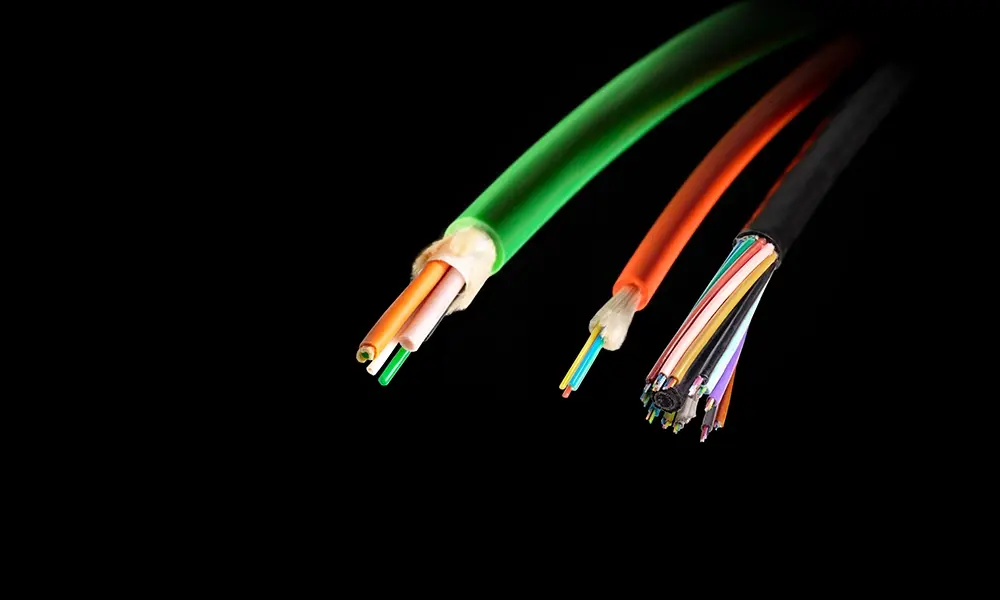
In addition to metallic conductors, there is another technology for signal transmission in the form of optical fibers. Here, information is not transmitted as electrical current, but as optical signals in the form of light pulses.
Fiber-optic cables are made of very thin glass or plastic fibers and offer several advantages:
- Very high transmission speeds without signal loss
- Long ranges
- Insensitivity to electromagnetic interference
- Galvanic isolation
Fiber-optic cables are therefore mainly used in telecommunications, data networks, medicine, and aerospace. However, they are not suitable for the transmission of electrical energy.
Which conductor material is the best?
The question of the "best" conductor material cannot be answered so easily, as it always depends on finding the right solution for the different factors of the application.
The optimal choice always depends on the respective application and the specific operating conditions. External influences such as temperature, chemical loads, mechanical stress, or electromagnetic interference also influence the selection of the right cable.
In addition to the conductor material, other features of the cable also play an important role:
- Strand construction
- Cross section
- Stranding
- Insulation material
- Shielding
- Jacket material
The interplay of these factors determines whether a cable or wire reliably meets the requirements of an application over the long term.
Therefore, the best thing to do is seek expert advice when choosing cables or wires. This ensures that the chosen solution meets all practical requirements reliably, safely, and economically.