


Instrumentation Cables: Screened Signal Cable for Process and Control Systems
What are instrumentation cables?
Instrumentation cable carries the low-voltage analogue and digital signals that connect field instruments, sensors, and transmitters back to control systems. HELU Australia's range uses twisted-pair construction with a copper drain wire, in either an overall screened build or an overall and individually screened build, to keep signal transmission accurate and free from electromagnetic interference across process, control, and automation applications.
What we have to offer—At a glance
- Twisted-pair construction: Cores twisted into pairs to reduce the electromagnetic interference induced in the conductor.
- Overall screened option: A single overall aluminium foil screen with copper drain wire, protecting the whole cable from external interference.
- Overall and individually screened option: Each pair individually screened as well as overall, isolating pairs from each other for signal-intensive, high-precision applications.
- Tinned copper drain wire: Provides a reliable earthing path for the screen, supporting clean, noise-free signal transmission.
- Built for field-to-control-room runs: Sized and constructed for connecting instruments, sensors, and transmitters back to PLCs and control systems.
- Two configurations to match the application: A simpler overall screen for standard installations, or the individually screened build where multiple signal loops run through a noisy environment.
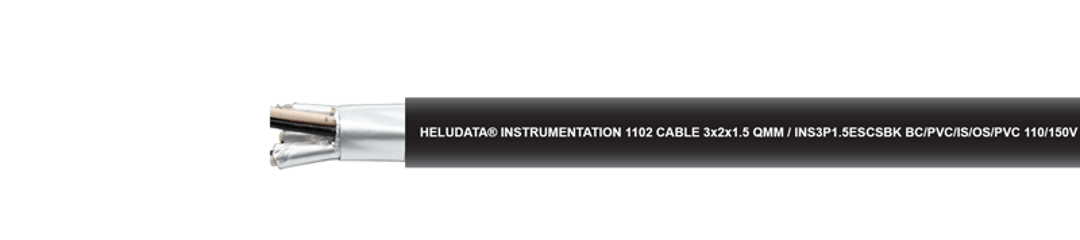
| Product | Temperature | Number of Pairs | Cross-Section | Data Sheet |
| HELUDATA® INSTRUMENTATION 1101 OS | -20oC to 90oC | 1-50 | 0.5-1.5 | Overall Screened |
| HELUDATA® INSTRUMENTATION 1102 IS/OS | -20oC to 90oC | 2-36 | 0.1-1.5 | Individually and Overall Screened |
Enquire about our Instrumentation cables range
Design and construction of instrumentation cables
Instrumentation cable uses stranded copper conductors twisted into pairs, which reduces the electromagnetic interference that would otherwise be induced along the conductor. In the overall screened build, the assembled pairs are wrapped in a single screen with a copper drain wire earthed to protect the whole cable from external interference. In the overall and individually screened build, each pair carries its own screen and drain wire in addition to the overall screen, isolating individual signal loops from each other as well as from outside interference — the construction used where several signal circuits run together in an electrically noisy environment.
Applications for instrumentation cables
Instrumentation cable is used to connect field instruments, sensors, and transmitters back to PLCs and control systems, carrying the analogue and digital signals used for process monitoring and control. It's specified across industrial, process, and automation environments where accurate, interference-free signal transmission matters — from simple sensor-to-controller runs suited to the overall screened build, through to signal-intensive control systems where the overall and individually screened build keeps multiple loops isolated from each other and from surrounding electrical noise.
FAQ
Why are the conductors twisted into pairs? Twisting the conductors reduces the chance of electrical voltages and currents being induced by nearby interference, which helps keep the signal accurate over the length of the run.
When would I need individually screened pairs instead of just an overall screen? Individually screened pairs are used where multiple signal loops run through the same cable in an electrically noisy environment, or where high-precision signals need to be isolated from each other as well as from external interference. A single overall screen is usually sufficient for more standard installations.
What does the drain wire do? The drain wire provides a low-resistance path from the cable's screen to earth, allowing interference picked up by the screen to be safely conducted away rather than affecting the signal conductors.