Four Kilometres Through Marshland: The Cabling of a Wind Farm

The view below ground at a wind farm is just as exciting as it is above ground: For underground construction experts like Schulte-Perk GmbH, the installation of a kilometre-long, medium-voltage cable proves a complex task.
Feeding power from six wind turbines reliably into the grid... not as easy as it sounds. In Lower-Saxony town of Damme, a four-kilometre-long, medium-voltage cable run needed to be installed through challenging terrain. This was a project that demonstrated what skills are in demand when it comes to cabling wind farms.
How to Minimise Loss Over Long Stretches
As part of the expansion of the wind farm in the Lower-Saxony town of Damme, six new wind turbines were connected to the grid. This involved a team from the pipeline construction company Schulte-Perk GmbH installing two new sections of cable run. “Each contains a cable system that responsible for three of the six total wind turbines,” explains Dieter Thomas, Project Lead with Schulte-Perk GmbH.
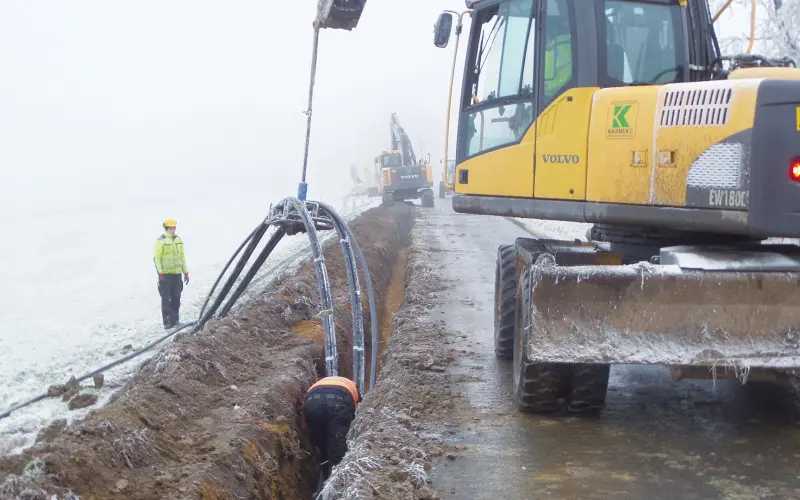
The NA2XS(F)2Y medium-voltage cable from HELU that was used in this project has a cross-section of 150 mm². This single-core cable was bundled into a cable system and installed in a 120-centimetre-deep and 60-centimetre-wide trench containing a pre-prepared bed of sand. “This distribution is necessary to transmit power over the four-kilometre stretch with minimal loss. The longer the cable run, the more energy is lost,” explains Dieter Thomas.
The two cable systems join up again at the coupling station. From there, the power produced is transmitted in a single cable bundle to the transmission station located near the transformer station. To achieve this, a cable bundle consisting of three non-sheathed single-core cables, each with a cross-section of 630 mm², is required. “This bundle transmits the power produced by all six turbines. This is the best way to keep transmission losses as low as possible.”
The transmission station represents not just a physical location, but also a legal entity: It belongs to the transformer station of the local supplier who feeds the power into the three-phase grid.
Wind Farms Require not only Power Cables, but also Data Cables
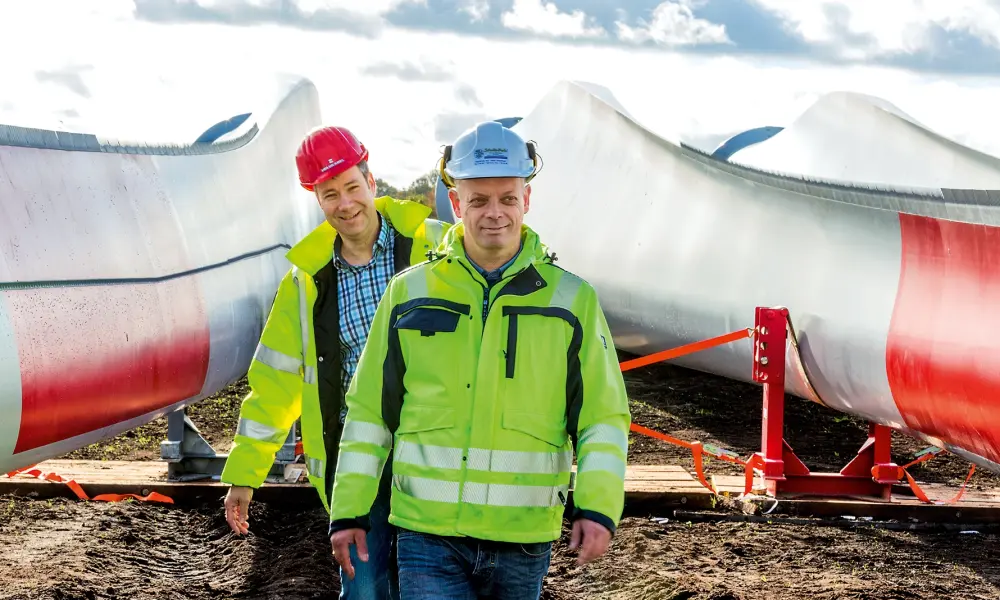
Dieter Thomas takes a look at the 65-metre (213-foot) long rotor blades. (© HELU / Christa Henke)
In the trenches, plastic conduits and a copper cable run alongside the medium-voltage cables. “The copper cable earths the system and prevents voltage differentials between the coupling station and the wind turbines,” explains Thomas. The plastic conduits protect fibre-optic cables that transmit data and control signals and make the remote maintenance of the wind farm possible. These cables deliver all of the information from the wind turbines to the monitors of the operators of the wind farm.
The job became especially challenging any time the cable run had to cross existing infrastructure. This included paths, streams, and water mains. “In these instances, we needed to dive deep below grind,” describes Thomas. For road crossings, flush drilling was used. This involves a drill head boring through the ground. Then, an expander head is used to widen the borehole to the required diameter. This process is complicated when the drill needs to curve. These boreholes can be 10, 20, or even 50 metres long. Even the quality of the soil changes constantly. To counteract this, bentonite is added to the drilling fluid to stabilise the walls of the borehole.
Testing Cable Quality: Load Testing With 54,000 Volts
-
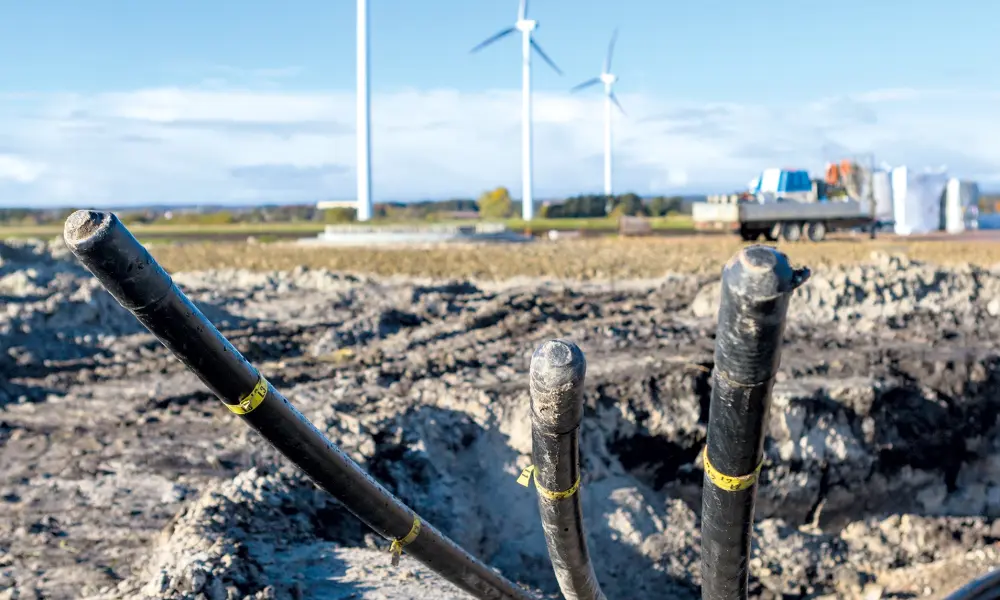
Six additional wind turbines will be installed at the wind farm in Damme to replace 15 existing turbines. (© HELU / Christa Henke)
-
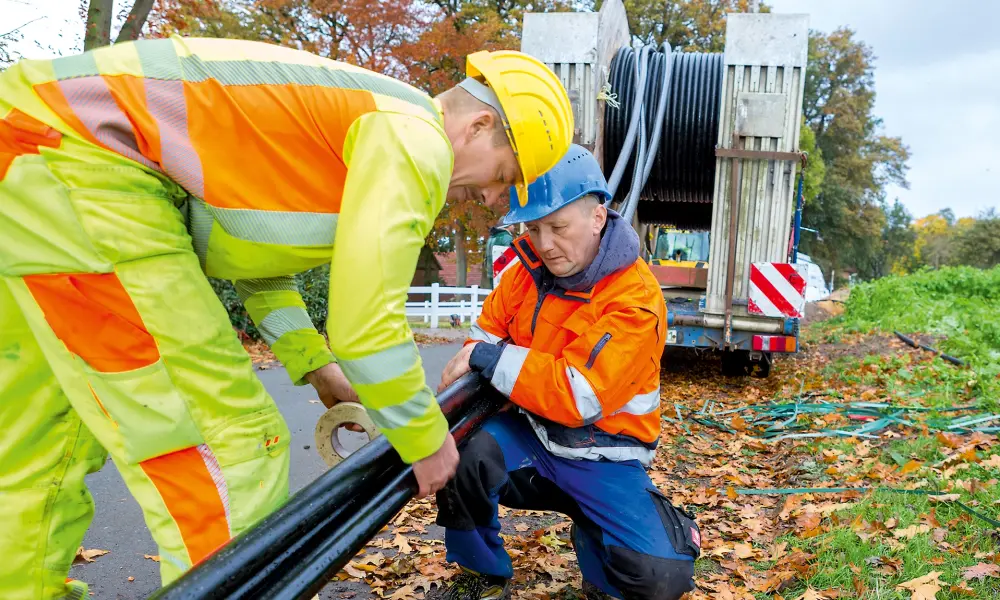
Schulte-Perk workers bundle the three single-core, medium-voltage cables and lay them into the ground. (© HELU / Christa Henke)
-
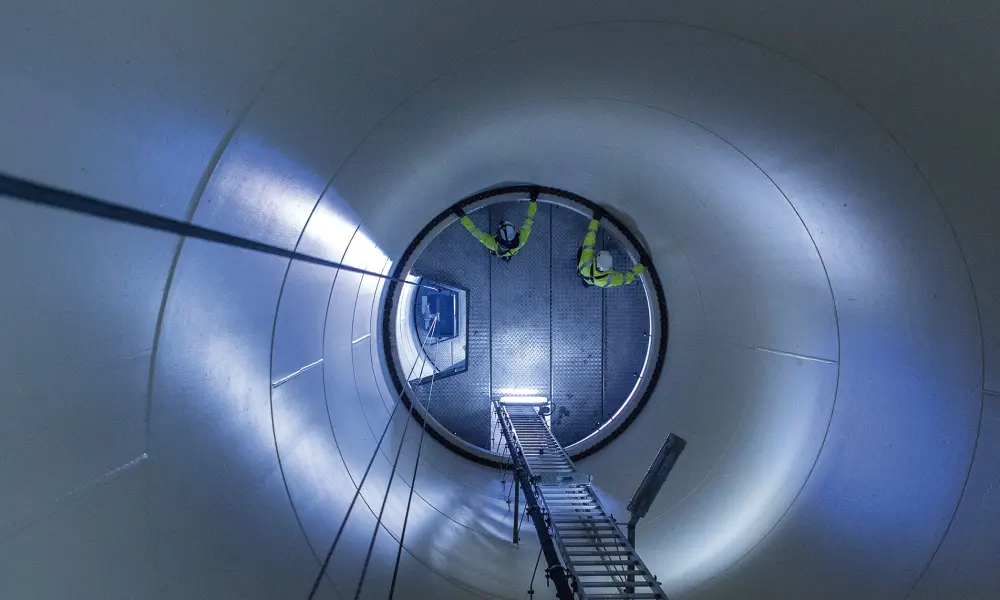
Schulte-Perk installs medium-voltage cables for wind turbines. (© HELU / Christa Henke)
-
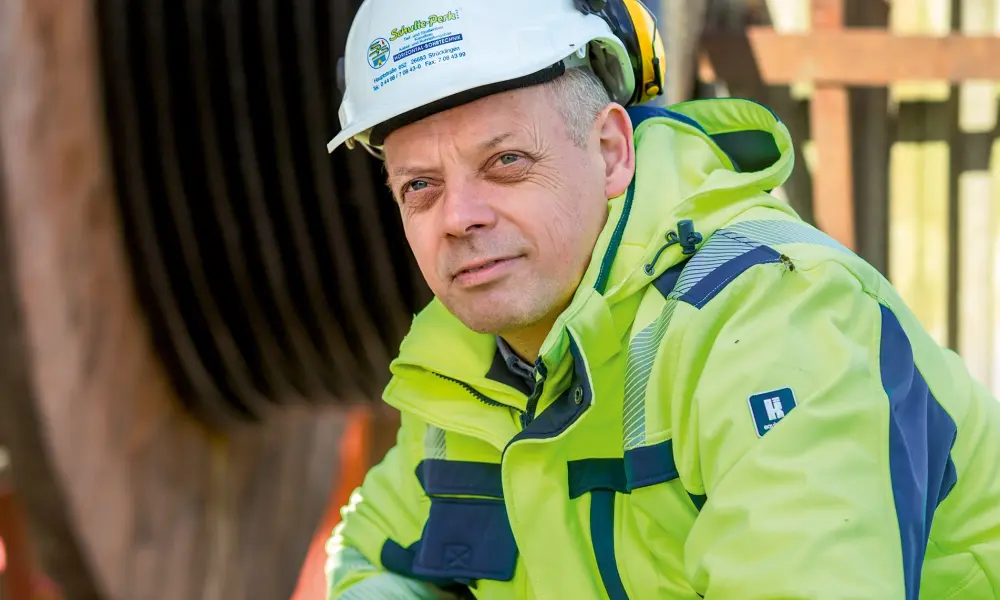
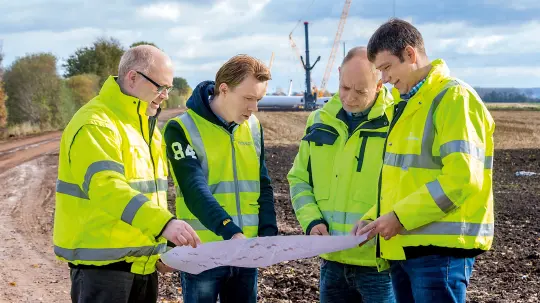
Dieter Thomas, project manager at Schulte-Perk, is an expert in civil engineering projects. Thomas and his team are responsible for installing the kilometres of underground cables that enable electricity generated in wind turbines to be transported into the local power grid. (© HELU / Christa Henke)
Before the trenches at a wind farm can be backfilled, every section of cable run is subjected to a high-voltage test. Every section is tested for one hour at a test voltage of 54,000 volts. This despite the fact that the cables will only be transmitting maximum 30,000 volts under normal operation. “Before filling the trenches, we need to be completely sure that everything is working properly,” explains Dieter Thomas. “The operator of the wind farm can trust that the cables we’ve routed and installed were tested in accordance with technical standards.”
As expected, both sections of cable run have passed the tests. Since then, these medium-voltage cables have transmitted the electricity produced by the six new wind turbines amounting 55 kilowatt hours per year—the same amount produced by the previous 15 systems together. “It really is impressive how quickly things progress when construction is able to take off,” says Berthold Klatte, Managing Director of WPD Windpark Damme GmbH & Co. KG.