Load Testing in Wind Power: What Cables in Wind Turbines Must Be Capable Of

Whether it’s torsion, abrasion, or compliance with international standards, cables used in wind turbines must be capable of performing enormous feats. W2E, a leading developer of wind turbine systems, relies on expertise from HELU.
Wind turbines are being built across the globe—from the North Sea to deserts. But they typically have one thing in common: Regardless of where they end up in the end, they all start in Rostock with the wind turbine developers at W2E, Wind to Energy.
Here, the subject of cables is constantly on the docket. “Of course, the first thing people always think of is the transmission of power,” says Dr. Torsten Schütt, Head of Electrical Engineering at W2E. “Currently, our systems are sitting in the 3-megawatt range. This results in a combined current of several thousand amperes.”
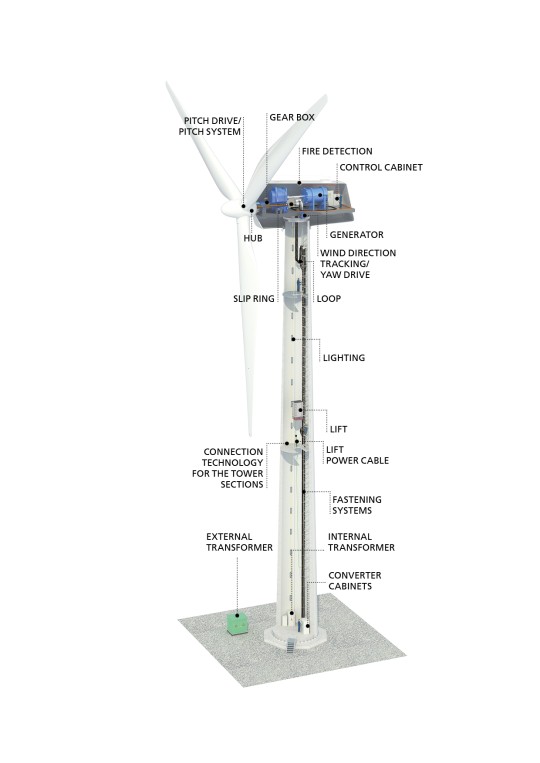
However, alongside the physical power cables, there are many other cable types that ensure the reliable operation of the wind turbines. They transmit data from the various sensors for things such as pressure, rotational speed, current, voltage, temperature, and oil levels. Or they control different motors such as those that position the nacelle and rotor blades ideally with regard to the wind direction. Beyond the wind turbines, the entire wind farm is connected via a network of fibre-optic cables which supply operators with real-time information on all of the systems.
For any questions regarding electrical connection technology, HELU is right at W2E’s side. “We’ve been involved in the wind power industry since the beginning, and we’re familiar with all of the challenges,” says Uwe Schenk, Senior Industry Manager Renewables at HELU. “For me, it has always been important to be on site with the system for the customer,” he explains. “This is the only way to experience first-hand where the pain-points are and what we as a cable manufacture can do for them.”
The Biggest Challenges For Cables in Wind Turbines
International Guidelines
International standards and directives such as UL, IEC, or CSA present special challenges for the developers of wind turbine systems—particularly for global projects. For example, according to UL 6141, all accessible cables in North America must be installed in conduits. If this isn’t feasible or possible, only so-called tray cables are allowed to be used in open-cut installations. W2E relies on HELU to stay up-to-date with such changes and to obtain the required certifications. The more regions one product can be used in, the easier it is to realise international projects.
Equipotential bonding
Due to the large amount of metal used in wind turbines, their height, and their exposure to the elements, they are practically predestined to be struck by lightning. These strikes often occur to the rotor blades and must be discharged from the hub, through the tower, then to the earth via lightning receptors which serve as predefined strike points. For lattice steel towers, this is significantly more complex. Unscreened cables must be enclosed in a Faraday cage. This means it’s easier to simply used screened cables from the outset.
Abrasion
Due to torsional movements, cables in the loop are constantly rubbing against one another. Abrasion reduces the wall thickness which, over the long term, can lead to damage to the core insulation and copper wires. To prevent this, HELU uses polyurethane and other comparable thermoplastic elastomers. The surface finish is just as important. The outer sheath be low-adhesion so that the cables can glide past one another without rubbing.
Temperature
Wind turbines are installed in the most diverse locations which means they are regularly subjected to extreme temperatures ranging from freezing cold to sweltering heat. HELU uses specialty plastic materials in their cables that are designed to withstand temperature ranges from -55 to +145 degrees Celsius. This makes them suitable for use around the globe without the need for different variations for different climate zones.
Electromagnetic compatibility (EMC)
Screening ensures that the cables installed in a system do not influence one another electromagnetically. Otherwise, this could lead to significant interference within the system. The cables installed in the loop, in particular, have increased requirements with regard to cable construction: In order to ensure continuous, optimal screening through even torsional movements, HELU recommends the use of a spiral-wrapped screen (D-screen).
Torsion
The cable loop provides the flexibility the nacelle and rotor blades need to be able to turn to optimally face the wind. The torsion-rated cables used for this must be able to twist around their own axis up to three times. To achieve this, exceptionally durable, class 5 and 6 copper conductors with optimum lay lengths are used. Specialty materials that are highly resistant to abrasion are used as insulation for the cores and as a sheath material. This is how these cables are able to withstand 18,000 torsion cycles.
Free of halogens
In the case of fire, halogen-containing materials can release toxic gases and corrosive acids. To avoid costly damage, insurers are the first to insist that halogen-free materials are used.
Oil resistance
The special oils used in the wind power industry represent a challenge for many commonplace sheath materials. Many of these fail in ageing tests. This is why the HELUWIND WK series is tested for long-term durability far beyond the normal testing procedures outlined by VDE or UL (Oil Res I, Oil Res II).
What the Experts Have to Say
“Thanks to various international directives, developing wind turbine systems for use across the globe can be a real challenge. In order to keep the costs for us as low as possible, we are very careful to purchase as few types of cables as possible that are also certified for use in many countries.”
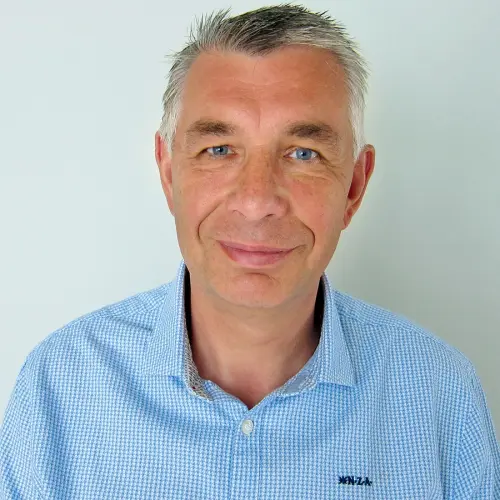
Dr. Torsten Schuett, Head of Electrical Engineering, W2E
“In the loop itself, I’ve seen many cables that weren’t up to task, as far as torsion is concerned. This resulted in corkscrewing, core breakage, and material abrasion which lead to system outages and expensive repairs. To prevent this, we subject our cables to ruthless, long-term testing."

Uwe Schenk, Senior Industry Manager Renewables Industries, HELU