Open, closed & semi-closed plastic drag chains: Comparison & selection guide
Plastic drag chains, also referred to as plastic cable carriers in some contexts, are solutions for organizing, guiding, and protecting cables in moving machinery systems. These chains are designed according to operating conditions and protection requirements, with common types including open, semi-, and closed plastic drag chains. So, how do these three types differ, and which one should you choose for your system? Let’s explore their characteristics, applications, and selection criteria in the following article.
Article Content
1. What are open, closed, and semi-closed plastic drag chains?
Designed to meet different cable protection requirements, open, closed, and semi-closed plastic drag chains have distinct structures, typically differentiated by the design of their crossbars or covers.

1.1. What is an open plastic drag chain?
An open plastic drag chain is a type of plastic cable carrier with crossbars connecting the two sides of the chain links while leaving most of the internal space exposed. This design makes it convenient to inspect, arrange, and access cables during installation or maintenance.
Key features:
- Easy to inspect cable conditions during operation.
- Convenient for adding, replacing, or adjusting cable positions.
- Suitable for systems operating in relatively clean environments with a low risk of foreign objects directly affecting the cables.
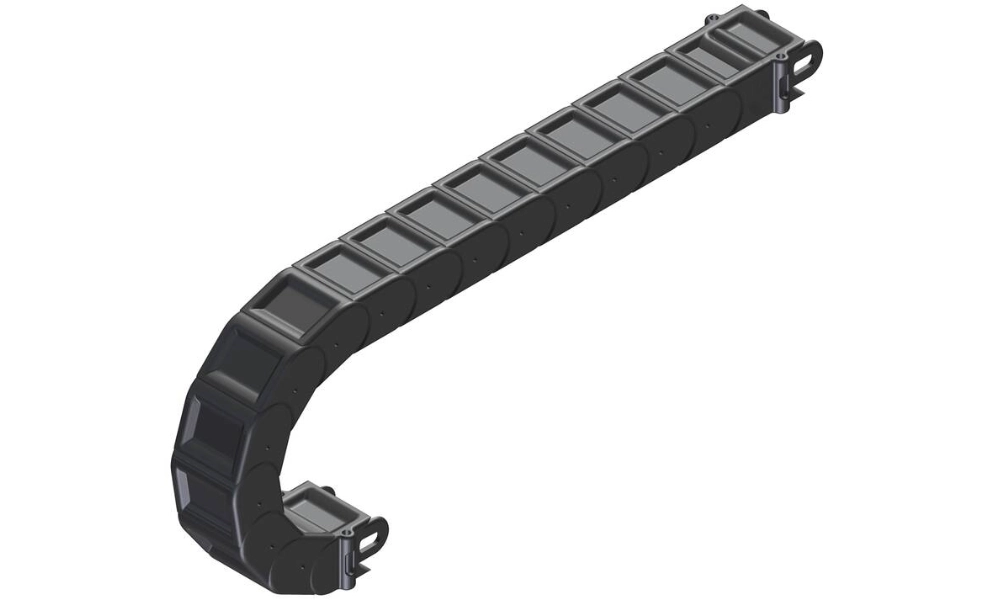
1.2. What is a closed plastic drag chain?
Unlike an open plastic drag chain, a closed plastic drag chain has crossbars or covers that enclose the cable-carrying space, forming a closed structure. With this design, the cables are less exposed to chips, debris, and certain external mechanical impacts during operation.
Key features:
- Provides increased cable shielding under suitable operating conditions.
- Worth considering for locations where chips or debris may be generated.
- The cover may need to be opened or removed to access cables in designs that do not allow direct access.
- Resistance to dust, water, or chemicals depends on the specific specifications of each product.
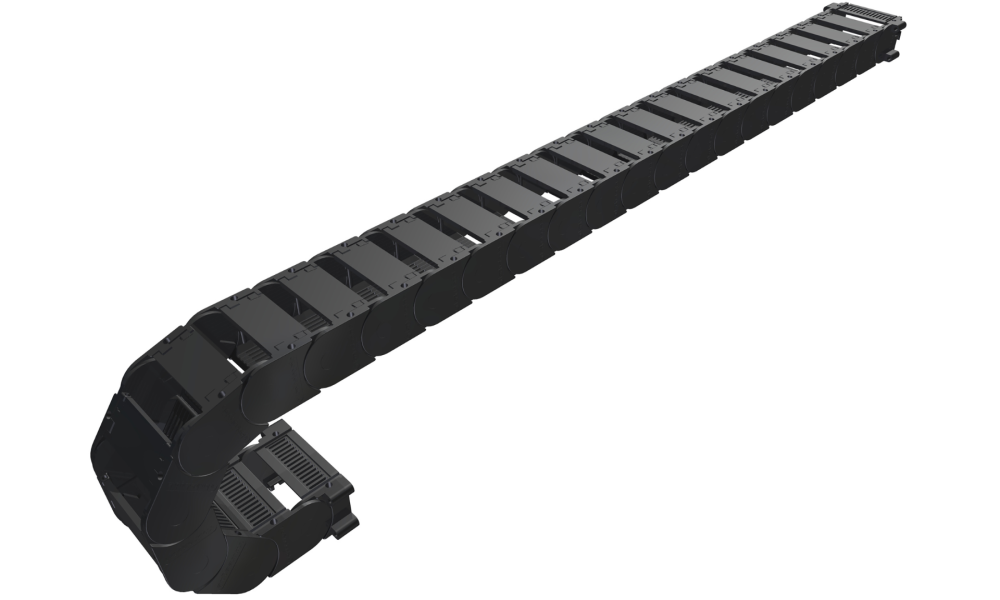
1.3. What is a semi-closed plastic drag chain?
A semi-closed plastic drag chain has a structure that falls between open and closed designs. Depending on the manufacturer's design, the crossbars or covers only partially enclose the cable-carrying space, rather than leaving it completely open or fully closed like the other two types. As a result, this type of plastic drag chain can offer a balance between cable accessibility and protection. However, the actual level of protection should be determined based on the specific construction of the plastic drag chain version you choose.
Key features:
- Provides an intermediate level of shielding compared with the corresponding designs.
- May offer easier cable access than some closed types.
- Worth considering when a system requires a certain level of shielding while still allowing relatively convenient maintenance.
2. Comparison of open, closed, and semi-closed plastic drag chains
For an overview of the differences between open, closed, and semi-closed plastic drag chains , refer to the following table:
| Criteria | Open plastic drag chain | Semi-closed plastic drag chain | Closed plastic drag chain |
| Structure | Most of the cable-carrying space is open | Partially covered | Most of the cable-carrying space is enclosed |
| Cable visibility | Easy | Relatively convenient | The cover may need to be opened |
| Level of protection | Basic | Medium | High |
| Installation and maintenance | Generally quick and easy | Balances cable visibility and protection | May require additional steps to remove the cover |
| Suitable environment | Clean areas with few contaminants | Areas requiring partial protection | Areas where chips or debris may be present |
| Initial investment | Lower than the other two types | Medium | High |
3. When should you use an open plastic drag chain?

With most of its cable-carrying space exposed, an open plastic drag chain allows technicians to easily inspect, arrange, or replace cables when necessary. Common applications include:
- Automation machinery: Systems with multiple control and signal cables that require frequent inspection or adjustment.
- Assembly and testing equipment: Machinery with multiple sensors, moving mechanisms, and cables that need to be easily accessible.
- CNC machines under suitable conditions: Locations where chips and debris are well controlled and a fully enclosed structure is not required.
- Indoor production lines: Relatively clean areas with a low risk of foreign objects coming into direct contact with cables.
4. When should you use a closed plastic drag chain?

A closed plastic drag chain is suitable for applications requiring increased cable protection against chips, debris, or external mechanical impacts, such as:
- Milling machines, lathes, and metalworking equipment: Areas where metal chips or debris may be generated during operation.
- Woodworking machines: Moving mechanisms that may be exposed to wood dust or machining debris.
- Machinery on industrial production lines: Locations where cables may be exposed to impacts or contact with external objects.
- Equipment operating in environments with many contaminants: Systems requiring increased cable protection based on actual operating conditions.
5. When should you use a semi-enclosed plastic chain?

A semi-closed plastic drag chain is suitable for systems that require a certain level of cable protection while still allowing convenient inspection and maintenance. This type of plastic cable carrier is commonly used in the following applications:
- Automation machinery: Systems that need to partially limit external impacts while still requiring periodic cable inspection.
- Conveying and positioning equipment: Moving mechanisms that require neatly arranged cables while allowing convenient system adjustments.
- Machining equipment in low-chip environments: Locations where cables require partial protection but a closed structure is not necessarily required.
- Production lines requiring frequent maintenance: Systems that need to balance cable accessibility with the need to limit the entry of foreign objects.
6. 5 criteria to consider when choosing a plastic drag chain
Below are five important criteria to consider when selecting a plastic drag chain for your system:
- Operating environment: If the working area contains metal chips, dust, or debris, consider a semi-closed or closed drag chain, or an appropriate shielding solution. In clean environments, an open drag chain may meet your needs.
- Cable dimensions and quantity: Choose a chain with suitable internal width and height for the number of cables, pneumatic hoses, and other lines to be accommodated. You should also leave sufficient space to reduce friction and prevent cables from being compressed during movement.
- Bend radius: The chain's bend radius must meet the minimum bending requirements of the cables used. Check this parameter against the technical documentation for both the chain and the cables to limit excessive stress during operation.
- Speed and travel distance: Determine the speed, acceleration, travel length, and load to select a suitable chain series. For high-speed systems or long travel distances, refer to the manufacturer's operating specifications and installation requirements.
- Maintenance requirements and operating costs: If cables need to be inspected or replaced frequently, prioritize designs that provide convenient cable access. In addition to the initial purchase price, consider installation, maintenance, replacement costs, and machine downtime to optimize long-term costs.
7. Featured HELU plastic drag chain series
At HELU, we offer the HELUCHAIN® Plastic drag chain series in various designs and sizes to meet the needs of machine tools, industrial robots, and automation systems. Depending on the travel distance, installation space, and number of cables, you can consider the following product series:
- HELUCHAIN® PLASTIC LINK 1-PF: A closed-tube design suitable for short-travel applications requiring increased cable protection against chips and dust. The product is used in machine tools, welding machines, and metalworking equipment.
- HELUCHAIN® PLASTIC LINK 2-KL: An economical solution for light industrial applications. Integrated plastic connectors simplify installation, making the product suitable for industrial robots, conveyor systems, textile machines, and paper-making machines.
- HELUCHAIN® PLASTIC LINK 4-PK: A highly flexible chain series that allows length, width, and height adjustments without specialized tools. The product is suitable for robots, machine tools, and internal logistics systems.
- HELUCHAIN® PLASTIC LINK 4-45: Designed for applications requiring a wide cable-carrying space and high lateral stability. With an internal height of 45mm and an internal width of up to 400mm, this plastic drag chain is suitable for systems containing multiple cables or large-diameter hoses.
Comparison of HELU plastic drag chain technical specifications
| Technical Specification | PLASTIC LINK 1-PF | PLASTIC LINK 2-KL | PLASTIC LINK 4-PK | PLASTIC LINK 4-45 |
| Internal height (Hi) | 23–57 mm | 7–50 mm | 16–80 mm | 45 mm |
| External height (Ha) | 35–75 mm | 10–65 mm | 25–104 mm | 64 mm |
| Internal width (Bi) | 23–134 mm | 7–195 mm | 30–400 mm | 50–400 mm |
| Chain pitch (t) | 35–65 mm | 35–65 mm | 35–115 mm | 65 mm |
| Bend radius (R) | 75–300 mm | 15–400 mm | 40–500 mm | 75–340 mm |
| Travel distance (Lv) | — | Up to 100 m | Up to 100 m | Up to 200 m |
| Long-term operating temperature range | — | -20 to 100°C | -20 to 100°C | -20 to 90°C |
Contact HELU Vietnam today for consultation and a product quote
8. Frequently asked questions about plastic drag chains
These three types of plastic drag chains mainly differ in their cable protection structures. An open chain has an exposed cable-carrying space, a semi-closed chain is partially covered, and a closed chain has a cover that encloses more of the space, helping limit direct cable exposure to external impacts.
An open plastic drag chain is suitable when cable accessibility and maintenance are priorities in a relatively clean environment. A semi-closed chain may be suitable when a balance between protection and accessibility is needed, while a closed chain should be considered when increased protection against chips or debris is required.
Not all closed drag chains can resist water or completely prevent dust ingress. The level of protection depends on each product's construction and technical specifications, so you should check the manufacturer's documentation before use.
Yes, provided that the replacement chain meets the requirements for dimensions, bend radius, load, speed, and travel distance. You should also check the available installation space and compatibility with the existing cable system.
It may be suitable for some CNC machines, depending on the installation location and the level of exposure to chips, coolant, or other substances. If metal chips may enter the chain and damage the cables, consider a closed design or a more suitable protection solution.