DC Cable Connectors for Photovoltaic Systems
Currently, many countries are gradually following the trend of shifting from fossil energy to renewable energy sources to aim for sustainable development and solve the problem of energy depletion in the future. In Vietnam, renewable energy projects, specifically solar energy, are developing rapidly with great potential for investors.
According to Wikipedia, Vietnam has great potential for solar energy development, especially in the central and southern regions. The average number of sunny hours in the Northern region ranges from 1,500 to 1,700 hours of sunshine per year. The Central and Southern regions have higher average annual sunshine hours, from 2,000 to 2,600 hours/per year. From the advantages of weather and climate conditions, businesses have taken advantage of this to invest in and develop solar energy projects in Vietnam.
With the desire to accompany investors in developing solar power systems, we, HELU Vietnam not only bring specialized DC power cable products for solar projects but also provide quality connector product lines, serving the electrical connection system of solar energy projects.
Contact our HELU Vietnam engineers to get a quote & expert consultation
1. What are DC cable connectors?
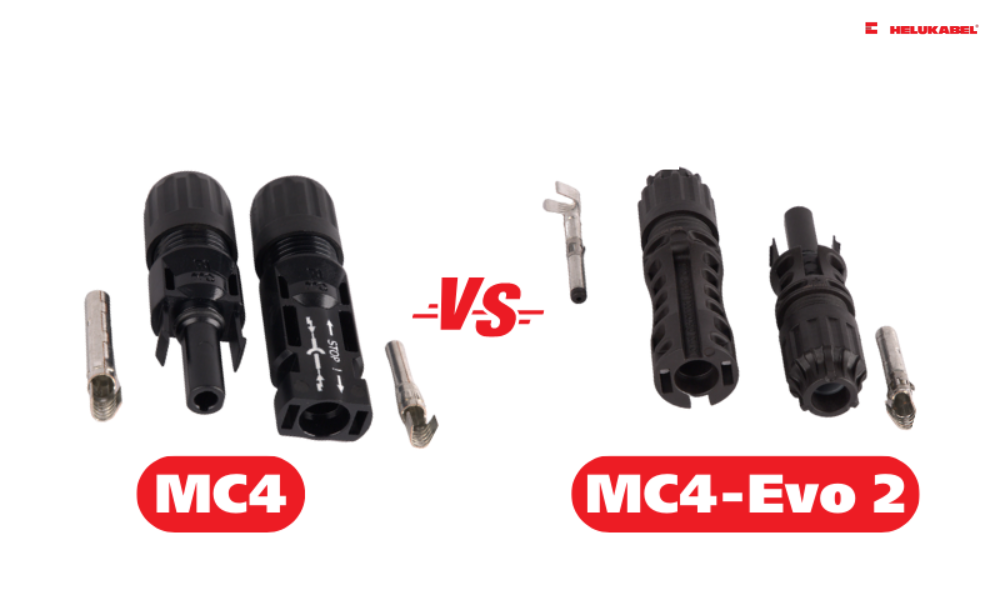
DC cable connectors are a component of electrical conduction system, used to connect and transmit electrical signal from power source to electrical equipment. It is used to connect the output of the DC power supply to the input of the receiving device.
DC cable connectors are generally of two types: male connectors and female connectors. The male connector is attached to the lead end and plugged into the female connector of the receiving device, while the female connector is mounted on the device and the lead end is plugged into it. DC cable connectors come in a variety of sizes and designs to accommodate different devices and power supplies.
2. Advantages of HELU’s DC connectors

With the above advantages, HELU's MC4 DC connector is a good choice for solar power systems, ensuring performance, safety, and durability in the harsh environment of solar energy.
Expert insights on DC connectors
"Currently, most technical failures in solar power systems are often related to connection points (cross-mating)... Our MC4 connectors feature core technology that not everyone can replicate 100%, which results in significant differences in contact resistance and chemical resistance."
"When using an incompatible connector, the danger is difficult to detect at first because the resistance is still low, but the temperature at the contact point continues to rise. After 2–3 years, the connector may crack, fail, or even cause an electrical arc and a system fire."
Mr. Joseph Yang — Director, Electrical Connectors (ECS), Stäubli Taiwan

Mr. Joseph Yang — Director, Electrical Connectors (ECS), Stäubli Taiwan
3. Which type of DC connector should you choose?
Quick comparison of 3 product lines — click "View Products" to go to the specific technical specifications section.
| MC4 connectors | MC4-Evo 2 connectors | MC4-Evo 2A connectors | |
| Voltage | 1,000 V | 1,500 V | 1,500 V |
| Ingress Protection | IP67 | IP68 | IP65/IP68 |
| Rated current | 22–30 A | 39–69 A | 39–69 A |
4. PV-male and female cable coupler MC4
The MC4 connector applied MULTILAM technology, which helps to ensure long-term durability and stability, to maintain low performance continuously throughout the service life. The product has been tested to many international standards and is available for assembly with cross sections up to 10 mm². This product is compatible with MC4 and MC4-Evo 2 connectors.
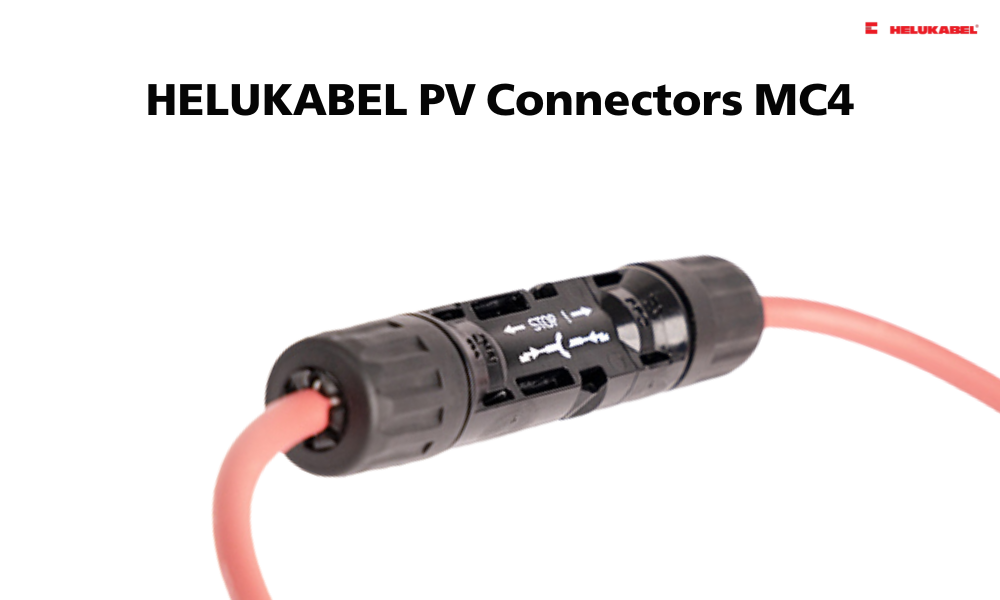
3.1 Technical data
- With Snap-in lock
- Temperature range -40°C to +90°C
- Protection class IP 67
- Safety class II
- Rated voltage 1000 V (IEC)
- Rated current 22A (2.5 mm²), 30A (4mm², 6mm²)
- Contact resistance 0.35 mOhm
3.2 Structure
- Material: Polyamide (PA)
- Contact: Cu, tinned, rotated
5. PV-male and female cable coupler MC4-Evo 2 1500 V
MC4-Evo 2 cable connectors are IEC, UL, JET, and cTÜVus internationally certified and approved according to DC 1500 V (IEC, JET), and DC 1500 V (UL) standards. Since 2004, with MULTILAM technology, this cable connector has proven its quality and precision through international tests. The product is suitable for all climates thanks to its resistance to UV, ammonia, and protection classification (IP68). This connector is available as a field and preassembled connector, standard crimping tools can be used. Mating compatibility with MC4 connector family.
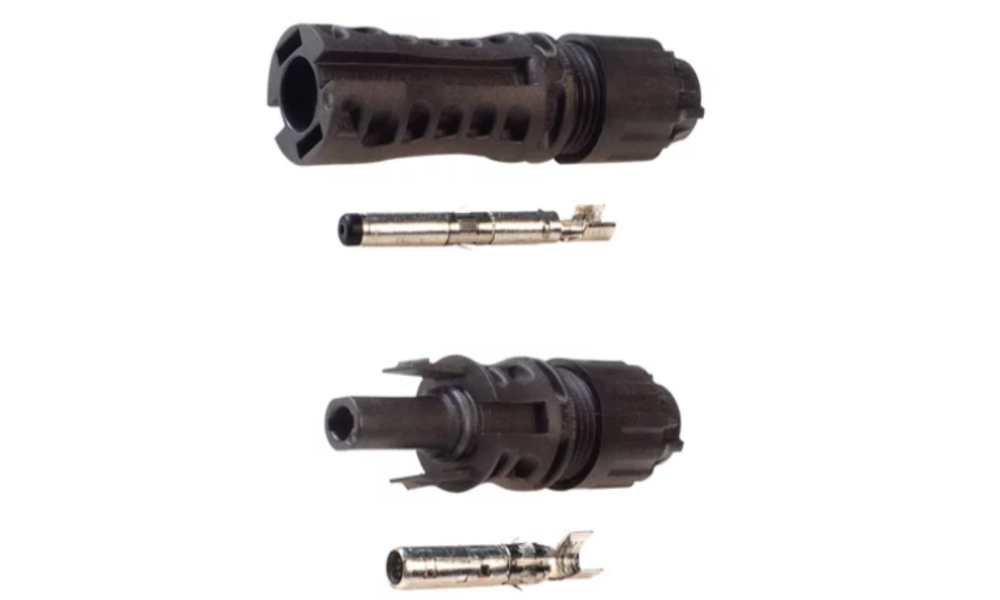
MC4 Evo 2 connectors
5.1 Technical data
- Protection classification: IP 68
- Safety class: II
- Temperature range: -40°C up to +85°C
- Rated voltage: 1500 V (IEC)
- Rated current: 39A (2.5mm²), 45A (4mm²), 53A (6mm²), 69A (10.0mm²)
- Contact resistance of plug connectors: 0.2 mOhm
5.2 Material
- Polyamide
- Contact: Cu, tinned
- Flammability acc. to UL 94: V0
6. MC4-Evo 2A Connector
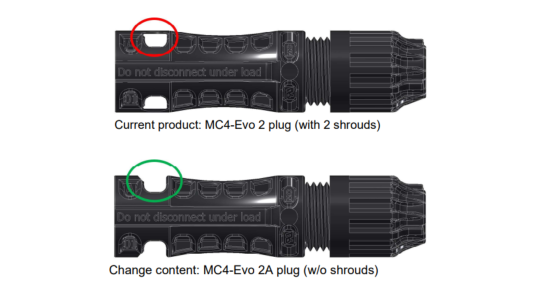
The MC4-Evo 2A DC cable connector is an improved version of the MC4-Evo 2 connector. Essentially, the technical specifications and characteristics of the MC4-Evo 2A connector remain unchanged from those of the previous MC4-Evo 2 model.
Compared to the MC4-Evo 2 series, the updated version features only minor differences in its external design. Specifically, the MC4-Evo 2A lacks the two side covers at the rear of the connector, while the remaining components remain unchanged. According to the manufacturer, this removal is intended to reduce complexity in production and shipping, optimize the installation process, while still ensuring compatibility with other MC4 products to meet customer requirements.
6.1 Technical data of the MC4-Evo 2A connector
- Temperature range: -40°C to +85°C
- Protection rating: IP65/IP68
- Safety Level: II
- Rated voltage: 1,500 V (IEC)
- Rated current: 39 A (2.5 mm²), 45 A (4 mm²), 53 A (6 mm²), 69 A (10 mm²)
- Contact resistance between the connector and the plug: < 0.2 mΩ
- Ammonia resistance, certified by TÜV Rheinland in accordance with 2 PfG 1911/03.2011
6.2 Material
- Material: Polyamide (PA)
- Contact point: Tin-plated copper
Order Now on HELU E-Store – Fast & Easy!
FAQs
The MC4 connector has a voltage rating of 1000 V, a maximum current of approximately 45 A, a contact resistance of ~0.25 mΩ, a temperature rating of up to 105°C, and a PC/PA housing.
The MC4-Evo 2 supports 1,500 V (TÜV/UL/JET certified), a maximum current of 69 A, a resistance of less than 0.2 mΩ, and is rated for temperatures up to 115°C. It features a PA housing and offers additional resistance to salt and ammonia.
The MC4-Evo 2A shares the same technology platform and electrical specifications as the Evo 2 (1500V, IP65/IP68), but it is factory-assembled with a simpler connector housing, enabling faster installation and reducing errors on-site.
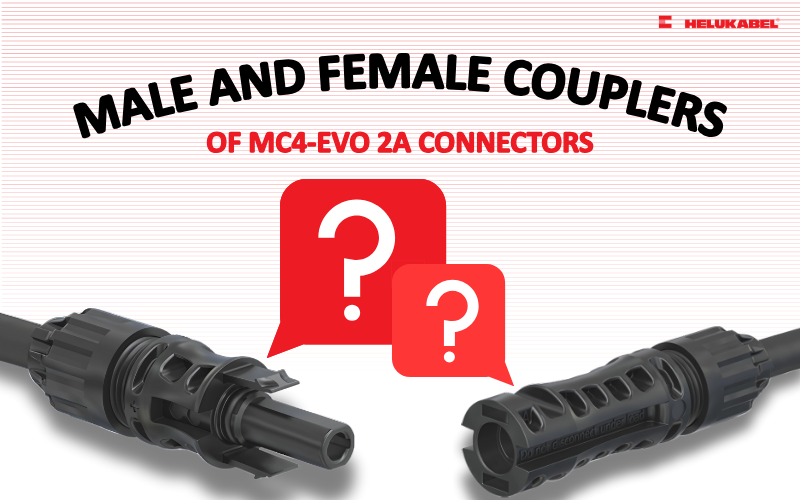
You should identify them by their internal contact cores, not by the color of their outer sheaths:
- The male connector has a protruding metal pin in the shape of a plug, which is typically connected to the positive wire (+, red jacket)
- The plug has a recessed contact socket with two raised plastic tabs on the housing; it is typically connected to the negative wire (–, black housing)
Detailed guide to distinguishing between male and female MC4-Evo 2A connectors
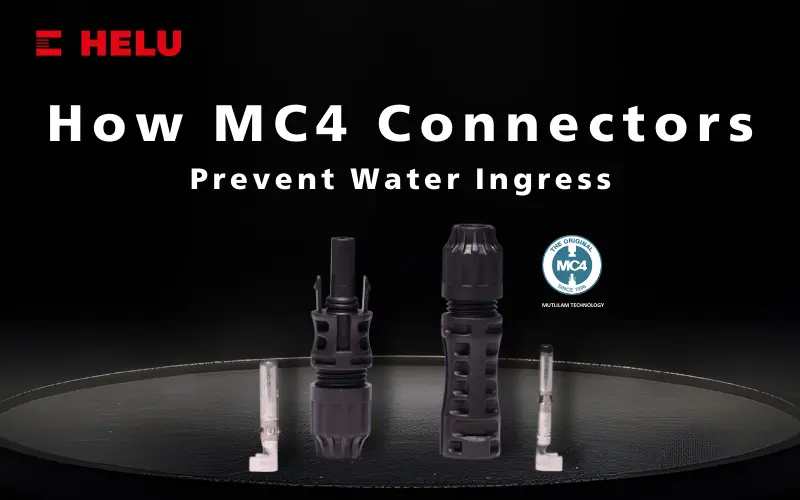
Yes. The MC4 is IP67-rated, the MC4-Evo 2 is IP68-rated, and the MC4-Evo 2A is rated for both IP65 and IP68—it is completely dustproof and can withstand submersion in water at a depth of 1 meter for 1 hour. This capability is provided by a rubber gasket, a locking mechanism that seals when the connector is firmly mated, and a UV- and heat-resistant PA plastic housing. However, even though it meets the IP68 standard, the connector should not be left submerged in water continuously for extended periods.
Common causes: improper crimping, mixing connectors from different brands, using cables with too small a cross-sectional area, incorrect polarity, or moisture intrusion causing contact corrosion. Signs to look for: discoloration of the plastic housing, melted plastic, or scorching at the connection point, leading to voltage drop and reduced system performance.
Learn about solutions to help prevent overheating at MC4 connectors
You should not. Manufacturing tolerances and differences in contact materials between manufacturers can cause the connectors to not fit properly, increasing contact resistance and leading to overheating. You should use a matching male/female pair from the same reputable manufacturer.
MULTILAM is Stäubli’s proprietary contact technology that reduces contact resistance to less than 0.2 mΩ, minimizing power loss and the risk of heat generation at the connection point—a factor that Stäubli experts say is the cause of most technical failures in solar power systems.
Do not do this. Never disconnect the MC4 connector while the solar panel is exposed to sunlight or while the system is connected to a power source or battery, as this can cause a dangerous electrical arc. Be sure to disconnect the power source or shade the solar panel before performing this operation.
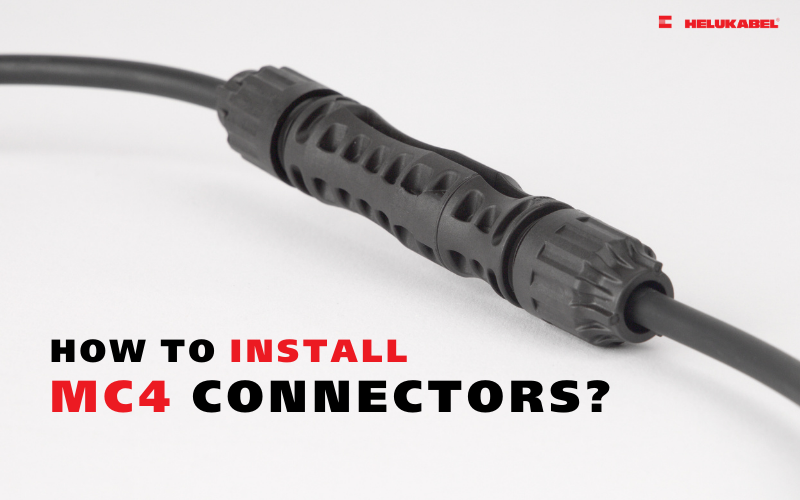
Discover the dos and don’ts of installing MC4-Evo 2A cable connectors
Leave at least 20 mm of wire extending from the connector before bending it. Bending the wire too sharply increases resistance, generates heat, and can cause long-term damage to the solar power system.
Learn in detail what to do and what not to do when installing MC4-Evo 2A cable connectors
After installation, use an ohmmeter or continuity tester to check the connections, visually inspect the plastic housing for cracks or gaps, and gently pull on the cord to ensure the locking mechanism is securely engaged and won’t come loose.
Selecting the right DC cable connectors is crucial to ensuring the performance and safety of a solar power system.
- Connection standards compatible with the type of DC cable currently in use
- Cable thickness and diameter compatible with the connector
- Durability ensures the system's load-bearing capacity
- A reputable manufacturer; offers excellent UV and chemical resistance
- IEC 61730 Standard: The IEC 61730 standard is used to evaluate the safety of electronic devices used in solar power systems.
- UL 1703 Standard: The UL 1703 standard is a safety standard for solar power systems and is used to test the safety of DC cable connectors.
Discover more products for solar power projects
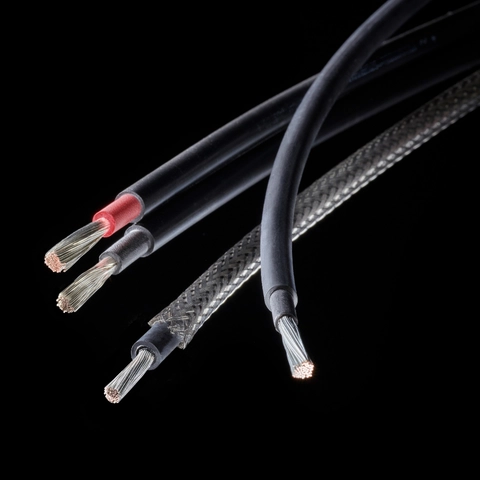
DC cables
To our products
AC power cables
To our products