RS485 vs. Modbus: Differences & relationship explained
RS485 and Modbus are often mentioned together in industrial automation and control systems. But are they the same technology? This article will help you understand the differences, how they work together, and what to consider when choosing the right RS485 cable.
Table of contents
1. What is RS485?
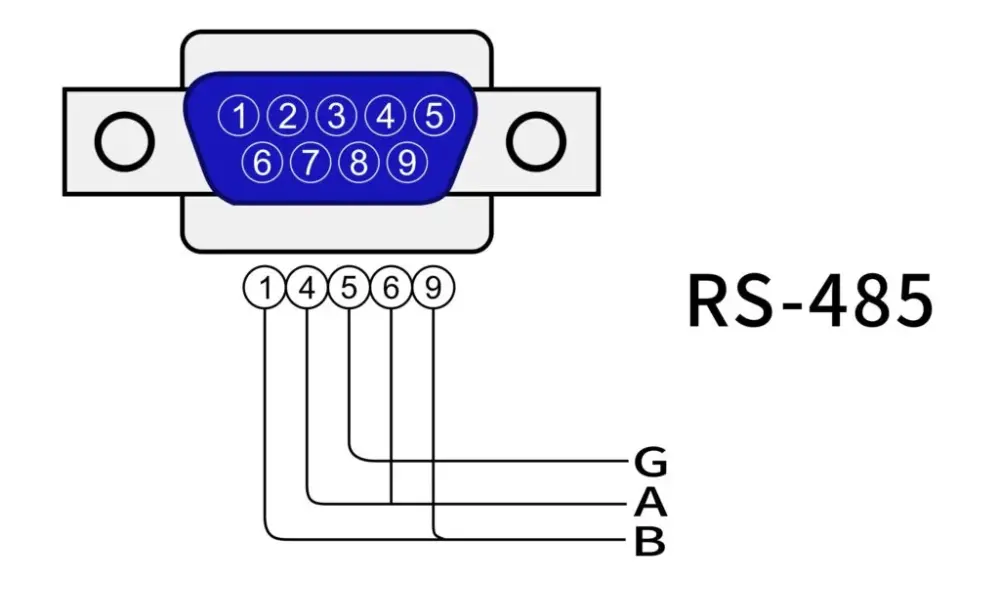
RS485 (EIA-485) is a physical-layer communication standard that defines characteristics related to signal transmission, such as cable impedance, voltage levels, maximum transmission distance, and bus connection topology. In other words, this standard focuses on how electrical signals are transmitted over the line and does not define the content or format of the data being transmitted. How data is organized, sent, and received according to specific rules is determined by a higher-layer protocol, such as Modbus.
2. What is Modbus?
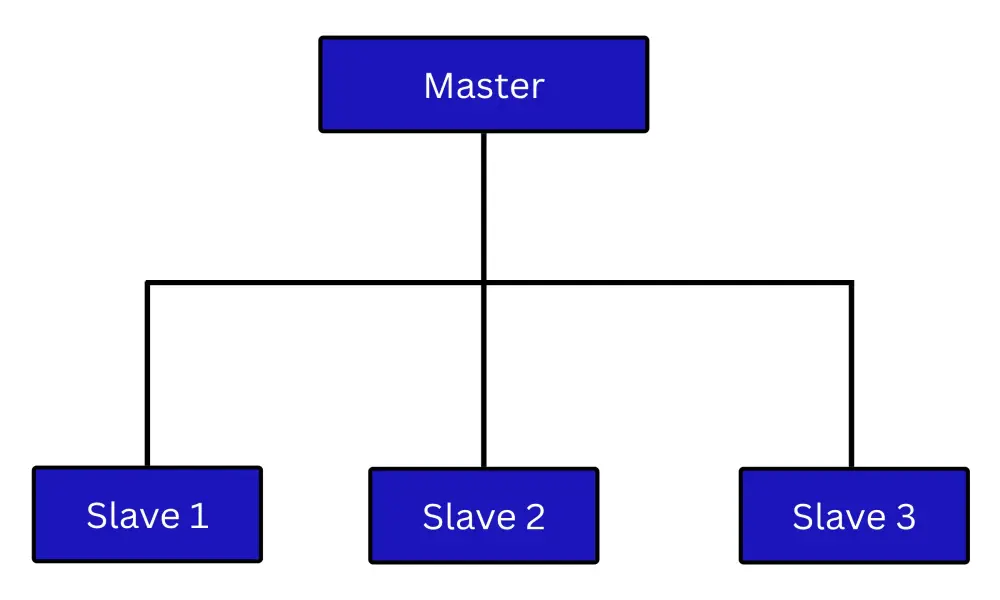
Modbus is an application-layer communication protocol. It was developed by Modicon in 1979 and is an open protocol that can be used free of charge. Modbus defines how data is structured and exchanged between a master device and one or more slave devices. In particular, the protocol is not limited to a single transmission method and can operate over different communication platforms, such as RS485, RS232, RS422, or Ethernet via TCP/IP.
3. Are RS485 and Modbus the same? Comparing the differences
The answer is no. As you can see above, RS485 and Modbus are two different concepts, and they are not competing technologies either. They are often combined for use in industrial systems, typically with Modbus RTU running over an RS485 network.
The difference between RS485 and Modbus lies in their roles within the system. You can think of them simply as follows:
- RS485 is the “transmission line”: It determines how signals are transmitted over the wires.
- Modbus is the “communication language”: It determines how devices send, receive, and interpret data according to specific rules.
A system can use RS485 without Modbus because RS485 can be combined with different protocols, depending on the devices and application. Conversely, Modbus does not necessarily have to run over RS485 and can be implemented over other transmission methods, such as RS232, RS422, or Ethernet.
Quick comparison of RS485 and Modbus.
| Criteria | RS485 | Modbus |
| Nature | Physical-layer communication standard | Communication protocol |
| Role | Signal transmission | Data exchange |
| Signal | Differential between A and B | Not defined |
| Connection | Multi-drop bus | Master – Slave |
| Addressing | Not defined | Slave ID |
| Data | Not defined | Coils, Inputs, Registers |
| Error checking | Not defined | CRC-16 / LRC |
| Duplex | Half-duplex / Full-duplex | - |
| Distance | ~1,200 m at 100 kbps | Depends on transmission method |
| Transmission method | Twisted-pair cable | RS485, RS232, Ethernet... |
| Variants | - | RTU / ASCII / TCP/IP |
| Applications | Industrial communication | Automation, monitoring, control |
4. How do RS485 and Modbus work together?
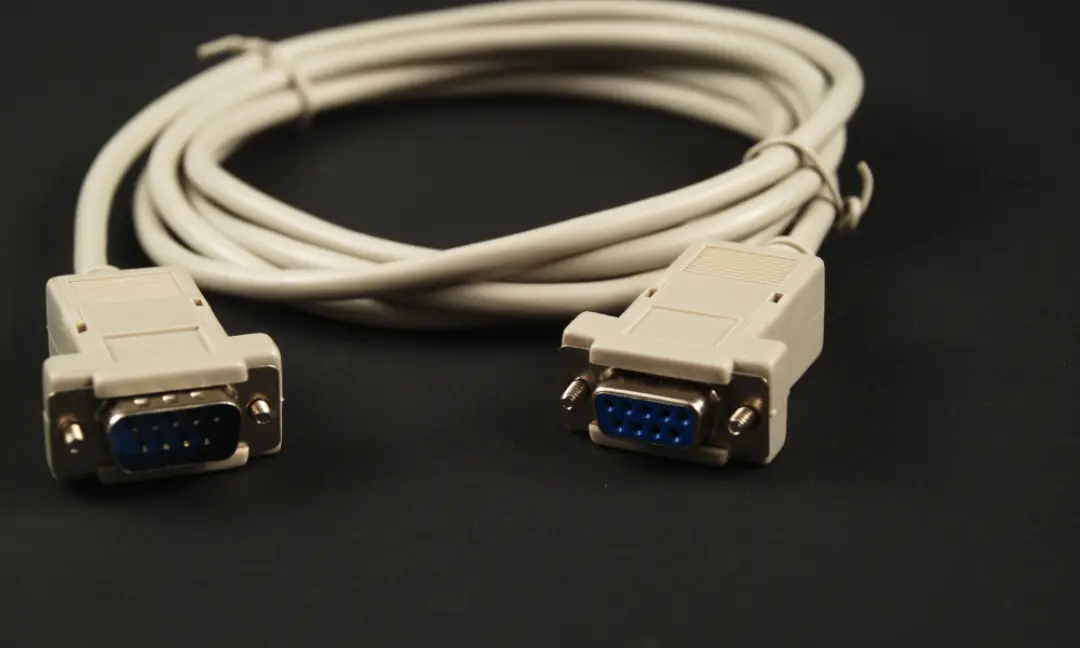
In practice, Modbus RTU is often implemented over RS485 to connect and exchange data between multiple devices. This combination provides a simple communication method that is suitable for many industrial automation and control systems.
4.1. How to implement Modbus RTU RS-485
In a Modbus RTU network, a Master device such as a PLC or controller actively sends requests to Slave devices on the same RS485 network. Each Slave is assigned a unique address so that the Master can identify the device it needs to communicate with. When receiving a request, the Slave processes the data and sends a response back to the Master.
Implementation features:
- Master – Slave: The Master actively sends requests, while the Slave responds.
- Multi-drop: Multiple devices can share the same RS485 line, with up to 32 devices.
- Unique addressing: Each Slave has an address so that the Master can identify the device it needs to communicate with.
- Two-way transmission: Data is sent and received over the same bus.
4.2. Implementation considerations
To ensure that a Modbus RTU system over RS485 operates reliably, you need to pay attention to both device configuration and transmission-line implementation, specifically:
- Correct wiring structure: Prioritize a bus topology and limit long branches.
- Device addressing: Each device on the network needs a unique address, typically from 1–247.
- Consistent parameters: Devices need to use the same baud rate, parity, and transmission format.
- Termination resistor placement: Termination resistors are usually placed at both ends of the bus to reduce signal reflections.
- Choose the right cable: Prioritize twisted-pair cables, with shielding if the system is installed in an environment with high levels of interference.
- Balance transmission speed and distance: The longer the transmission line, the more carefully you need to consider the transmission speed and cable characteristics.
- Check the signal: If the connection is unstable, check the device address, transmission parameters, wiring, and termination resistors in sequence.
5. Devices commonly connected via RS485
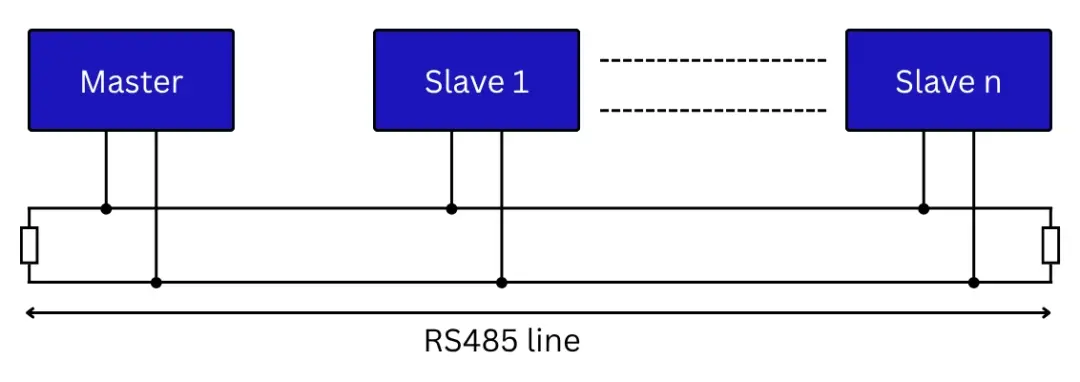
In addition to the widely used Modbus RTU protocol, RS485 can also be used with various protocols in industrial environments. Some common applications of RS485 include:
| Device group | Examples | Purpose of RS485 connection |
| Control devices | PLC, HMI, controllers | Data exchange, monitoring, and device control |
| Measurement devices | Energy meters, power meters, flow meters | Collecting data on energy, flow, and operating parameters |
| Sensors | Temperature, humidity, pressure, environmental sensors | Sending measured data to the controller or monitoring system |
| Actuators | VFDs, drives, motor controllers | Receiving control commands and sending device status information |
| I/O modules | Remote I/O modules, data acquisition modules | Collecting signals from field devices and transmitting them to the control system |
| Building automation devices | HVAC controllers, lighting controllers, access controllers | Connecting distributed devices to the central management system |
| Energy management devices | Smart meters, power monitoring devices | Monitoring power consumption and electrical system parameters |
| Monitoring & security devices | Cameras, card readers, alarm controllers | Exchanging data with monitoring and control systems |
6. Top 5 criteria for choosing the right RS485 cable for your system
When selecting an RS485 cable , you should consider the following criteria:
| Criteria | Key considerations |
| Impedance | Approximately 120 Ω |
| Construction | Twisted-pair cable for signal wires |
| Noise protection | Prioritize cables with shielding in noisy environments |
| Conductor cross-sectional area | Choose according to transmission-line length and system requirements, approximately 0.22 mm² for short transmission lines |
| Transmission speed | Can range from 100 kbps to 10 Mbps, depending on distance and system |
| Transmission-line length | Approximately 12 m at 10 Mbps to 1,200 m at 100 kbps |
| Capacitance | Particularly important for long-distance, high-speed transmission |
| Environment | UV, moisture, oil, chemicals, mechanical impact... |
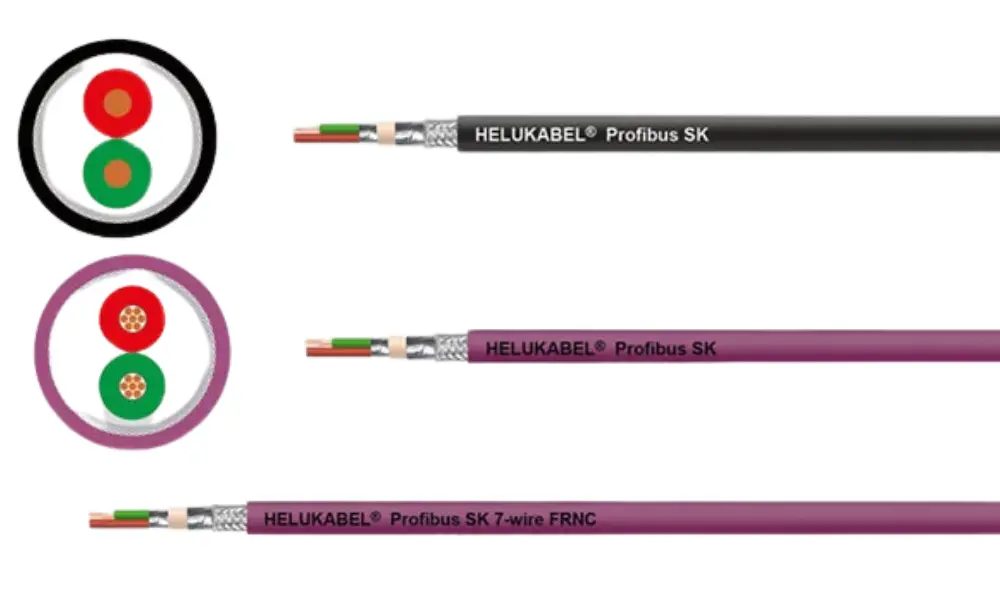
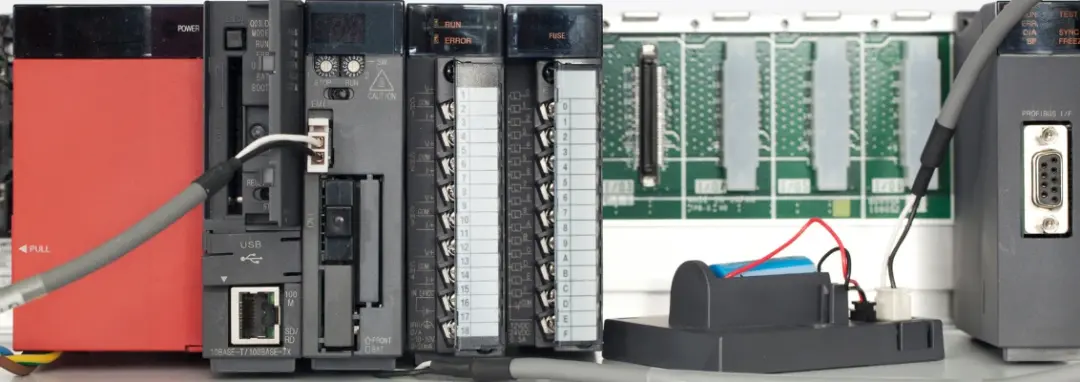
SK RS485 Profibus Cable.
6.1. 120 Ω characteristic impedance
RS485 cables are typically designed with a characteristic impedance of 120 Ω, which is suitable for the characteristics of RS485 transmission lines. Using an RS485 cable with a suitable impedance helps prevent signal reflections, especially when transmitting data over long lines.
6.2. Twisted pair and noise protection
RS485 uses differential signal transmission, so twisted-pair cable is the most suitable choice. Twisting the two signal wires together helps reduce the effects of electromagnetic interference from the surrounding environment. For industrial systems with many sources of interference, such as motors, variable frequency drives, or power cables, it is recommended to prioritize RS485 cables with shielding to improve signal stability.
6.3. Conductor cross-sectional area, transmission speed & line length
For the conductor cross-sectional area, you should choose according to the transmission-line length and system requirements. According to reference guidelines, a cable of approximately 0.22 mm² may be suitable for short transmission lines, while longer lines may require a larger cross-sectional area, such as 0.5 mm².
Transmission-line length and data transmission speed have an inverse relationship: the higher the speed, the shorter the transmission distance. Typically, transmission can reach approximately 10 Mbps at 12m, while at a distance of 1,200m, the speed decreases to approximately 100 kbps.
6.4. Capacitance and transmission speed
In addition to conductor cross-sectional area, capacitance per unit length is also a parameter you need to consider when choosing an RS485 cable, especially when transmitting data at high speeds. Higher cable capacitance can limit the ability to transmit signals over long lines. Therefore, if the system requires high transmission speeds or long distances, you should prioritize cables specifically designed for RS485, with suitable electrical specifications from reputable suppliers.
6.5. Installation environment
The operating environment is one of the important criteria when choosing any type of cable, including RS485 cables. For outdoor systems, you should consider cables with resistance to UV, moisture, and environmental impacts. In industrial environments, the cable selected may also need to provide resistance to oil, chemicals, or mechanical impact, depending on the installation location.
7. RS485 cables you may be looking for
Our HELU RS485 cable ranges are designed with twisted-pair conductors to reduce the effects of interference during signal transmission. Depending on the product range, the cables may feature shielding, PE/PVC insulation, and different configurations in terms of the number of wire pairs, conductor cross-sectional area, and installation capabilities.
Some notable HELU RS485 cable ranges include:
| Product | Construction / Key features | Applications |
| HELUDATA® 2919 PE/PVC-TP 30 GREY | 2x2x24 AWG | Data, control, and measurement systems, suitable for dry or damp environments |
| HELUDATA® 2919 PE/PVC-TP-C 30 GREY | 1x2x24 AWG | High-speed data transmission via RS422/RS485 protocols |
| PAAR-TRONIC-Li-2YCY</b> / <b>PAAR-TRONIC-Li-2YCYv | PE-insulated data cable with twisted-pair construction | Long-distance signal transmission and RS422/RS485 applications |
| HELUKABEL® BUS RS-485 PVC FLEX | 120 Ω impedance, UV-resistant PVC sheath, UL certified | Bus systems such as Modbus and RS485 applications |
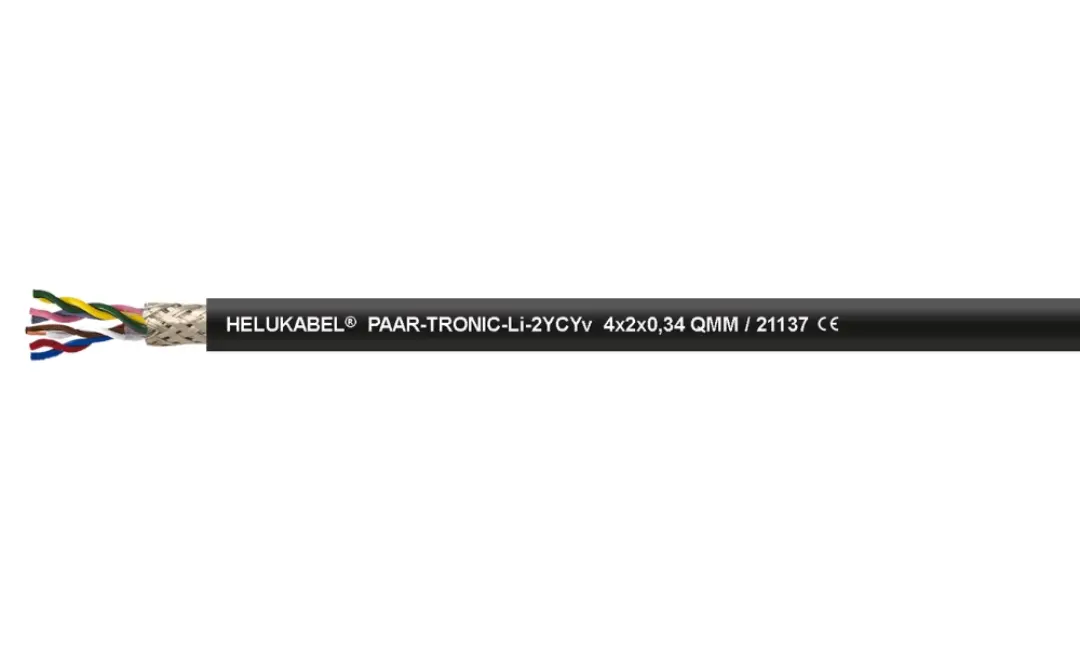
Choosing the right cable construction will help your RS485 system operate reliably. Depending on the transmission-line length, transmission speed, installation environment, and noise protection requirements, you can choose different RS485 cable ranges. Contact our HELU Vietnam engineering team today for consultation and to find the right product for your system requirements.