What are RS485 cables? Structure, types, and applications
RS485 cable is a shielded signal cable used in industrial communication. Learn about the structure, types, and applications of RS485 cables!
Article content
In industrial automation systems, dozens — or even hundreds — of devices like PLCs, sensors, and variable frequency drives (VFDs) need to communicate with each other over distances of up to thousands of meters. RS485 cable is the physical component that carries those signals — delivering stable, noise-resistant performance at a much lower cost than industrial Ethernet solutions.
1. What are RS485 cables and RS485 protocols?
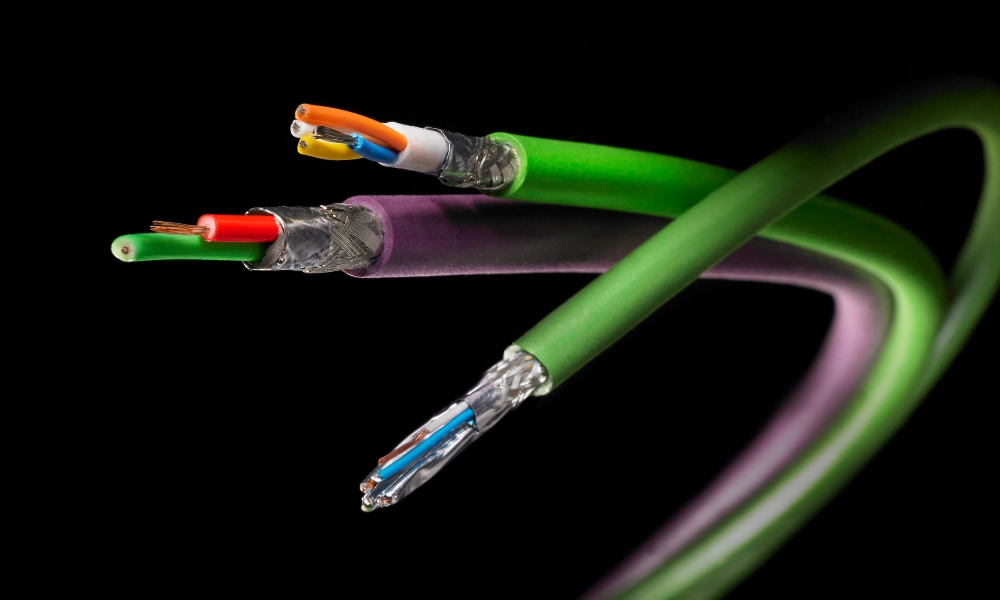
The RS485 cable features a twisted-pair conductor design combined with two shielding layers to ensure stable signal transmission over distances of up to 1,200 meters.
1.1 What are RS485 cables?
RS485 cable (also called RS485 signal cable) is a type of signal cable specifically designed for the RS485 communication standard used in industrial environments. It features twisted pair conductors combined with two shielding layers — aluminum foil and tinned copper braid — to ensure stable signal transmission over distances of up to 1200 meters.
In factory automation, building management systems (BMS), and solar energy monitoring, RS485 cable connects devices such as PLCs, HMIs, VFDs, and sensors through common protocols like Modbus RTU, BACnet MS/TP, and Profibus.
However, a very common mistake is confusing RS485 cable (the physical product) with the RS485 standard (the communication protocol). These two concepts are closely related but fundamentally different.
1.2 RS485 cable vs. the RS485 protocol
RS485 (or EIA/TIA-485) is a serial communication standard published by the Electronic Industries Association (EIA). It defines the electrical characteristics of transmitters and receivers on a differential signaling line. In simple terms, RS485 is a set of rules for how devices "talk" to each other: it uses a balanced pair of wires, supports up to 32 devices on a single bus (multi-drop), transmits data up to 1,200 meters at speeds up to 10 Mbps, and supports both half-duplex (alternating send/receive) and full-duplex (simultaneous send/receive) modes.
RS485 cable, on the other hand, is the physical wire product manufactured to meet the technical requirements of the RS485 standard. It is not just "two wires" — it is engineered with a 120-ohm characteristic impedance, twisted pair structure, and specialized shielding layers to meet the strict demands of this standard.
2. Construction of RS485 cables
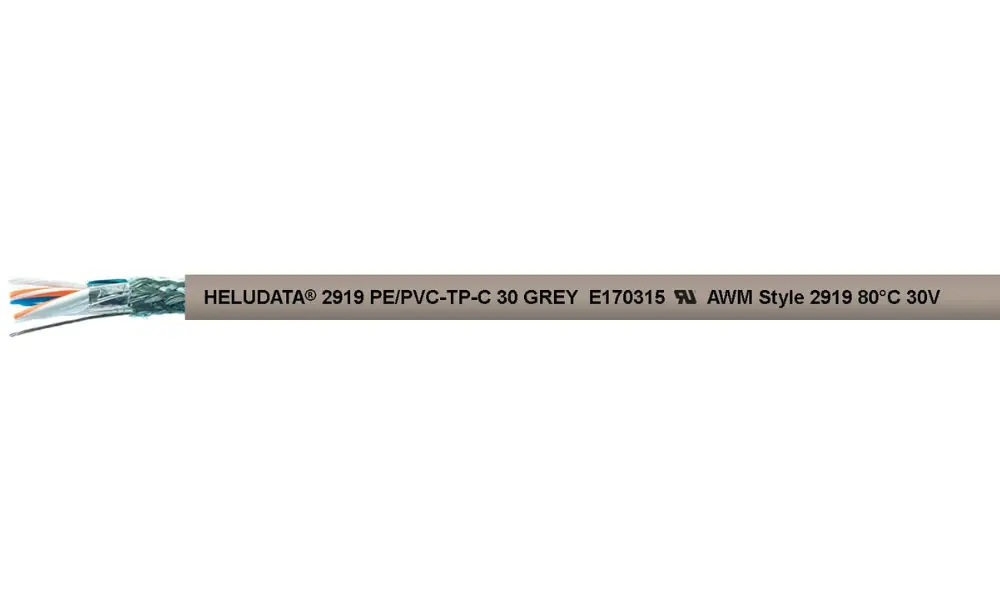
HELUDATA® 2919 PE/PVC-TP-C 30 Grey cable
RS485 cable has a multi-layer construction. Each layer serves a specific function in protecting the signal from electromagnetic interference (EMI) and ensuring stable transmission. Here is the detailed structure from the inside out:
2.1 Twisted pair copper conductor
The copper conductors are the core component of RS485 cable, responsible for carrying electrical signals between devices. The conductors are made of fine copper strands braided together, usually tinned to improve oxidation resistance.
The most distinctive feature of RS485 cable is its twisted pair structure: two conductors are twisted together at a specific twist rate. This structure works on the principle of noise cancellation — when external electromagnetic noise hits the cable, it affects both wires in the twisted pair almost equally. At the receiver, the noise signals on both wires cancel each other out (common-mode rejection), leaving only the useful signal. This is the differential signaling principle that the RS485 standard uses.
Common conductor sizes are 24 AWG (0.22 mm²) or 22 AWG (0.34 mm²), depending on transmission distance and application requirements. For example, the HELUDATA® 2919 series from HELU uses tinned copper 24 AWG conductors, while the HELUKABEL® BUS RS-485 PVC FLEX series uses 22 AWG conductors for longer transmission distances.
2.2 Insulation
Surrounding each conductor is an insulation layer that separates the conductors from each other and from other cable components, preventing short circuits or signal leakage.
The most common insulation material for RS485 cable is PE or Foam PE. Foam PE is preferred in high-speed data cables because it has a lower dielectric constant than solid PE, which reduces signal loss at high frequencies and maintains stable impedance. The HELUDATA® 2919 and HELUKABEL® BUS RS-485 PVC FLEX series both use Foam-Skin-PE insulation for their data cores.
Some RS485 cable lines designed for fixed indoor installation use PE insulation according to the DIN VDE 0819-103 standard, such as the PAAR-TRONIC-Li-2YCYv series from HELU.
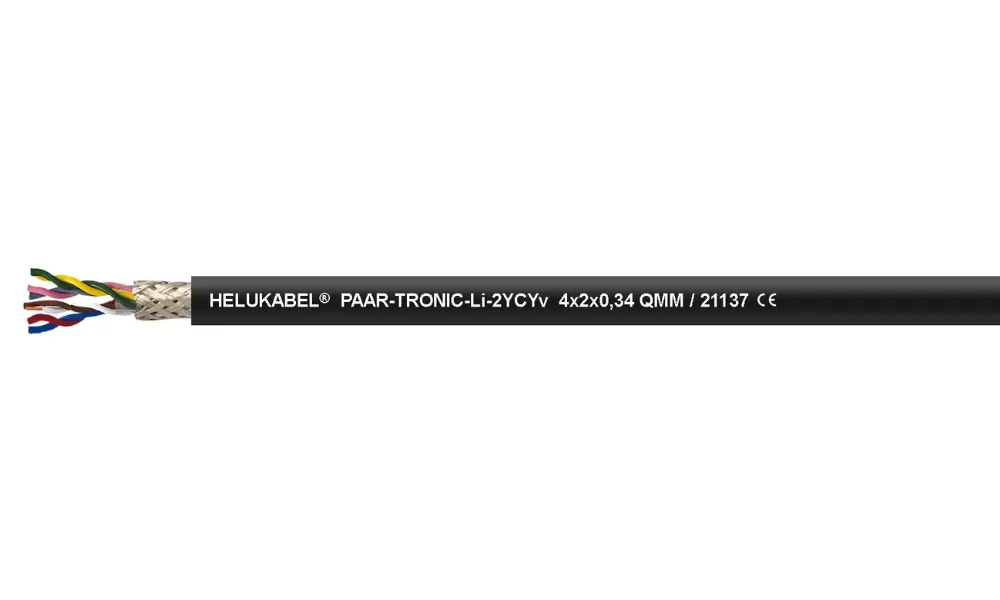
The PAAR-TRONIC-Li-2YCYv cable features shielding layers consisting of aluminum foil, braided screen of tinned copper wire, and a ground wire.
2.3 Dual shielding layers
This is the component that sets shielded RS485 cable apart from standard signal cables. Most industrial RS485 cables feature two shielding layers that work together:
- Layer 1 — Aluminum foil: A thin, plastic-coated aluminum foil is wrapped tightly around all conductor pairs. This layer is highly effective at blocking high-frequency EMI — the type of noise commonly found in industrial environments with VFDs, servo motors, and power switching equipment.
- Layer 2 — Tinned copper braid: Outside the aluminum foil is a braid woven from many small tinned copper wires. This layer adds protection against lower-frequency noise and also provides mechanical reinforcement for the cable.
Additionally, beneath the shielding layers is an uninsulated tinned copper wire called a drain wire. This wire makes it easy to connect the shielding to a ground point during installation, ensuring that noise is directed to ground instead of affecting the signal.
The combination of aluminum foil + copper braid + drain wire allows RS485 cable to perform reliably even when run parallel to power cables or placed near strong noise sources in a factory.
2.4 Outer sheath
The outer sheath protects the entire internal structure from mechanical, chemical, and environmental damage. The sheath material is chosen based on installation conditions:
- PVC: The most common option, cost-effective, suitable for indoor installation in dry and damp rooms. The HELUDATA® 2919 series uses a gray PVC sheath (RAL 7005).
- Reinforced PVC: UV-resistant, weatherproof, and can be buried directly underground. The PAAR-TRONIC-Li-2YCYv series uses TM2 PVC compound with a black sheath (RAL 9005), suitable for outdoor installation.
- Oil-resistant PVC: For industrial environments exposed to oils and lubricants. The HELUKABEL® BUS RS-485 PVC FLEX series has an oil- and UV-resistant PVC jacket, certified to UL Style 2464.
3. Types of RS485 cable
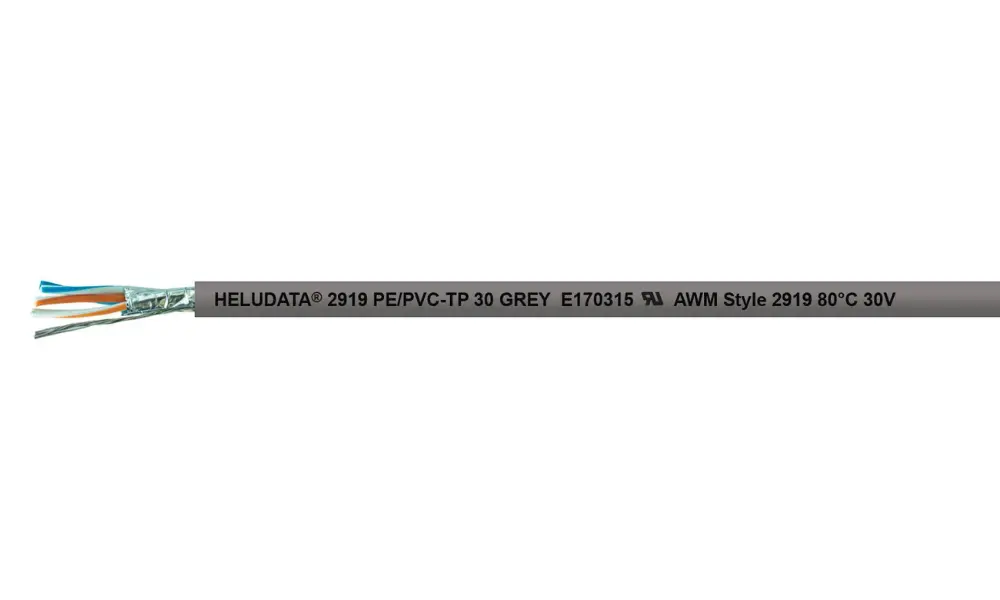
HELUDATA® 2919 PE/PVC-TP 30 GREY 2-pair RS485 cable
RS485 cables on the market come in many configurations. Understanding how they are classified will help you choose the right cable for each specific application, avoiding wasted costs or communication failures. Below are the three main classification criteria.
3.1 Classification by the number of pairs
The number of pairs is the most important classification criterion, as it determines the communication mode the cable supports.
- 1-pair RS485 signal cable (1×2 conductors) uses one twisted pair for half-duplex communication — meaning devices can only send or receive data at any given time, not both simultaneously. This is the most common configuration because most industrial protocols like Modbus RTU and BACnet MS/TP operate in half-duplex mode. The HELUDATA® 2919 PE/PVC-TP-C 30 GREY (1×2×24 AWG) from HELUKABEL is a typical example of a 1-pair cable.
- 2-pair RS485 signal cable (2×2 conductors) uses two separate twisted pairs. This 4-wire configuration enables full-duplex communication — devices to send and receive data at the same time, increasing the speed of data exchange. 2-pair cable is well suited for applications that require fast response times, such as SCADA systems, point-to-point master-slave networks, or when a backup pair is needed for added system reliability. The HELUDATA® 2919 PE/PVC-TP 30 GREY (2×2×24 AWG) from HELU is a 2-pair cable.
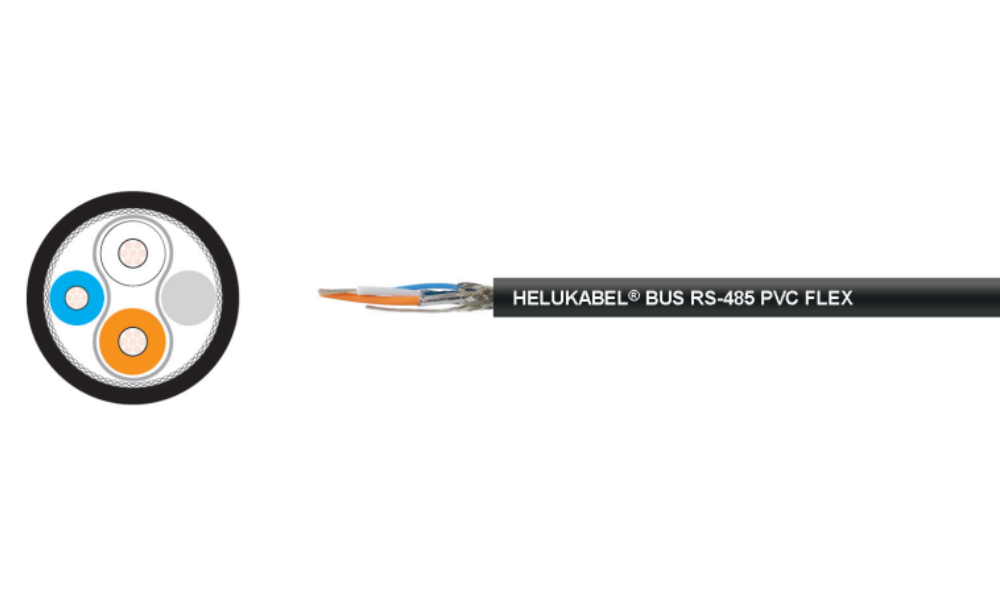
HELUKABEL® BUS RS-485 PVC FLEX cable
3.2 Cable classification by conductor size (AWG)
Conductor cross-section directly affects line resistance, which in turn determines the maximum signal transmission distance and signal quality at the receiver.
- 24 AWG (0.22 mm²) RS485 cable is the most common conductor size for RS485 cable. Most HELU RS485 data cable lines — including the HELUDATA® 2919 and PAAR-TRONIC-Li-2YCYv — use 24 AWG conductors.
- 22 AWG (0.34 mm²) RS485 cable has a larger cross-section and lower resistance. Thicker conductors mean lower signal attenuation over the same distance, which is especially beneficial when transmitting at high speeds or when cable runs approach the 1,200-meter limit. The HELUKABEL® BUS RS-485 PVC FLEX series uses 22 AWG conductors, making it suitable for bus systems in large factories.
- 18 AWG (0.75 mm²) is the largest conductor size commonly found, used for special applications in heavy-noise environments or when signal attenuation must be minimized.

Some reinforced PVC materials are oil-resistant and designed for harsher industrial environments
3.3 Cable classification by sheath material
In addition to the above classifications, RS485 cable is also categorized by its outer sheath material:
- PVC is the most common material, cost-effective, and suitable for fixed indoor installation in dry, damp, or technical rooms. PVC offers basic flame-retardant properties. The HELUDATA® 2919 series uses a gray PVC sheath (RAL 7005) with an operating temperature range of −30°C to +80°C. This is the default choice for most RS485 applications in buildings and factories under normal environmental conditions.
- Reinforced/oil-resistant PVC is designed for harsher industrial environments. The PAAR-TRONIC-Li-2YCYv series uses TM2 PVC compound (reinforced PVC) with a black UV- and weather-resistant sheath that can be buried directly underground. The HELUKABEL® BUS RS-485 PVC FLEX has an oil-resistant PVC jacket, certified to UL Style 2464, making it suitable for factories where oil and lubricant exposure is common.
- LSZH (Low Smoke Zero Halogen) jackets are also available from some manufacturers. LSZH material contain no halogens, produces very little smoke when burned and does not emit toxic gases.
4. Applications of RS485 cables
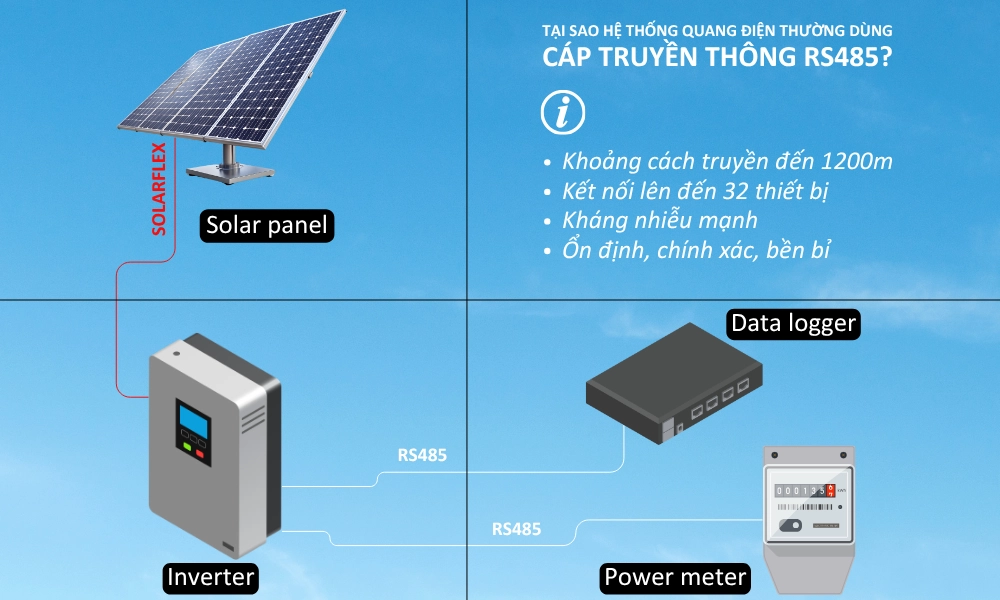
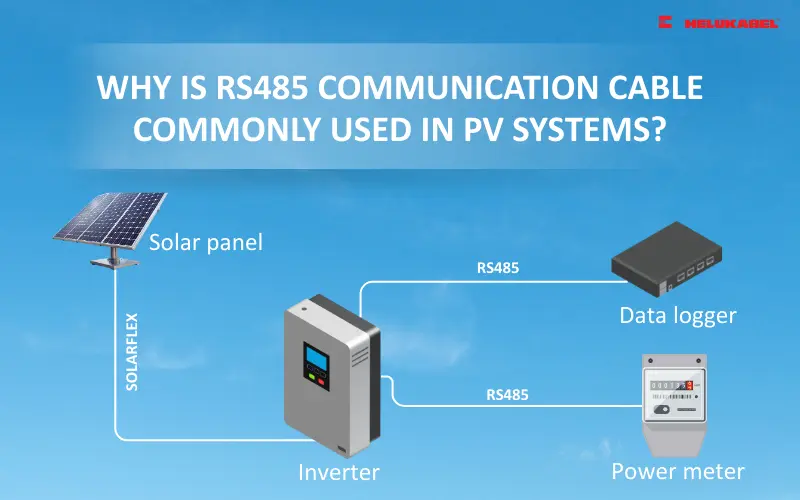
In solar farms, RS485 cables are used to connect individual solar inverters with a centralized monitoring system, allowing real-time performance tracking and optimization of power generation.
Thanks to its stable long-distance signal transmission, multi-device bus support, and low deployment cost, RS485 cable is widely used across many sectors:
- Industrial automation: In manufacturing plants, RS485 cable connects sensors, motor controllers, VFDs, and HMIs (human-machine interfaces) through the Modbus RTU protocol. A single RS485 cable pair can connect up to 32 devices spread across the factory floor, enabling process monitoring and control without running separate wires to each device.
- Building Management System (BMS): Building management systems use RS485 cable to link HVAC components, lighting systems, and access control to a single control center. The ability to transmit up to 1,200 meters is especially valuable in large buildings, mixed-use complexes, or multi-building campuses — where Ethernet cable is limited to just 100 meters.
- Solar power systems: In solar power installations, RS485 cable connects inverters and metering devices to a central monitoring system. The distance between panel arrays and the control room in a solar farm can reach hundreds of meters — and this is exactly where RS485 excels over other communication methods.
- Metering and POS Systems: RS485 cable is also used in smart meters, laboratory instruments, data loggers, and POS (point-of-sale) systems in retail chains.
Explore the applications of RS485 cables in solar power systems
5. How is RS485 cable different from standard signal cable?
A common question when designing industrial communication systems: can you use standard signal cable or Ethernet cable instead of RS485 cable? The short answer is no — and here are the technical reasons.
5.1 Comparison table
| Criteria | RS485 cable | Ethernet cables (Cat5, Cat6) |
| Characteristic impedance | 120 Ω (± 12 Ω) | 100 Ω (± 15 Ω) |
| Core structure | Twisted pair | Twisted pair |
| Shielding | 2 layers | UTP (unshielded) or STP/FTP (1 layer) |
| Maximum distance | 1200 m | 100 m |
| Transmission speed | Max. 10 Mbps | 1 Gbps (Cat5e) – 10 Gbps (Cat6) |
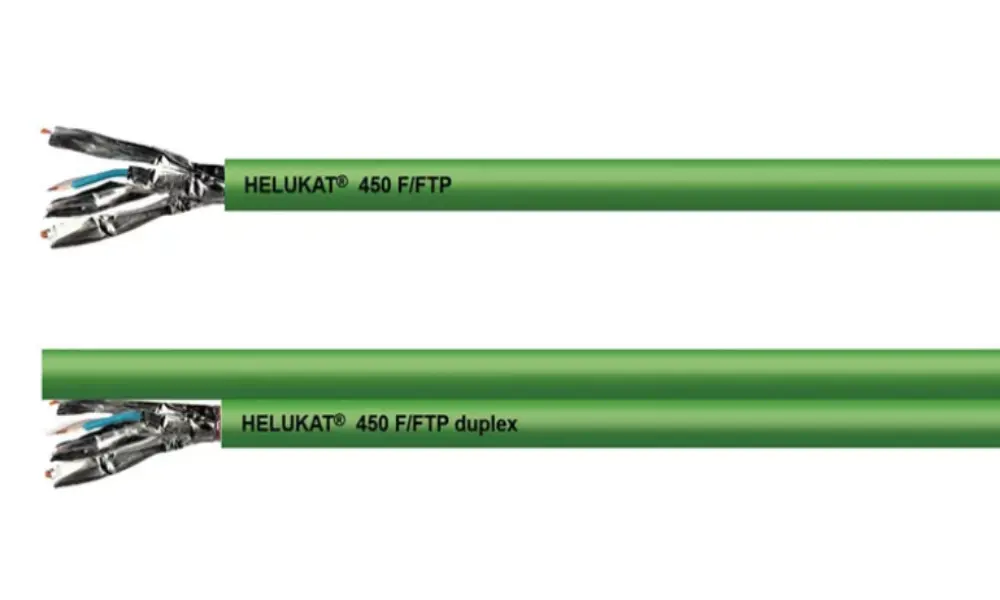
Cat5 and Cat6 network cables are better suited for high-speed Ethernet networks, supporting speeds of up to 10 Gbps over shorter distances (up to 100 meters)
5.2 When to choose RS485 cables vs. ethernet cables?
The choice between RS485 signal cable and Ethernet cable depends on the specific application.
RS485 cable is optimized for industrial environments that require long-distance communication (up to 1200 meters), high noise immunity, and multi-drop connectivity for automation, building management, and distributed control systems.
Ethernet cable (Cat5, Cat6), on the other hand, is better suited for high-speed networking, supporting speeds up to 10 Gbps over shorter distances (up to 100 meters). It is typically used for data networking in homes, offices, and commercial environments.
In summary, use RS485 for industrial control systems that demand high reliability, and Cat5/Cat6 for high-speed data networks. You do not need RS485 cable for standard home networking.
Explore the characteristics and classifications of Ethernet cable types
6. HELU RS485 cable product lines
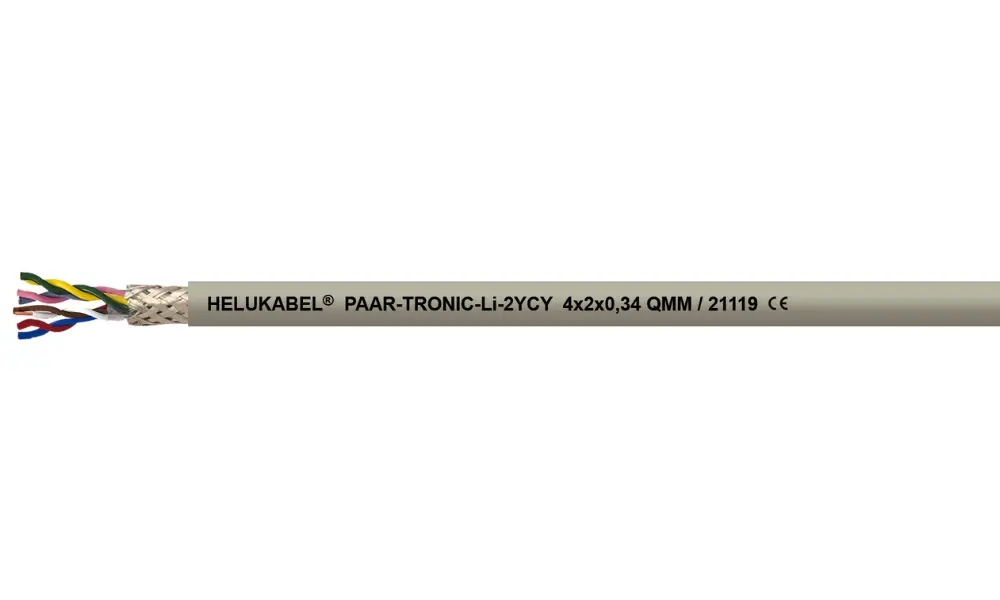
PAAR-TRONIC-Li-2YCY RS485 signal cable
HELU offers a wide range of RS485 cables to meet various industrial communication needs, from in-plant control systems to outdoor applications and industrial bus networks. Below are some key product lines:
6.1 HELUDATA® 2919 RS485 cables
The HELUDATA® 2919 series is UL-certified and suitable for industrial automation and process control, designed for fixed installation in dry or damp environments. Two versions are available:
HELUDATA® 2919 PE/PVC-TP 30 GREY - 2 x 2 x 24 AWG
HELUDATA® 2919 PE/PVC-TP-C 30 GREY - 1 x 2 x 24 AWG
6.2 PAAR-TRONIC-Li-2YCY and PAAR-TRONIC-Li-2YCYv
These two RS485 cable products are commonly used in solar energy applications.
6.3 HELUKABEL® BUS RS-485 PVC FLEX cables
RS-485 bus cables have a 120-ohm termination and are used in systems such as CAN or Modbus to transmit digital or analog signals.
7. FAQs about RS485 cables
It depends on the communication mode. For half-duplex (alternating send/receive), RS485 cable needs a minimum of 2 wires (1 pair: Data+ and Data−) plus 1 drain wire for grounding. For full-duplex (simultaneous send/receive), the cable needs 4 wires (2 pairs: TX+/TX− and RX+/RX−) plus a drain wire. Some systems also require an additional signal ground wire between devices.
According to the TIA/EIA-485-A standard, the maximum transmission distance is 1,200 meters. However, this is a theoretical value under ideal conditions. The actual distance depends on the baud rate: at 9,600 bps, you can reach close to 1,200 m, but at 10 Mbps, the distance drops to about 12 m. The relationship between speed and distance is inverse — the higher the speed, the shorter the achievable distance.
It may work over short distances (under 50 m) and at low speeds, but it is not recommended. The main reason is impedance mismatch: Cat5/Cat6 cable has a 100 Ω impedance, while the RS485 standard requires 120 Ω. This 20 Ω difference causes signal reflections at connection points, leading to communication errors over long distances or at high speeds. Additionally, standard Cat5 UTP cable has no shielding, while dedicated RS485 cable has two shielding layers (foil + braid).
RS232 is a serial communication standard typically used for point-to-point connections. It is widely known for its simplicity and ease of implementation. The maximum cable distance for RS232 is usually limited to 15 meters at 19,200 baud.
RS485 is superior in terms of distance, number of connected devices, and noise immunity. RS232 is only suitable for short-distance connections between two devices (for example, a PC connected directly to a modem or measurement device). In industrial environments, RS485 is almost always the better choice.
The 120 Ω impedance is required for impedance matching between the cable and other components in the RS485 network. When a signal travels through the cable to the end of the line, if the cable impedance does not match the load impedance, part of the signal is reflected back. This reflection overlaps with the original signal, causing waveform distortion and bit errors.
To reduce reflections, the two endpoints of an RS485 network (the first and last devices on the bus) are typically fitted with 120 Ω termination resistors connected between Data+ and Data−. This 120 Ω value must match the characteristic impedance of the cable — which is why dedicated RS485 cable is manufactured with a 120 Ω impedance.
According to the TIA/EIA-485-A standard, one RS485 segment supports up to 32 unit loads — equivalent to 32 standard devices on a single wire pair. However, newer RS485 transceivers with high input impedance (1/4 or 1/8 unit load) can increase this number to 128 or 256 devices without a repeater. If even more devices are needed, repeaters or hubs can be used to expand the network.
If you still have questions, don’t hesitate to contact the HELU Vietnam engineering team for detailed answers.
HELU Vietnam Contact Information
| HELU Vietnam 905 Nguyen Kiem Street, Hanh Thong Ward, Ho Chi Minh City, 700000, Vietnam | Phone:
+84 28 77755578 Email: info@helukabel.com.vn | Connect with us on |
| Order through our online channels: Tiki | Shopee | Lazada | Product Finder | ||