5 common misconceptions about shielded cables: What is the truth?
Many misconceptions about shielded cables sound reasonable, but they can easily lead to wrong choices. This article will clarify five common misunderstandings and help you understand the true nature of the issue.
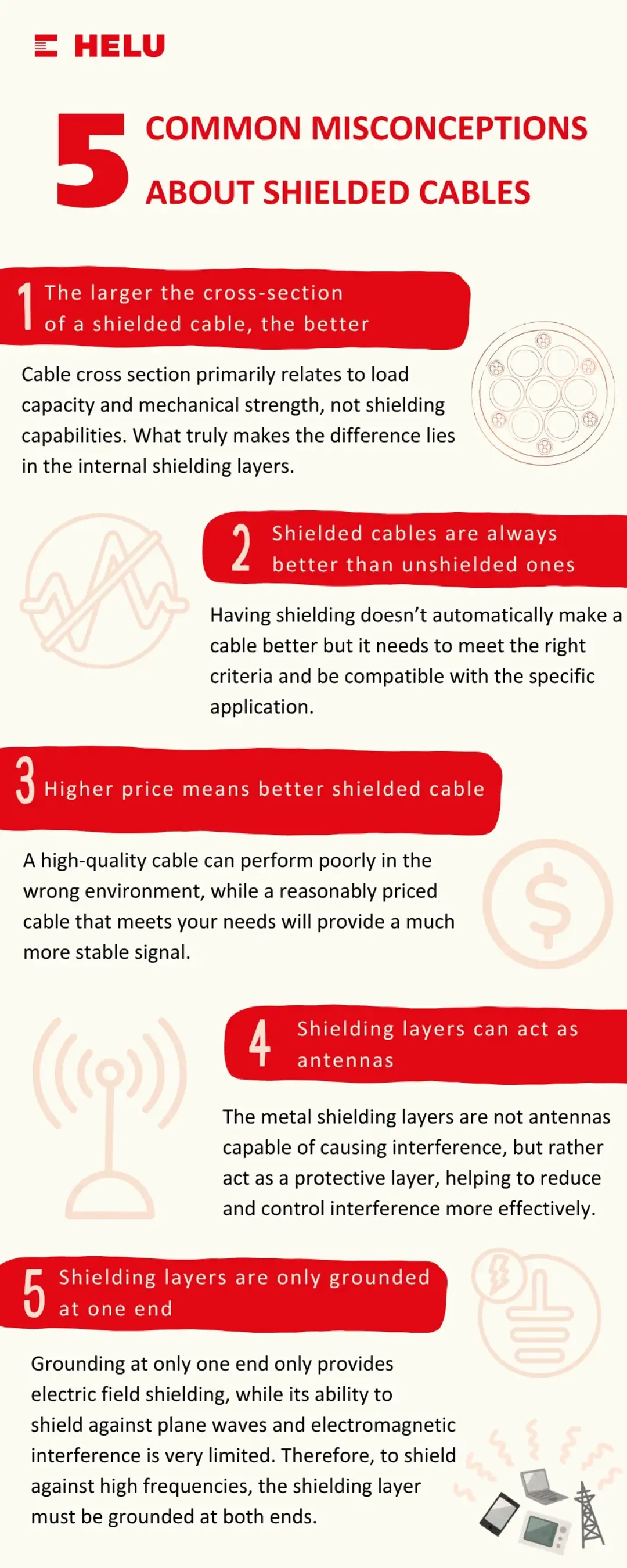
Misconception #1: The larger the cross-section of a shielded cable, the better
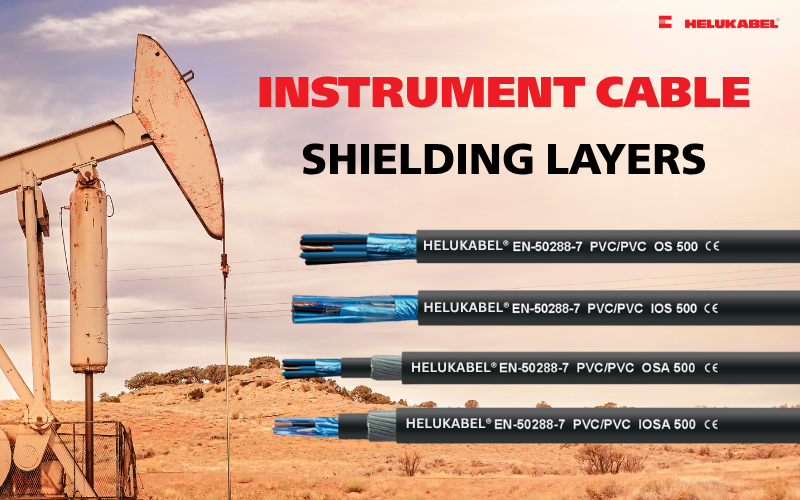
It may sound logical that a shielded cable with a larger cross-section provides better interference protection, but in reality, that’s not the case. Cable cross section primarily relates to load capacity and mechanical strength, not shielding capabilities. What truly makes the difference lies in the internal shielding layers (screen and shield), namely the aluminum foil and copper braid, which are responsible for blocking interference signals from the external environment.
However, simply having a shielding layer isn't enough, you need the right type for the right environment. In moderately noisy environments, a foil layer may be sufficient to protect the signal. However, when the noise level is higher, you should consider using a braid layer or a combination of both foil and braid to increase the shielding effectiveness of the cable.
Therefore, interference resistance doesn't lie in the cable's size, but in how you choose and protect the signal within. A thick cable without proper shielding can still be susceptible to interference, while a thinner cable with proper shielding will maintain a much more stable signal.
Misconception #2: Shielded cables are always better than unshielded ones
In practice, most systems such as offices, schools, and homes still operate stably with unshielded (U/UTP) cables. This type is easy to install, cost-effective, and has been proven over time. More importantly, if the environment does not have significant interference, using shielded electromagnetic cables does not provide a clear benefit and may even unnecessarily increase costs and installation complexity.
Shielded cables are only truly necessary when your environment demands them, such as in areas with strong electromagnetic interference (EMI/RFI), outdoor wiring or harsh environments, high-heat generating systems (dense PoE), or long-distance 10G transmission, and importantly, where proper grounding is possible. Otherwise, a poorly installed shielded cable can cause more problems than not using one at all. Therefore, having shielding isn't always better but you need to have criteria for choosing the right one for the right time and place.
Misconception #3: Higher price means better shielded cable
Higher prices often come with better materials, higher manufacturing standards, and greater durability, but that doesn't automatically mean compatibility with all systems. Effective noise reduction depends on choosing the right type of shielding, coverage level, cable structure, and especially the installation and grounding method.
A high-quality cable can perform poorly in the wrong environment, while a reasonably priced cable that meets your needs will provide a much more stable signal. Therefore, it's not about how much you pay, but about understanding your system's needs and providing the right connection.
Misconception #4: Shielding layers can act as antennas
There's a common misconception that the shielding layers of shielded cables can act like antennas because they are long pieces of metal. This leads to concerns that these shielding layers might “attract” signals from the environment or emit signals that appear on the twisted pair wires.
In fact, the shielding layers, as well as the balanced copper twisted-pair wires in UTP cables, both act as antennas to some extent. The difference is that the interference transmitted to the shielding layers is actually 100 to 1,000 times less than the interference transmitted to an unshielded twisted-pair wire in the same environment. This is due to the well-defined and controlled common-mode impedance of the internal wire pairs with respect to the ground plane, thanks to the shielding layers.
Therefore, it can be concluded that the metal shielding layers are not antennas capable of causing interference, but rather act as a protective layer, helping to reduce and control interference more effectively.
Misconception #5. Shielding layers are only grounded at one end
When a shielded cable connects two devices, engineers are always instructed that the shielding layer should only be connected to the chassis or grounded at one end. The most common reason given is to avoid ground loops. Cables carried over long distances will experience varying ground potentials. This difference in ground potential will create interference currents within the cable shielding layer. Grounding at only one end only provides electric field shielding, while its ability to shield against plane waves and electromagnetic interference is very limited. Therefore, to shield against high frequencies, the shielding layer must be grounded at both ends.
For the shielding to be effective when grounded at both ends, it must first be avoided as a return path. High-power current and/or radio frequency (RF) current should be conducted on separate, dedicated return conductors, isolated from the chassis. If the interference current on the shielding is direct current (DC) or at power frequencies, then capacitive RF grounding to the equipment housing will reduce the RF current but create high impedance at low frequencies and avoid ground loops at audio frequencies. Another approach is to use a differential receiver and signal. In this case, the induced voltage in the center conductors is common-mode voltage and will be reduced by the receiver's common-mode rejection ratio (CMRR).
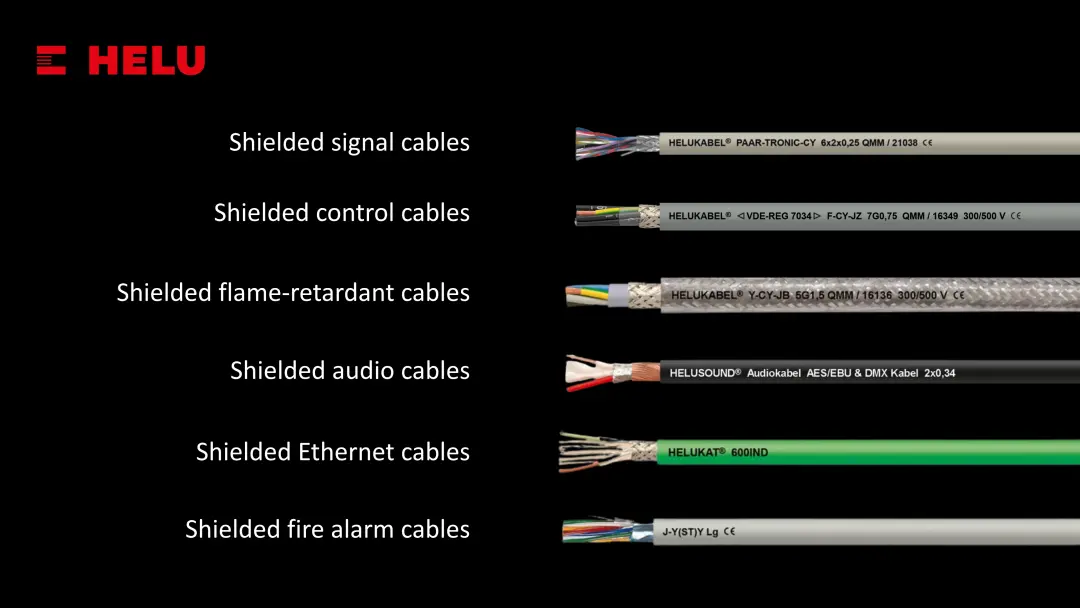
Some notable shielded cables from HELU
HELU's range of shielded cables is designed to meet diverse transmission needs in both industrial and residential applications. We offer a full range of shielded signal cables, shielded control cables, shielded flame-retardant cables, shielded audio cables, shielded Ethernet cables, shielded fire alarm cables, and more.
Overall, each HELU shielded cable is structurally optimized through shielding layers to suit specific applications, meeting both shielding needs and ensuring long-term reliability for the entire system.
If you are looking for shielded cables for your system, don't hesitate to contact HELU Vietnam's engineering team for advice and to find the right solution!
HELU Vietnam Contact Information
| HELU Vietnam 905 Nguyen Kiem Street, Hanh Thong Ward, Ho Chi Minh City, 700000, Vietnam | Phone:
+84 28 77755578 Email: info@helukabel.com.vn | Connect with us on |
| Order through our online channels: Tiki | Shopee | Lazada | Product Finder | ||