Where are shielded control cables used? 5 typical applications of Y-CY-JB cables
Shielded control cables are wrapped with metal or foil layer surrounding the core, which helps block electromagnetic interference (EMI) from inverters, motors, and power cables to ensure accurate transmission of control signals. This type of cable is widely used in measurement systems, automated packaging, conveyor systems, and industrial computers. HELU’s Y-CY-JB is a prime example.
Article content:
1. Why do control systems need shielded control cables?
In a factory, inverters, motors, welding machines, and power cables generate electromagnetic fields. If control cables lack shielding, interference will “sneak” into the signal and cause:
- Sensors reading incorrect values, measuring devices displaying inaccurate data
- PLCs receiving incorrect commands, causing machines to stop or operate abnormally
- Data loss and communication errors between devices
The metal layer acts as a "shield," directing the interference current into the ground rather than allowing it to enter the signal-carrying core.
Learn about common misconceptions regarding shielded control cables

2. Top 5 key applications of Y-CY-JB shielded control cables
Quick apecs for the Y-CY-JB cable
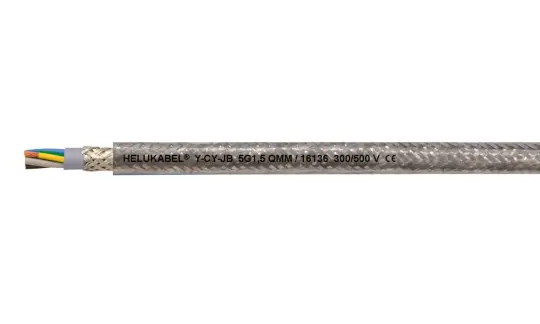
Y-CY-JB is a line of shielded control cables with the following basic specifications:
- Temperature: -15°C to +80°C
- Tin-plated copper braid ~85%
- Class 5 conductor
- Transparent, oil-resistant PVC outer sheath
- VDE Registration No. 7032.
👉 View the full construction and specifications for the Y-CY-JB cable
| Applications | Why is Y-CY-JB shielded cable necessary? |
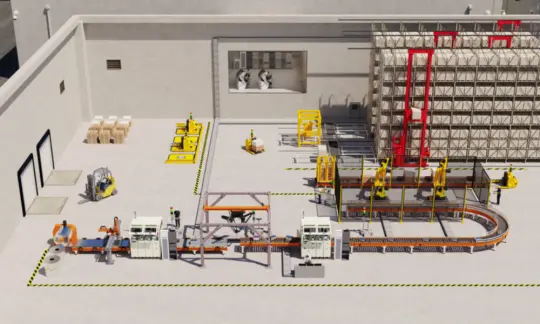
| Measurement system | Small analog signals are highly susceptible to EMI, which can distort the results. |
| Automatic packaging machine | Many servo motors and inverters operate near signal cables |
| Conveyor control system | Cables run parallel to power cables over long distances |
| Industrial computers, control cabinets | There is a need for fast, accurate data transmission between devices |
| Cables for connecting machines on a production line | Low-voltage power connections and distribution for machinery; vibration-resistant |
3. When should you not use the Y-CY-JB shielded cable?
Not all applications requiring EMC protection are suitable for the Y-CY-JB cable series. Situations in which the Y-CY-JB shielded control cable should not be used include:
- Outdoor installation or in direct UV light.
- Continuous motion, such as in conveyors and robots, requires a specialized cable designed for drag chains.
- Temperatures exceeding +80°C or below -15°C.
For the cases mentioned above, see other models in the HELU shielded cable lineup .
4. Checklist for selecting shielded control cables
To select the right type of shielded control cable for each application, consider the following factors:
- Environment: indoors or outdoors? Is there exposure to oil or chemicals?
- Installation type: fixed, slightly flexible, or continuously moving?
- Noise level: The operating environment is near a large inverter or motor. In high-noise environments, a shield with high coverage (≥85%) should be selected.
- The operating temperature is within the cable's permissible range.
- Number of conductors, cross-sectional area, and voltage suitable for the load and signal.
- Standards: VDE, IEC, etc., as required by the project.
- Maintenance: Check the quick-release mesh → prioritize transparent covers such as Y-CY-JB.
Are you still unsure which type of cable to choose for your system?
Submit a request to a HELU Vietnam engineer for consultation
Contact HELU Vietnam today for consultation and a product quote
FAQs
This is a cable with a metal shield (copper braid, aluminum foil, or both) surrounding the core to block electromagnetic interference, ensuring stable signal transmission.
For high-frequency noise (inverters, servos), it is common to ground both ends to ensure proper potential equalization. For low-frequency analog signals, you may ground only one end to avoid ground loops. You should follow the equipment manufacturer’s recommendations.
You shouldn't. Industrial communication networks require specialized cables with characteristic impedance that meets the protocol standard.
Machine manufacturing, packaging, food & beverages, assembly lines, measurement systems, and indoor control cabinets.