


What is an elevator flat cable? Structure & key features
Elevator flat cables are essential components in the power and signal transmission system between the elevator car and the central control cabinet. Thanks to their flat ribbon design and flexible bending capability that follows the continuous up-and-down movement of the car, these cables meet the operating requirements of modern elevator systems. So, what is the specific structure of an elevator flat cable, what functions does it perform, and how should you choose one? Let's explore these topics with HELU in the article below!
1. What is a flat elevator cable?
An elevator flat cable is a type of electrical cable with individually insulated conductors arranged in parallel in a flat ribbon configuration. Its main function is to transmit power, control signals, and communication signals between the elevator car and the external control system.
Thanks to its space-saving flat design, an elevator flat cable can flex and move in sync with the elevator car as it travels up and down. This type of cable is widely used in various systems, from residential elevators and freight elevators to hospital elevators and high-speed elevators.
2. Structure of an elevator flat cable
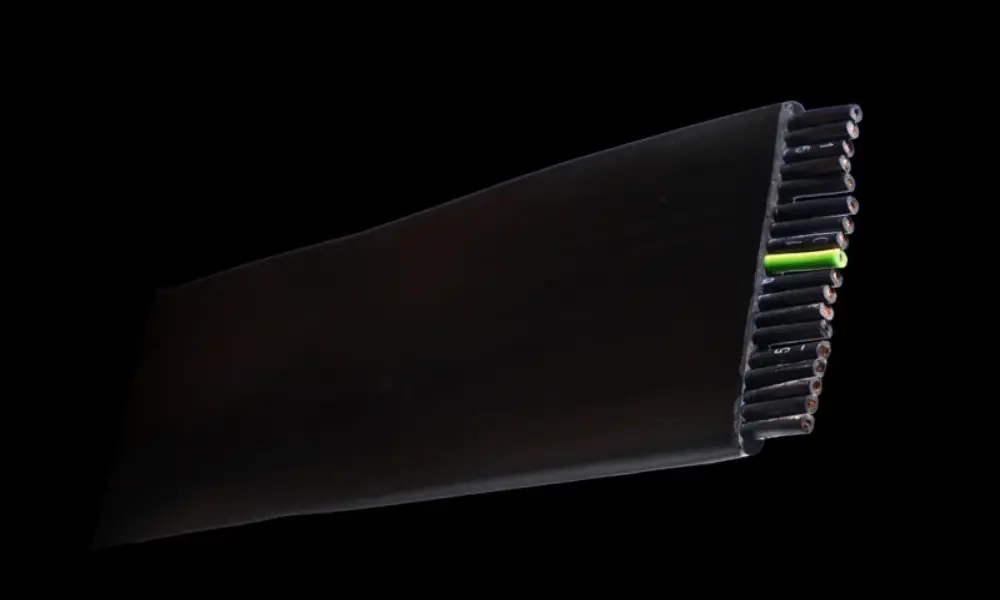
Basically, an elevator flat cable consists of three main parts: conductors, insulation, and an outer protective sheath.
2.1. Conductors
The conductors of an elevator flat cable are typically made of 100% pure flexible copper, consisting of multiple small copper strands tightly stranded together. This design increases flexibility and durability, allowing the cable to withstand thousands of continuous bending cycles during operation. Depending on the system design, the number and cross-sectional area of the conductors can vary (typically around 0.5–2.5 mm², with the number of cores ranging from 4 to 42). In addition, some cable types use tinned copper conductors or copper-clad aluminum conductors to enhance durability under specific operating conditions.
After being insulated, the conductors are arranged horizontally in parallel to form the characteristic flat ribbon. The spacing between the conductors in an elevator flat cable is precisely calculated to maintain the cable's shape, distribute forces evenly, and ensure smooth bending during movement.
2.2. Insulation
Each conductor in an elevator flat cable is covered with an individual insulation layer, typically made of PVC or XLPE. This layer electrically isolates the conductors from one another, prevents electrical leakage, and protects the conductors against mechanical impacts. In addition, the insulation colors are clearly differentiated to help technicians identify each core easily during connection.
2.3. Outer sheath
This is the protective layer that covers the entire internal structure of the elevator flat cable, providing resistance to friction, abrasion, and environmental impacts within the elevator shaft. The two commonly used materials are PVC (Polyvinyl Chloride) and PUR (Polyurethane), depending on the requirements for flexibility, abrasion resistance, and the elevator's operating conditions.
2.4. Additional components depending on application requirements
For demanding operating environments, flat cables can be equipped with additional specialized reinforcement components, typically including:
- Shielding layer: Uses aluminum foil or braided copper mesh to suppress electromagnetic interference (EMI), helping maintain signal stability in buildings with numerous electronic devices.
- Reinforcement components: Additional load-bearing fibers, reinforcement cores, or steel wires help prevent elongation and improve tensile strength in cables used for high-rise elevators.
- Specialized sheath materials: Low-smoke, zero-halogen (LSZH) materials or flame-retardant materials are used to meet stringent fire safety requirements.
In practice, the selection of these additional components for elevator flat cables depends entirely on the travel height, operating speed, and actual conditions within the elevator shaft.
3. Functions and advantages of elevator flat cables
In addition to their transmission functions, the design of elevator flat cables also offers several outstanding advantages.
3.1. Stable power and signal transmission
Elevator flat cables are responsible for transmitting power, control signals, and communication signals between the elevator car and the control system. The conductors are maintained at precise spacing, helping ensure uninterrupted signal transmission and minimize crosstalk between individual wires.
3.2. Space-saving installation
Thanks to their flat structure, elevator flat cables fit neatly within the elevator shaft, occupying less space than some round cable solutions with the same number of cores and functional requirements. This is particularly useful for elevator systems with limited installation space.
3.3. Reduced cable system weight
The flat structure of elevator flat cables allows conductors and insulation layers to be arranged appropriately according to the design, avoiding unnecessary components. As a result, some flat cable types can achieve a lower weight than round cables with equivalent functions, helping reduce the load on the suspension system and supporting elevator car movement.
3.4. Efficient heat dissipation
With a larger surface area relative to their volume, flat cables dissipate heat more quickly during continuous operation. However, their actual current-carrying capacity still depends on the conductor cross-sectional area, insulation material, installation method, and operating conditions.
3.5. Durability against repeated bending
Elevator flat cables are specially designed to flex and bend continuously, following the elevator car's movement hundreds of times per day without the risk of internal conductor breakage. This helps maintain durability and transmission performance over an extended period.

4. Common types of elevator flat cables
Elevator flat cables can be classified according to various criteria, such as their intended function, the number and structure of conductors, insulation materials, or protective sheath materials. Among these, classification by function helps users easily identify the characteristics and roles of each cable type within an elevator system.
4.1. Control flat cable
Control flat cables are used to transmit control signals between the elevator car and the central control system. These cables connect electronic devices, sensors, and control components, ensuring that operating commands are transmitted accurately.
4.2. Signal flat cable
Signal flat cables are responsible for transmitting data and communication signals between devices inside the elevator car and the external system. They are commonly used to connect sensors, display panels, communication systems, and elevator status monitoring devices.
4.3. Power flat cable
Power flat cables transmit electrical power to electrical devices inside the elevator car, such as lighting systems, ventilation fans, and other auxiliary equipment. These cables must meet requirements for voltage, current, and bending performance during elevator operation.
4.4. Shielded flat cable
Shielded flat cables are equipped with a protective layer made of aluminum foil or metallic mesh to limit the effects of electromagnetic interference (EMI) from surrounding electrical equipment. This type of cable is suitable for systems with high requirements for signal stability, especially when transmitting control data or sensitive electronic signals.
4.5. Combined power and signal flat cable
Combined flat cables are designed with multiple conductors that perform both power transmission and control signal transmission. Integrating these transmission paths into a single cable helps simplify the wiring system, save installation space, and reduce connection complexity.
5. Common applications of elevator flat cables
Elevator flat cables are, of course, used in various elevator systems, as well as in lifting equipment with moving components. Some common applications include:
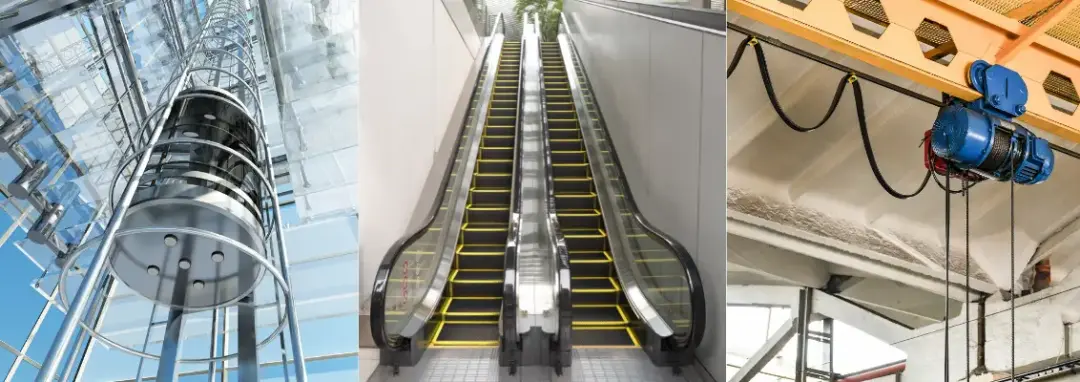
- Passenger elevators: Provide connections between the control cabinet and elevator car, supplying power for lighting, ventilation fans, and floor signals.
- Freight elevators and industrial lifting systems: Ensure reliable operation in demanding environments with high operating frequencies.
- Elevator car camera systems: Transmit images and camera surveillance data in real time.
- Building communication systems: Connect internal communication systems, electronic display panels, and building management systems (BMS).
- Escalators and passenger conveyors: Provide flexible power supply for moving structures.
- Overhead cranes and festoon systems: Supply power to lifting equipment that moves horizontally within factories.
6. Key criteria to consider when choosing elevator flat cables
When selecting elevator flat cables, you need to carefully consider the technical specifications to ensure that the cable is fully compatible with the system:
| Criteria | Specifications and selection requirements |
| Number of conductors | - 8–12 cores: Basic systems with few connected devices - 16–24 cores: Elevators with multiple devices and control signals - 36–42 cores: Complex systems with many auxiliary devices |
| Conductor cross-sectional area | - 0.5–0.75 mm²: Signal transmission and low electrical loads - 1.0–1.5 mm²: Power supply for auxiliary equipment - 2.5 mm²: Power supply circuits with higher current loads |
| Sheath material | - PVC: Indoor environments with normal operating conditions - PUR: Environments involving friction, oil, grease, or high abrasion resistance requirements |
| Rated voltage | Common ratings include 300/500 V and 450/750 V, depending on system requirements |
| Bending performance | Choose cables specifically designed for continuous movement and repeated bending |
| Travel length | Determine based on the elevator's travel height and cable installation arrangement |
| Environmental conditions | Consider resistance to oil, moisture, abrasion, and electromagnetic interference, depending on the installation location |
*Note: The information above is for reference only.
7. Comparison of flat and round cables for elevator systems
Besides flat cables, round cables are also commonly used in various elevator systems. So, what are the differences between these two cable types?
| Criteria | Flat cable | Round cable |
| Structure | Conductors arranged in parallel | Conductors bundled in a round configuration |
| Shape | Flat, thin ribbon | Cylindrical |
| Bending performance | Optimized for repeated bending in one plane | Depends on cable structure and design |
| Twist resistance | Helps limit twisting when properly installed | Twisting must be controlled during installation |
| Installation space | Compact and space-saving in the horizontal direction | Requires sufficient space based on cable diameter |
| Applications | Moving cables connecting the elevator car | Used for fixed transmission lines or according to specific system designs |
| Investment cost | Generally higher than round cables | Generally lower than flat cables |
8. Outstanding HELU’s flat cables
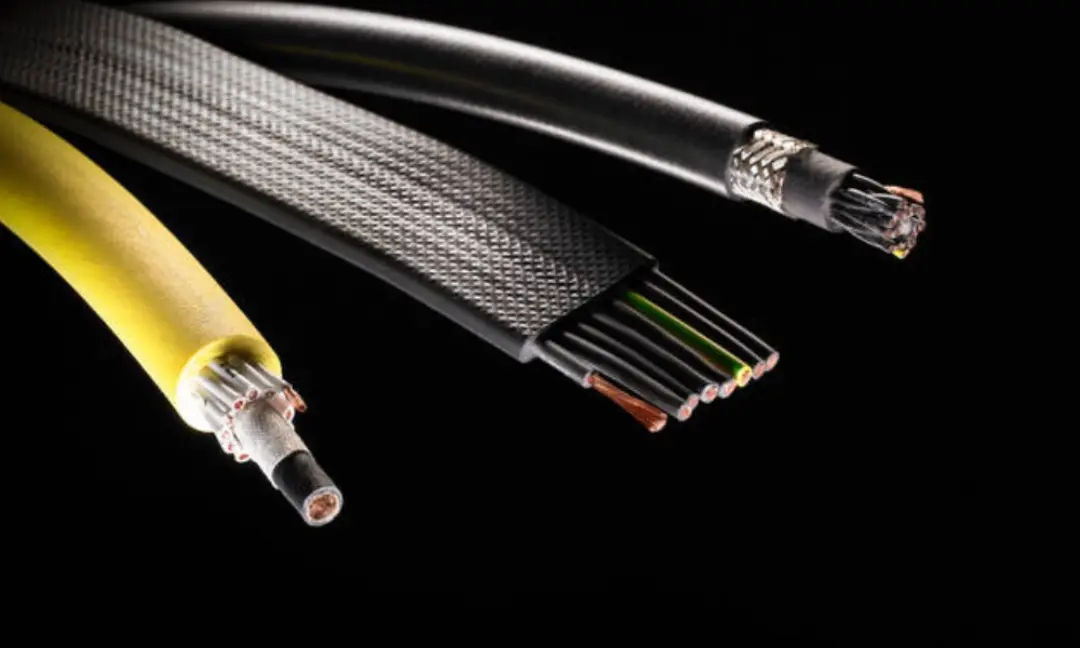
We HELU provide a wide range of flat cables with different materials and technical characteristics, suitable for various industrial moving applications. Below are the temperature ranges, rated voltages, and minimum bending radius of four representative product lines:
| Cable series name | Operating temperature (moving / fixed installation) | Rated voltage U₀/U | Minimum bending radius |
| PVC-flat | -5°C to +70°C / -40°C to +80°C | 300/500 V (≤ 1 mm²) 450/750 V (≥ 1.5 mm²) | 10 × cable thickness |
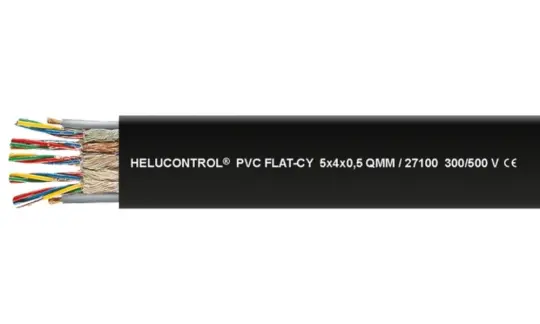
| PVC-flat-CY | -5°C to +70°C / -40°C to +80°C | 300/500 V | 15 × cable thickness |
| NEO-flat | -30°C to +80°C / -40°C to +80°C | 300/500 V | 10 × cable thickness |
| NEO-flat-C | -30°C to +80°C / -40°C to +80°C | 300/500 V | 15 × cable thickness |

LEARN MORE
Contact HELU Vietnam today for consultation and a product quote
9. Frequently asked questions about elevator flat cables
Yes. Flat cables can be used in high-rise elevators as long as they meet the requirements for suspension length, tensile load, and mechanical durability. For long travel distances, cable types with reinforced load-bearing cores are recommended.
Shielded elevator flat cables should be used when transmitting data signals, sensitive control signals, or camera images in environments with numerous high-power electrical devices that generate electromagnetic interference.
Yes. The outer sheath, suspension and mounting points, and any signs of abrasion, cracking, or deformation should be inspected regularly. This helps identify problems early and prevent operational interruptions while the elevator is running.
The service life of an elevator cable depends on material quality, elevator operating frequency, travel height, and installation methods. Selecting the right specifications and carrying out periodic maintenance can significantly extend the cable's service life.
Direct replacement is not recommended without carefully assessing the system structure. Elevator flat cables and round cables have completely different bending characteristics and installation space requirements. Any changes must be based on the system design and the manufacturer's technical specifications.
Ensure that the cable is suspended straight and properly secured. It must not be twisted, sharply bent, or allowed to rub against the elevator shaft walls. In addition, technicians must strictly follow the minimum bending radius and tensile force limits recommended by the manufacturer.


