Offshore Wind Power: Connection Technology for Harsh Conditions
Learn how common installation mistakes can be avoided as early as in the planning process.

Germany is continuing to expand its offshore wind capacity. The German government has recently amended the Offshore Wind Energy Act (WindSeeG) to enhance reliability and ensure a stable pace of development over the long term. For related industries, this means the market will continue to require high-performance, durable components for many years to come—from the wind turbines themselves to the grid-connection systems.
Electrical cables also play a crucial role in this context. Out at sea, electrical components are constantly subjected to extremely harsh conditions. At the same time, systems are becoming increasingly efficient, and the demand for continuous operation is growing. Therefore, the electrical infrastructure must operate reliably in this environment. Not all cables are the same: cables installed in each location within the turbine must meet very different requirements.
Learn about the pros and cons of
Inside the turbine tower: Specialized cables for continuous operation
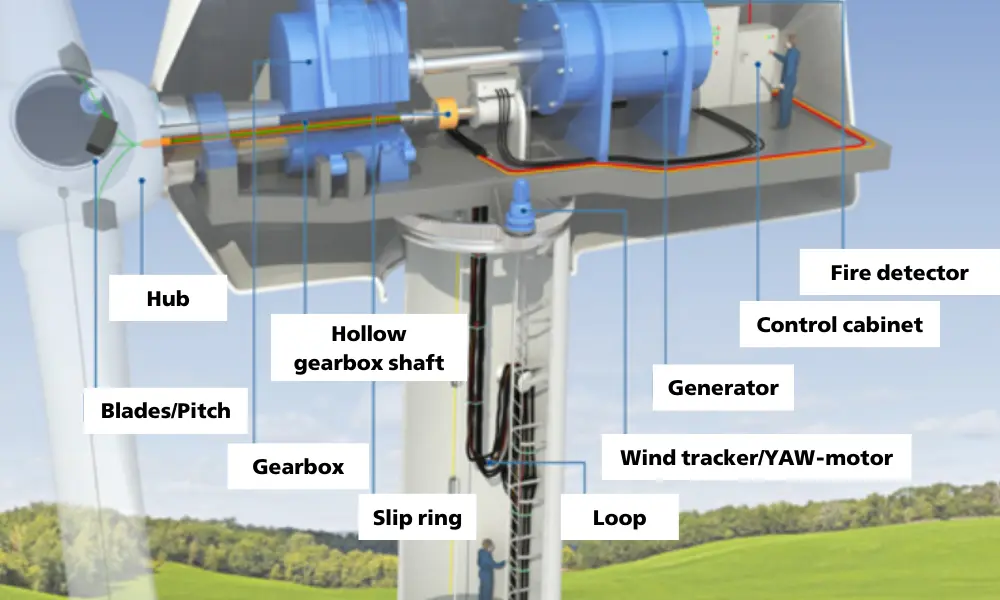
Inside the wind turbine nacelle
Torsion-rated cables for wind turbine applications
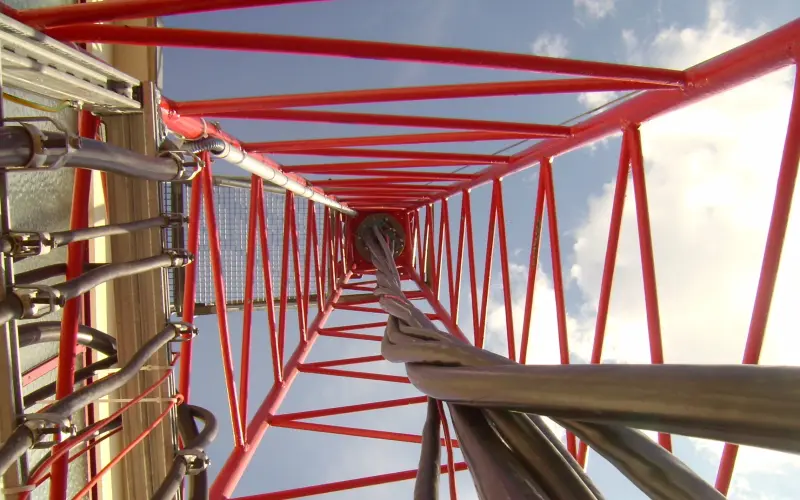
Cables within what is called the “cable loop” are in for a particularly difficult challenge. Because the nacelle turns with the wind, the low and medium-voltage cables installed there are constantly being subjected to torsion forces, meaning they are being twisted along their own axes. Conventional cables are not designed for long-term exposure to these kinds of mechanical loads.
HELU has developed the HELUWIND WK Torsion cable series specifically for this application, which includes the WK 110, WK 135, and WK 137 models. These are low-voltage cables capable of withstanding torsion up to ±150°/m and have been tested for over 18,000 torsion cycles.
In addition to its mechanical strength, the HELUWIND WK series offers many other advantages:
- Resistant to UV and ozone
- Halogen-free
- Highly wear-resistant and oil-resistant
- Stable operation in a seawater vapor environment
- Operating temperature range from -40 °C to +90 °C, for both flexing and fixed installations
Depending on the cable type, the HELUWIND WK series meets the requirements of IEC 60332-1-2/3 for flame retardancy, IEC 60754-1 for halogen-free performance, and IEC 61034-2 for smoke density. UL/CSA certification for the WK 135 and WK 137 allows for worldwide use.
HELU's torsion-rated cable
Each HELUWIND WK torsion-resistant cable series is designed for specific requirements: temperature range, market certifications, halogen-free status, and voltage rating. Most models also come in EMV-D (with an electromagnetic interference shield), MULTI (multi-conductor), and TP (twisted-pair) variants, intended for control and signal circuits in twisted-pair cable systems.
- 0.6/1 kV low-voltage cable: HELUWIND WK 103w-Torsion, HELUWIND WK 103k-Torsion, HELUWIND WK 110-Torsion, HELUWIND WK 135-Torsion, HELUWIND WK 137-Torsion FT4
- 1.8/3 kV and medium-voltage cable: WK 300w-Torsion and WK 310-Torsion (1.8/3 kV)
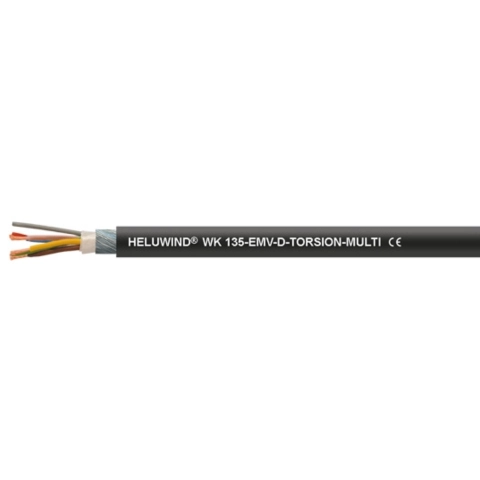
HELUWIND® WK 135
TORSION
TORSION-MULTI
EMV-D-TORSION
EMV-D-TORSION-TP
EMV-D-TORSION-MULTI
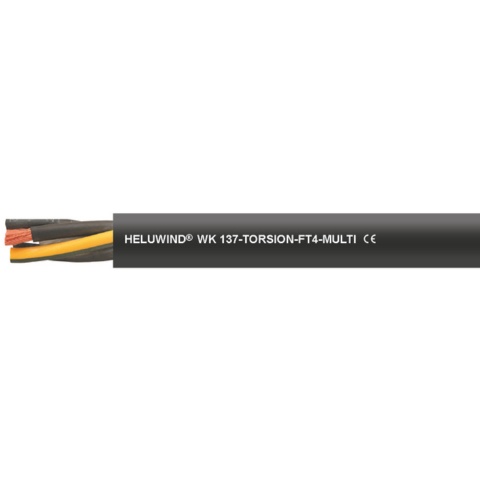
HELUWIND® WK 137
TORSION-FT4
TORSION-FT4-MULTI
EMV-D-TORSION-FT4
EMV-D-TORSION-FT4-TP
EMV-D-TORSION-FT4-MULTI
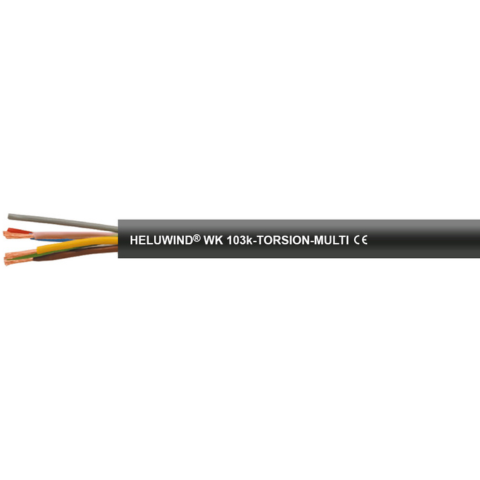
HELUWIND® WK 103
103w-TORSION, 103w-TORSION-MULTI
103w-EMV-D-TORSION
103k-TORSION, 103k-TORSION-MULTI
103k-EMV-D-TORSION
103k-EMV-D-TORSION-TP
Control and Communication: Data must also be transmitted reliably
In modern wind power systems, communication systems are consistently gaining in complexity and importance. Sensors are constantly measuring operating conditions, control systems are processing information, and various components are exchanging information with one another.
As a result, fiber optic cables, data cables, bus cables, and control cables have become critical components for ensuring continuous system operation. Depending on the application, cables must be resistant to electromagnetic interference (EMI) , oil-resistant, UV-resistant, or capable of withstanding movement and a wide temperature range.
Therefore, engineers should not focus solely on transmission speed. The cable must also have mechanical and electrical specifications suitable for the installation location.
Some representative HELU data cables, bus cables, and fiber-optic cables for wind turbines:
- Network and bus cables: HELUKAT 100T CAT.5e S/UTP PUR TORSION, PROFINET Type C Torsion, and PROFIBUS L2 Torsion
- HELUCOM fiber optic cables: HELUCOM WK Breakout AT-V(ZN)Y(ZN)Y and HELUCOM WK Mobil A-V(ZN)11Y / A-V(ZN)YY
- Data and control cables: PAAR-TRONIC-CY, SUPERTRONIC-PUR, DATAFLAMM, HELUTHERM 145 MULTI
On the sea, availability is of particular importance
It is already annoying when a machine malfunctions on the shop floor. But offshore, these malfunctions can quickly lead to expensive disruptions. Maintenance and repairs on the sea are difficult and can even depend on weather and swells.
That is why it is all the more important to ensure that the connection technology is appropriate for the application before construction begins. We are talking about more than merely conductor cross-sections and voltage. Additional factors to consider include:
- Torsion
- Bending radius
- Operating temperature range
- Resistance to UV, ozone, and oil
- Fire characteristics (fire spread resistance or fire resistance)
- Relevant standard requirements
| Location within the turbine | Main load | Appropriate cable type |
| Cable loop | Continuous twist of ±150°/m | HELUWIND WK 110 / 135 / 137 |
| Control systems, sensors | EMI interference, oil, temperature | Shielded control cables, shielded signal cables |
| Communications, SCADA | Transmission speed, distance | Fiber optic cables, bus cables, industrial Ethernet cables |
| Permanently mounted in the tower | Fire, smoke, UV | Halogen-free, flame-retardant power cable |
The right cable for the right application
A wind power system represents more than just “a” requirement for cables. A flexing cable in a cable loop must endure different loads than power, data, sensor, or communication cables in fixed installations. It is for precisely this reason that it is worth including electrical connection technology in the planning process for systems early, and to not simply select cables based on their electrical parameters on paper.
👉 Learn more about cable solutions for the wind energy industry, or contact HELU to speak with an engineer who can advise you on selecting cables for your project.