What are Cat6 cables? Construction, specifications, and applications
Cat6 cable shows up in virtually every network project today — from offices and factories to commercial building infrastructure. But not all Cat6 cables are the same: UTP Cat6 and STP Cat6 serve different environments, solid and stranded cores serve two completely different purposes, and standard Cat6 isn't always the optimal choice compared to Cat6A. This article breaks down Cat6 from its internal structure and real-world specifications to how it's classified and compared against Cat5e and Cat6A — so you can choose the right cable the first time.
Article content:
-
1What are Cat6 cables?
-
2Cable construction - Outer sheath
-
3Cable construction - Twisted pairs
-
4Cable construction - Spline / Separator
-
5Cable construction - Conductor
-
6Cat6 cable specifications
-
7Classification: UTP vs. STP Cat6 cables
-
8Classification: Solid vs. stranded Cat6 cables
-
9Classification: Fire rating(CM/CMR/CMP)
-
10Applications of Cat6 cables
-
11Comparison of Cat6, Cat7, and Cat5 Cables
-
12HELU cable catalog: Building infrastructure
-
13HELU cable catalog: Cat6A cables
-
14HELU cable catalog: Cat6 cable for drag chains
-
15HELU cable catalog: Cat6 cables for the Oil and Gas industry
1. What are Cat6 cables?
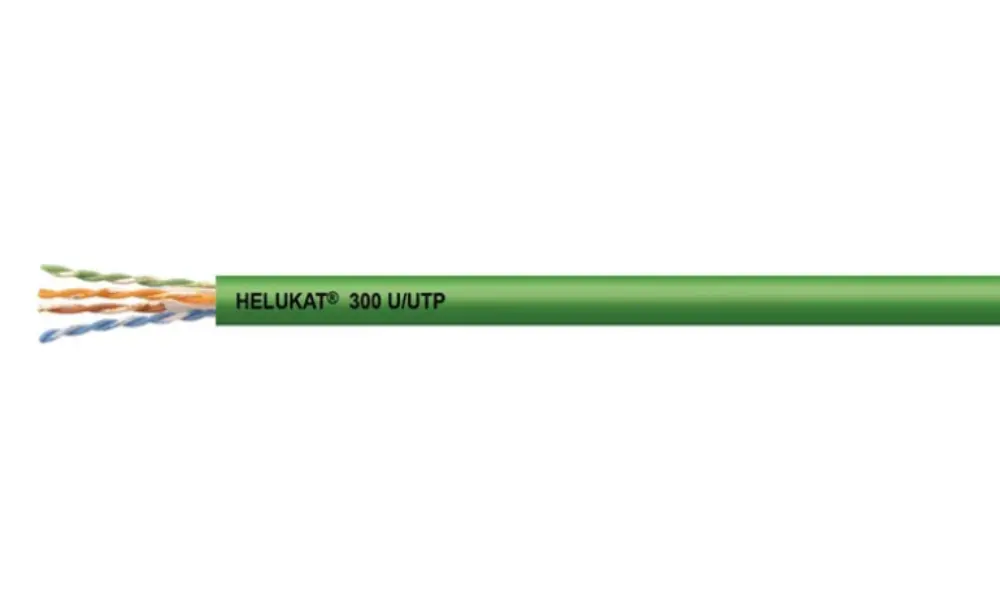
HELUKAT® 300LAN CAT.6 U/UTP FRNC LAN cable
Cat6 stands for Category 6, a twisted-pair cable standard defined by ANSI/TIA-568-B.2-1 (later updated as TIA-568-C.2). Developed in 2002, Cat6 was created to meet the demands of modern networks that increasingly required higher speeds and better noise resistance — needs that Cat5e could no longer keep up with.
Compared to Cat5e, Cat6 network cable supports 1 Gbps over the standard 100 m distance, and can reach 2 Gbps under ideal conditions or 10 Gbps at distances of ≤55 m — while Cat5e cannot run reliably at 10 Gbps over any practical distance.
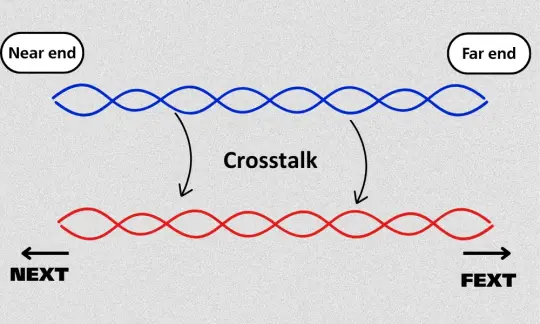
The spline is Cat6's most distinctive identifying feature. This cross-shaped plastic divider splits the cable's interior into four separate compartments, keeping the four wire pairs from touching each other. When two pairs run close together, the high-frequency alternating current in one pair induces a current in the neighboring pair — this is called crosstalk. The spline reduces this effect by increasing the physical distance between pairs, allowing more stable signal transmission at high frequencies that Cat5e cannot achieve.
Thanks to these advantages, Cat6 has become a popular choice for data centers, corporate offices, and buildings that need high-speed network infrastructure. As smart home devices and IoT become more widespread, Cat6 is now recommended even for residential installations — ensuring the infrastructure can handle demand for the next 10–15 years without needing to be rewired.
Cat6 comes in two common forms: UTP Cat6 (no shielding) and STP Cat6 (with a foil or braid shield layer). Depending on the installation environment, each type has its own advantages and range of applications.
2. Construction of Cat6 network cable
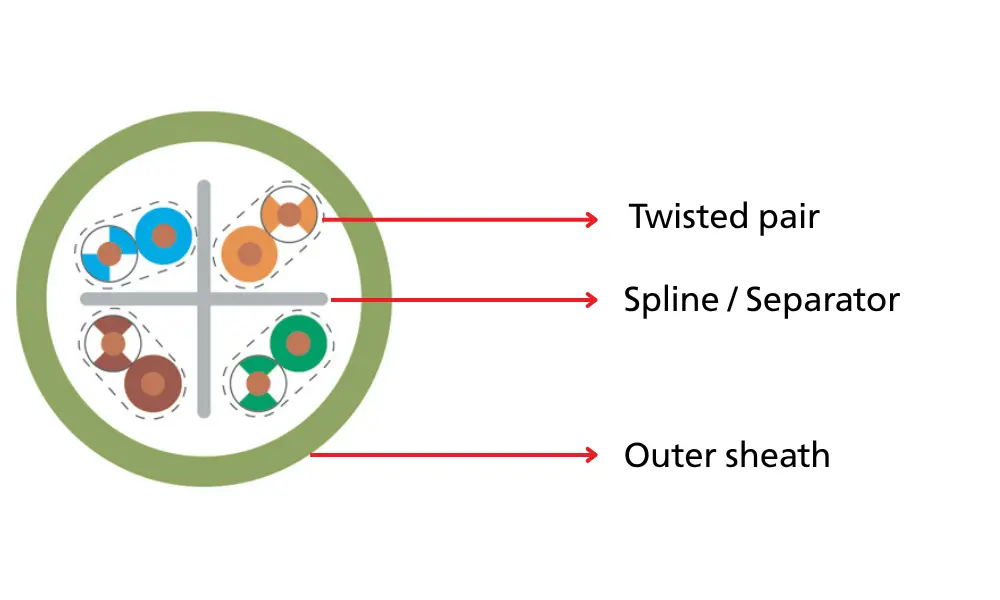
The construction of a Cat6 UTP network cable
To understand why Cat6 transmits signals better than Cat5e, it is important to understand how each layer inside the cable works. From the outside in, each component plays a specific role in protecting and transmitting signals.
2.1 Outer sheath — The first layer of protection
The outer sheath protects the entire internal structure from physical impact, moisture, and wear during installation and operation. Two materials are common:
- PVC: Flexible, durable, and low-cost — suitable for most residential and general office applications
- LSZH/FRNC (Low Smoke Zero Halogen / Flame Retardant Non-Corrosive): Emits minimal smoke and no toxic halogen gas when burned — required or recommended in enclosed spaces such as technical shafts, shopping malls, and buildings with high occupancy
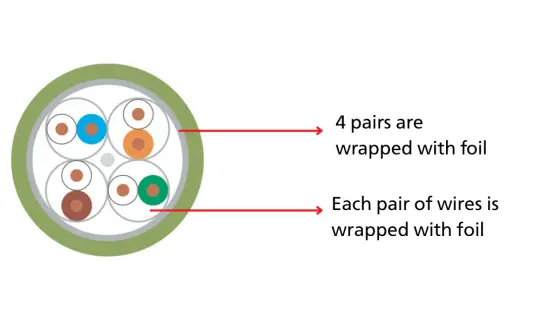
STP Cat6 cable adds an aluminum foil layer around each pair or around the entire cable, designated under ISO/IEC 11801 as F/UTP, U/FTP, F/FTP, or S/FTP depending on the specific construction.
2.2 Twisted pairs — The heart of data transmission
Inside the outer sheath are four twisted copper wire pairs (8 wires total), each pair color-coded to an international standard for easy identification and correct termination: blue/white-blue, orange/white-orange, green/white-green, brown/white-brown.
The twisted-pair structure is the most fundamental noise-cancellation mechanism in network cable. When current flows through a wire, it creates a surrounding magnetic field. If two wires run in parallel, this field interferes with the neighboring wire — a phenomenon called crosstalk. When two wires are twisted together, their magnetic fields point in opposite directions and cancel each other out. Cat6 has more twists per inch than Cat5e — this is precisely why Cat6 handles 250 MHz of bandwidth better than Cat5e's 100 MHz.
💡Learn about crosstalk in network cables and solutions to prevent it
2.3 Spline / Separator— The key differentiator
While twisting reduces noise within each pair, the spline reduces noise between pairs. This X-shaped plastic divider runs the length of the cable, splitting the interior into four separate compartments and maintaining a fixed distance and geometry between the pairs along the entire cable run.
Without a spline, the four pairs could touch each other or shift position relative to one another when the cable bends, reducing noise-cancellation effectiveness. The spline ensures consistent geometric structure — a requirement for Cat6 to perform reliably at 250 MHz across the full 100 m run.
2.4 Conductor — The data pathway
This is the component that directly carries the signal — and conductor quality has the greatest impact on real-world performance, especially over long distances and in PoE applications.
In terms of core structure, Cat6 network cable comes in two types:
- Solid: A single solid copper strand per conductor. Lower signal attenuation, suited for long cable runs — this is the standard for fixed horizontal cabling (in walls, ceilings, conduit)
- Stranded: Multiple thin copper strands twisted together. More flexible and better able to withstand repeated bending — suited for patch cords running from a wall jack to a computer, or from a patch panel to a device
3. Cat6 cable specifications and performance
| Specifications | Cat6 | Cat5e (for comparison) |
| Bandwidth (maximum frequency) | 250 MHz | 100 MHz |
| Speed at 100 m | 1 Gbps (1000BASE-T) | 1 Gbps |
| Speed at ≤55 m | 10 Gbps (10GBASE-T) | Stable support is not available |
| Impedance | 100 ohms | 100 ohms |
| Standards | ANSI/TIA-568-B.2-1 | ANSI/TIA-568-B.2 |
Cat6's specifications aren't just about top speed numbers — they reflect a fully optimized technical system: conductor gauge, twist density, and stricter physical standards than Cat5e all work together:
- A bandwidth of 250 MHz—double that of Cat5e — is the key factor that lets Cat6 handle multiple heavy data streams simultaneously without signal degradation.
- At a speed of 10 Gbps (10GBASE-T standard), the signal operates at very high frequencies. As distance increases, crosstalk accumulates along the cable run — particularly Alien Crosstalk (AXT), meaning noise induced from neighboring Cat6 cables running in parallel. Cat6 doesn't have enough shielding to eliminate AXT over long distances, so 10 Gbps is only guaranteed within ≤55 m. Cat6A solves this problem with heavier shielding and a larger cable diameter, controlling AXT to sustain 10 Gbps over the full 100 m.
- Fully backward compatability: Cat6 works well with Cat5e, Gigabit Ethernet, and Fast Ethernet equipment. Upgrading from Cat5e to Cat6 doesn't require replacing switches or routers — just the cable and connectors.
4. Types of Cat6 cable
4.1 UTP Cat6 vs. STP Cat6 cables
The core difference between UTP and STP Cat6 cable lies in how they handle electromagnetic interference (EMI). UTP has no additional shielding — the signal is protected entirely by the twisted-pair mechanism. STP Cat6 adds a foil layer and/or braided mesh, creating a physical shield that blocks external electromagnetic fields from affecting the signal.
Under the ISO/IEC 11801 standard, common STP Cat6 designations include:
- F/UTP: a single foil layer wrapping all four pairs (no individual pair foil)
- U/FTP: each pair has its own individual foil, with no overall shield
- F/FTP: overall foil plus individual pair foil — the strongest noise resistance in the Cat6 lineup
| UTP Cat6 | STP Cat6 (F/UTP or F/FTP) | |
| Shielding | Relies solely on the twisted-pair mechanism | Additional foil/braid shield layer |
| Grounding | Not required | Required — improper grounding turns the shield into an "antenna" that picks up more noise than UTP |
| Suitable environment | Offices, homes, low-EMI areas | Factories, data centers, near inverters/VFDs, high-power electrical equipment |
| Cost | Lower | Higher (extra shielding layer plus shielded connectors) |
| Installation | Simple, flexible | More complex, requires correct grounding technique |
- Choose UTP Cat6 for: standard offices, homes, commercial buildings, residential IP cameras.
- Choose STP Cat6 for: manufacturing plants, industrial parks, areas near variable frequency drives (VFDs), large electric motors, substations, or data centers requiring tight EMI control.
4.2 Solid vs. Stranded Cat6 cable
Beyond UTP/STP, Cat6 network cable is also classified by copper core construction — and this choice directly affects signal attenuation and cable lifespan:
| Solid core | Stranded core | |
| Construction | One solid copper strand per conductor | Multiple thin copper strands twisted together |
| Signal attenuation | Lower — suited for runs up to 100 m | Higher — suited only for runs up to ~10 m |
| Flexibility | Low — can break if bent repeatedly | High — withstands repeated bending well |
| Application | Fixed cabling in walls, ceilings, conduit | Patch cords, wall jack to device connections |
Solid-core Cat6 cable is the standard choice for horizontal cabling, permanent links, and industrial networks. The rigid structure of a solid core ensures better signal transmission over long distances with lower resistance — particularly important for PoE applications, where the cable must simultaneously carry data signals and power current.
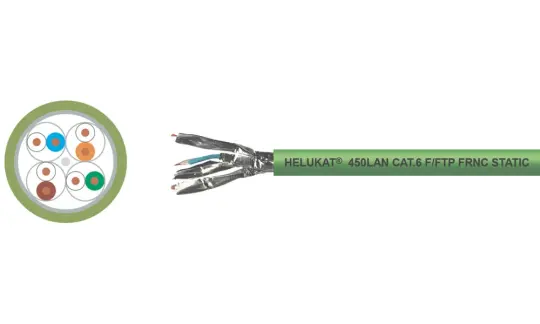
Some of HELU's solid-core Cat 6 network cables include: HELUKAT® 450 CAT.6 F/FTP FRNC STATIC (82501) and HELUKAT® 500 CAT.6A F/FTP FRNC STATIC (803378).
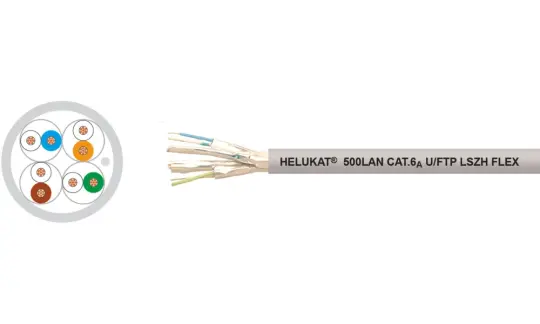
Stranded-core Cat6 cable, with its high flexibility and ease of installation, suits short-distance applications: patch panel connections, work-area terminations, or any location requiring frequent movement or re-plugging. Stranded cores hold up better with RJ45 connector termination and are easier to route through tight spaces than solid cores.
Some of HELU's Cat 6 LAN cable include: HELUKAT® 300 CAT.6 U/FTP PVC FLEX (802174) and HELUKAT® 500 CAT.6A U/FTP LSZH FLEX (804043).
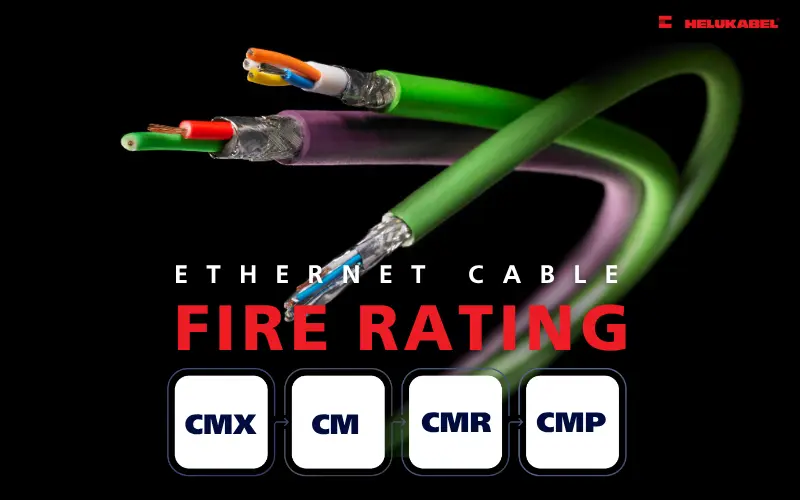
4.3 Cat6 cable fire rating classification: CM / CMR / CMP
In addition to the two classifications mentioned above, Cat6 network cables are also classified by fire resistance rating according to the NEC (National Electrical Code) standard.
| Designation | Full name | When to use |
| CM | Commercial | In-room, horizontal runs on the same floor — most common |
| CMR | Riser | Vertical runs through risers between floors — prevents vertical fire spread |
| CMP | Plenum | Runs through ceiling/floor plenum spaces with air circulation — highest fire-safety requirement, special sheath material |
Some of HELU's Cat6 cables with CMG/CM fire-resistance ratings include:
- HELUKAT® 250IND CAT.6 CMG SF/UTP PVC STATIC – Part No. 805655
- HELUKAT® 250S CAT.6 CMG SF/UTP PVC CHAIN – Part No. 805658
- HELUKAT® 250IND CAT.6 SF/FTP PVC STATIC (CMG) – Part No. 11017904
- HELUKAT® 500IND CAT.6A SF/FTP PVC STATIC (CMG) – Part No. 803693
- HELUKAT® 500IND CAT.6A S/FTP PVC STATIC (CMG) – Part No. 11007776
- HELUKAT® 500IND CAT.6A S/FTP FRNC STATIC (CM) – Part No. 11007777
- HELUKAT® 500S CAT.6A SF/FTP PVC CHAIN (CM) – Part No. 805704
5. Applications of Cat6 cables
Cat6 network cables are suitable for a wide range of applications
- Home networks: Cat6 comfortably handles 4K/8K streaming, online gaming, and smart-home setups with many devices connected at once. UTP Cat6 is an economical choice that's more than sufficient for most households today.
- Offices and businesses: Supports high-speed internal LANs, video conferencing, cloud applications, and ERP/CRM software. Cat6 enables deploying a 1 Gbps network today with the option to scale up to 10 Gbps in the future (over short ≤55 m runs) without replacing the entire cabling infrastructure.
- IP cameras and surveillance systems: Delivers stable HD/4K video streaming. Residential to office-grade IP cameras all perform well over UTP Cat6.
- PoE (Power over Ethernet): Cat6 supports IEEE 802.3af (15.4W), 802.3at/PoE+ (30W), and 802.3bt/PoE++ (up to 90W) standards. When a cable carries PoE current, sheath temperature rises accordingly — this is why CMR or CMP ratings should be used instead of CM to ensure safety, especially when bundling multiple cables inside enclosed conduit (where heat buildup is higher).
- Industrial environments and data centers: STP Cat6 (F/FTP) is recommended where variable frequency drives, electric motors, or strong EMI sources are present.
6. Cat5e vs. Cat6 vs. Cat6A comparison
| Criteria | Cat5e | Cat6 | Cat6A |
| Bandwidth | 100 MHz | 250 MHz | 500 MHz |
| Max speed | 1 Gbps / 100 m | 10 Gbps / 55 m | 10 Gbps / 100 m |
| Spline | No | Yes | Yes (thicker) |
| Cable cross-section | Smallest | Medium | Larger, heavier |
| Backward compatibility | — | With Cat5e | With Cat6, Cat5e |
| Cost | Lowest | Medium | Highest |
| Suitable | Basic Plan, Upgrade from an Existing Plan | Secondary Education Today | Future / Long-Term 10G Performance |
6.1 Cat5e vs. Cat6 cables
Both reach 1 Gbps over 100 m, but that's the only point where they're equal. Cat6 network cable doubles the bandwidth to 250 MHz, handling demanding applications like HD streaming, gaming, cloud services, and large data transfers much better — workloads that increasingly strain Cat5e. More importantly, Cat6 supports 10 Gbps at distances up to 55 m, something Cat5e cannot do at all. Given the relatively small cost difference, Cat6 is the more sensible choice for any new project today.
💡Helpful Information: Learn about the pros and cons of Cat5, Cat6, and Cat7 network cables
6.2 Cat6 vs. Cat6A cables
Cat6A is an upgraded version of Cat6, raising the operating frequency to 500 MHz and thoroughly resolving Alien Crosstalk through heavier shielding (S/FTP or F/UTP) — enabling stable 10 Gbps across the full 100 m run instead of just 55 m. This makes it well-suited for data centers, high-EMI environments, and infrastructure built for long-term needs. However, Cat6A cable is noticeably larger and stiffer, which can make it harder to route through tight conduit or bend around multiple corners — space and cost considerations should be carefully weighed before specifying it.
💡Discover the top 8 factors to consider when choosing UTP and STP network cables
7. HELU's Cat6 network cable product range
HELU's HELUKAT® line covers every application — from standard building infrastructure and industrial Ethernet networks to flexible cable-chain applications and demanding oil & gas environments.
💡 Are you interested in LAN cables - Check out our full product range
Below is HELU's Cat6/Cat6A product catalog:
7.1 Cat6 cables for building infrastructure
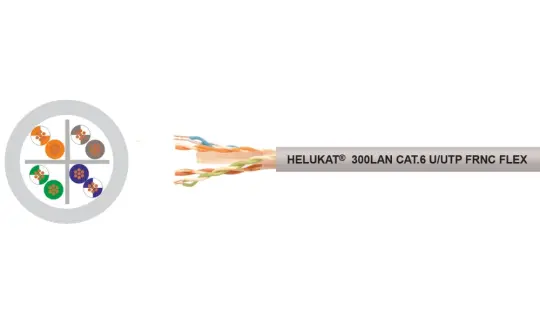
The HELUKAT® 300 line is the standard choice for LAN networks in offices and commercial buildings, meeting TIA/EIA-568 and ISO/IEC 11801 Cat6 requirements with 250 MHz bandwidth.
| Products | Outer sheath | Applications | Part No. |
| HELUKAT® 300LAN CAT.6 U/UTP FRNC STATIC | Halogen-free FRNC, Dca CPR | Fixed backbone cabling in buildings | 804766 |
| HELUKAT® 300LAN CAT.6 U/UTP FRNC FLEX | Halogen-free FRNC | Patch cords, device connections | 804996 |
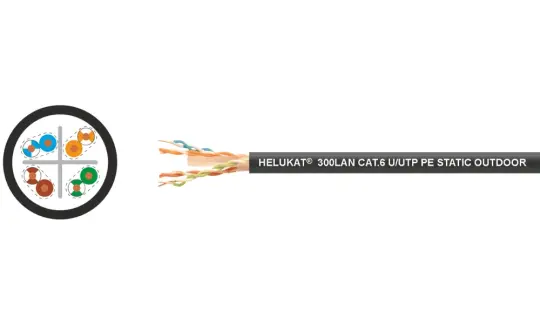
| HELUKAT® 300LAN CAT.6 U/UTP PE STATIC OUTDOOR | UV-resistant PE | Outdoor installation, weather-resistant | 805683 |
| HELUKAT® 450 CAT.6 F/FTP FRNC STATIC | FRNC, Dca CPR | High-EMI environments — factories, power centers | 82501 |
7.2 Cat6A network cables
The HELUKAT® 500IND / 500S line raises bandwidth to 500 MHz, supporting 10GbE across the full 100 m run — overcoming the 55 m limit of standard Cat6. Variants are optimized for specific industrial requirements:
| Products | Key features | Construction | Part No. |
| HELUKAT® 500IND CAT.6A S/FTP FRNC STATIC | Flame-retardant FRNC, low toxic smoke | S/FTP, solid core | 11007777 |
| HELUKAT® 500IND CAT.6A SK S/FTP PVC STATIC | CC-Link IE Field compatible, quick connector | S/FTP, FastConnect (SK) | 803693 |
| HELUKAT® 500IND CAT.6A S/FTP PVC FLEX | For Beckhoff CP-Link 4 | S/FTP, stranded core | 11023769 |
| HELUKAT® 500IND CAT.6A S/FTP LS0H EXTRAFLEX | Small bending radius | S/FTP, extra-flexible | 11023932 |
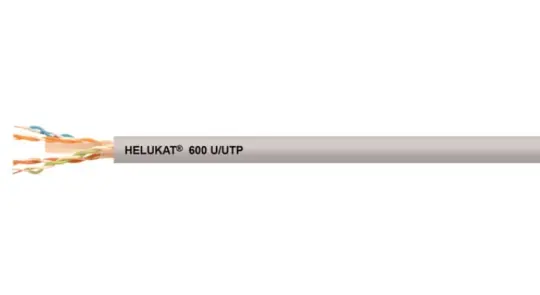
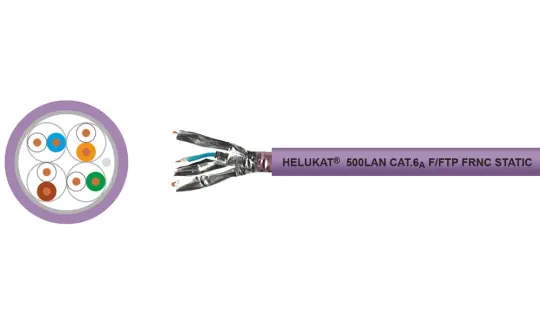
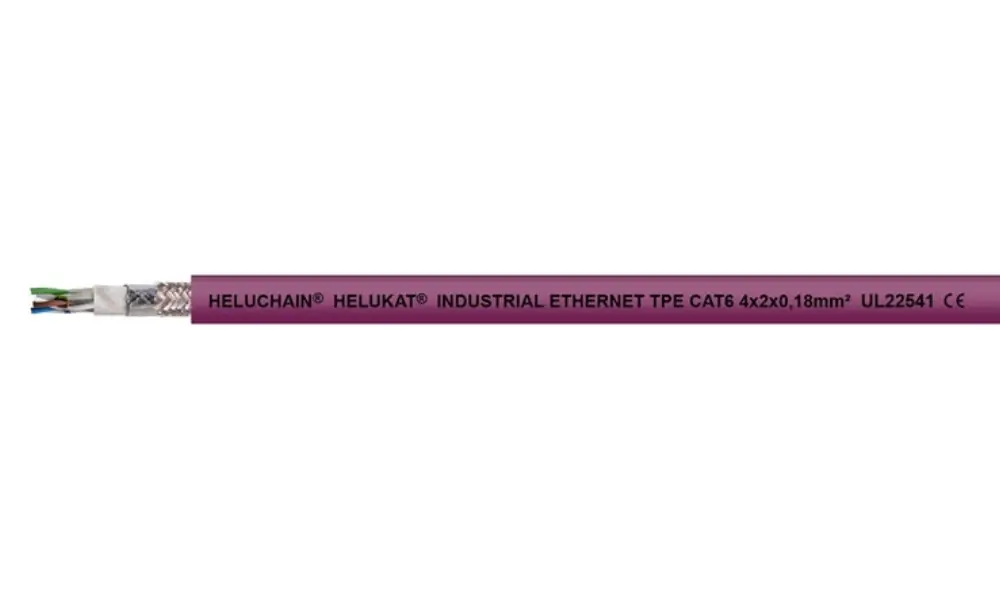
HELUCHAIN® HELUKAT® 250S CAT.6 SF/UTP TPE
7.3 HELUCHAIN® Cat6 cable for drag chain applications
Drag chain applications require Cat6 network cable that can withstand millions of bending cycles — standard office cable will fail at the core within a few months. The HELUKAT® 250S line is purpose-built for this environment.
HELUCHAIN® HELUKAT® 250S CAT.6 SF/UTP TPE (Part No. 11027808) is the standout model in the series:
- TPE outer sheath: significantly better abrasion resistance than PVC, durable in oily, greasy environments with fluctuating temperatures.
- SF/UTP construction: combined braid and foil shielding, reducing EMI from nearby drive mechanisms
- Other variants in the series: HELUKAT® 250S CMG SF/UTP PVC Chain (Part No. 805658), HELUKAT® 250S CAT.6 CMX SF/UTP PUR Chain (Part No. 803387)
7.4 Cat6 cable for Oil & Gas
The oil and gas industry imposes requirements that standard office or industrial cable cannot meet: exposure to hydrocarbons, direct burial, continuous vibration, and strict fire and explosion safety requirements.
HELUKAT® O&G Cat.6A F/FTP 4×2×AWG23/1 FRNC/FRNC (Part No. 11018072) was developed specifically for this segment