Common types of RJ45 connectors and their applications
An RJ45 cable (also called an Ethernet cable or network patch cable) is a network cable terminated at both ends with RJ45 connectors — the 8P8C (8-position, 8-contact) modular plug that is the universal standard for wired LAN connections. An RJ45 connector is the transparent plastic plug crimped onto the end of the cable, with 8 copper contacts that mate with ports on switches, routers, computers, IP cameras, and VoIP phones. The two standard wiring schemes for RJ45 connectors are T568B (dominant in commercial and enterprise environments, widely used in Vietnam) and T568A (used in some U.S. government standards). This article covers RJ45 connector anatomy, wiring standards, connector types, and HELUKABEL's HELUKAT® cable and patch cable range.
An RJ45 connector is also known as: a network connector, an RJ45 connector, or an 8P8C Ethernet connector.
RJ45 cables are also known as: RJ45 network cables, Ethernet cables, patch cables, and LAN cables.
1. What are RJ45 connectors?
"RJ" stands for Registered Jack, a telecommunications connection standard that facilitates the linking of data and voice transmission devices. This standard was first defined by the Bell System, and in the 1970s, the Federal Communications Commission (FCC) authorized its use to ensure customer equipment compatibility with telecommunications service providers' systems. The number "45" refers to the designation of this connection standard within the networking standards catalog.
There are various types of modular jacks used in telephone and networking systems, with RJ45 being one of the most common connectors in Ethernet networks. However, the term "RJ45 connector" is not entirely accurate. The correct name is 8P8C (8 Positions, 8 Contacts) connector, which means it has 8 positions and 8 electrical contacts. This type of connector is typically attached to the ends of Ethernet cables. A complete network cable (Ethernet cable) usually consists of an Ethernet cable with RJ45 connectors on both ends.
>>Learn more: What is a cable connector? The role of cable connectors in electrical systems
2. Components of RJ45 connectors
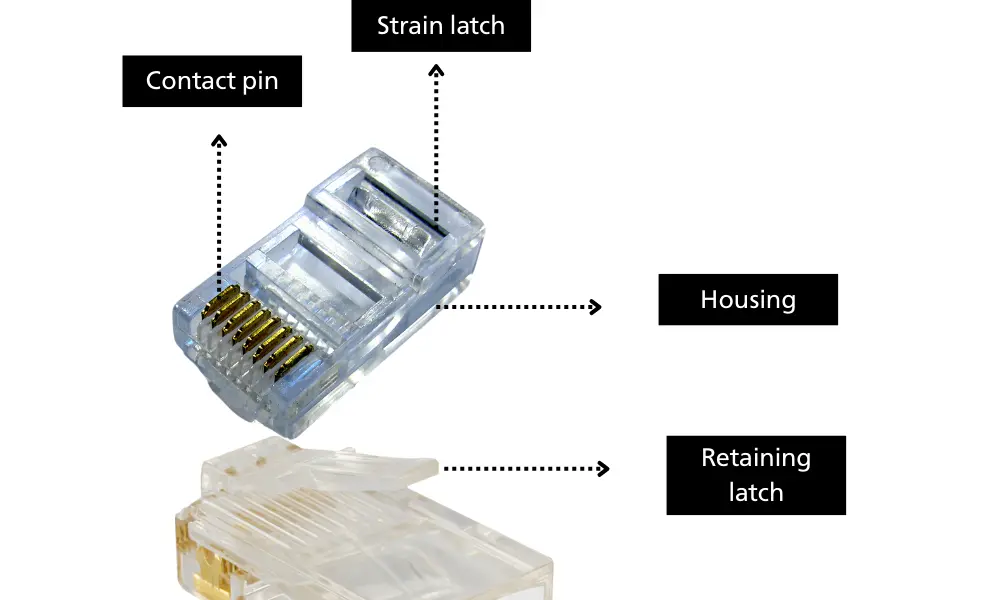
The components of an RJ45 connector
The RJ45 connectors consist of several important components:
- Plastic housing: The RJ45 network connector typically has a plastic housing made from high-performance PC material. The more transparent the housing, the higher the material quality.
- 8 contact pins: Not all RJ45 connectors on the market have gold-plated contact pins. However, gold-plated pins provide better resistance to corrosion and oxidation, ensuring more stable signal transmission. There are two types of gold-plated contact pins: Two-prong type: Suitable for stranded cables. Three-prong type: Compatible with both solid and stranded cables, offering a more secure connection and ensuring a stable link.
- Strain latch and retaining latch: The strain latch helps secure the RJ45 connectors into the network port, preventing it from becoming loose during use. Most Ethernet connectors have a strain latch along with a small rectangular hole, so a specialized crimping tool is required for proper termination. The retaining latch holds the network cable in place, preventing it from slipping out of the connector. When inserting or removing the RJ45 connector, press this latch gently to make installation and removal easier.
3. T568A and T568B wiring standards for RJ45 connectors
3.1 What are the T568A and T568B standards?
The RJ45 connector plays a crucial role in networking systems, enabling Ethernet cables to connect to devices such as routers, switches, and computers. Understanding the wire color codes and pinout diagrams of RJ45 connectors is essential for ensuring a stable and reliable network connection.
When wiring an RJ45 connector to an Ethernet cable, you need to consider two possible wiring standards: T568A and T568B, depending on your chosen wiring scheme:
- Each RJ45 connector has 8 positions (8P8C), meaning it requires 8 conductor wires to transmit data.
- These conductors are typically twisted into 4 twisted pairs to reduce interference and enhance signal transmission performance.
- The four primary colors used in both the T568A and T568B standards are: green, orange, blue, and brown.
Although the wire arrangements differ between the two standards, both ensure a stable network connection when used correctly.
>>See more: A glance at ethernet cables - Common types of ethernet cables
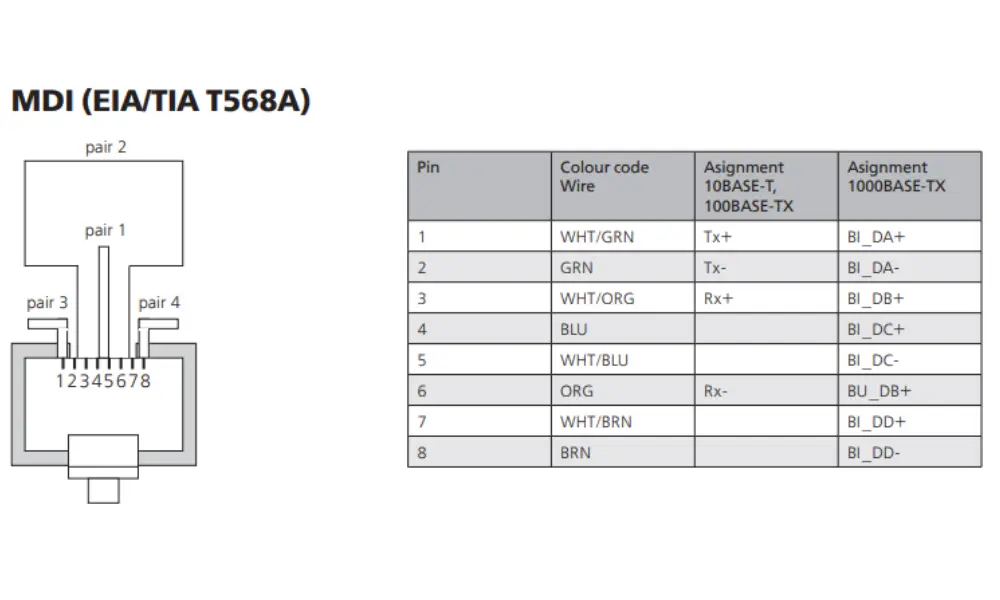
T568A wiring standard
3.2 T568A wiring standard for RJ45 connectors
The T568A wiring standard is commonly used in residential networking systems and is recommended by the U.S. government as the preferred wiring scheme. Below is the pinout order for the T568A standard when terminating an RJ45 network cable:
- White/Green
- Green
- White/Orange
- Blue
- White/Blue
- Orange
- White/Brown
- Brown
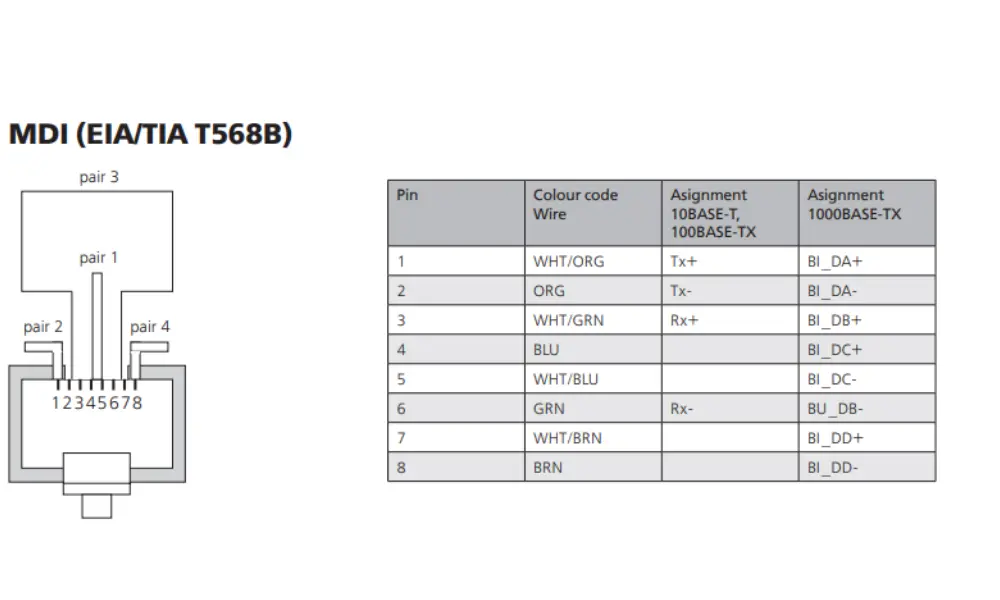
T568B wiring standard
3.3 T568B wiring standard for RJ45 connectors
The T568B wiring standard is more widely used in business and commercial networking systems. It is the most commonly adopted standard worldwide, especially in Ethernet networks.
Below is the pinout order for the T568B standard when wiring an RJ45 network cable:
- White/Orange
- Orange
- White/Green
- Blue
- White/Blue
- Green
- White/Brown
- Brown
Due to its widespread usage, the T568B standard is often preferred in most networking systems, ensuring compatibility and easier integration with various network devices.
4. Types of RJ45 Connectors
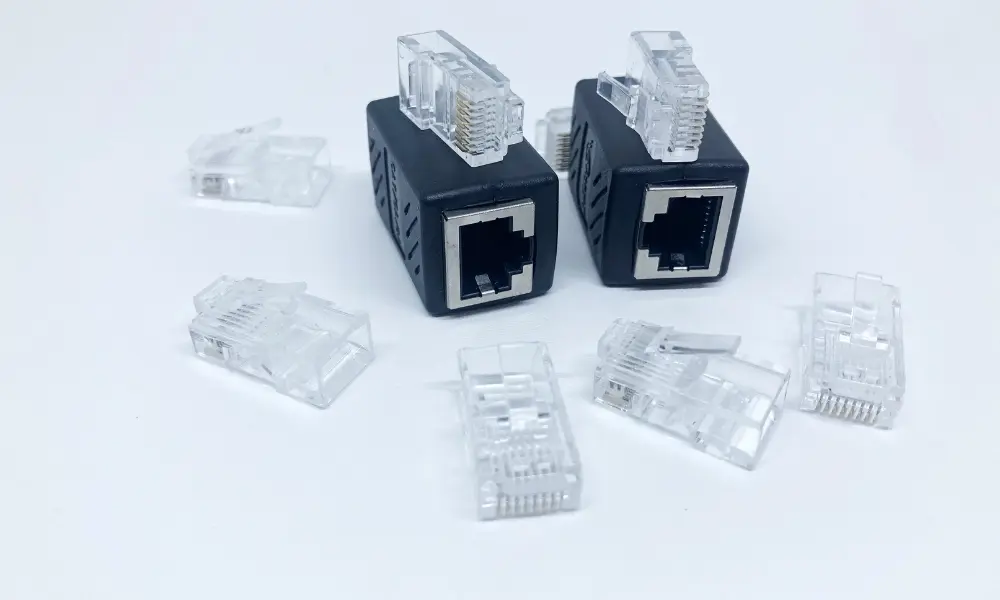
There are several ways to classify RJ45 connectors, such as by cable type, design, and application. Below are some of the most common classifications:
4.1 Male RJ45 connectors vs. female RJ45 connectors
The male RJ45 connector is the plug found at both ends of an Ethernet cable. It is typically made of transparent, white, black, or gray plastic, though different colors and materials may be available. Male RJ45 connectors are crimped onto network cables and are used to connect to female RJ45 ports on routers, switches, computers, and other networking devices.
The female RJ45 connector is the recessed socket designed to accept the male RJ45 plug. It is also known as an RJ45 female jack or RJ45 female socket. On most TVs, PCs, and other electronic devices, the RJ45 female port is located on the I/O (input/output) panel, often alongside other connectors such as HDMI and USB.
4.2 Standard RJ45 vs. Pass-Through RJ45 connectors
Standard RJ45 connectors (Non-Pass-Through RJ45): Also known as the traditional 8P8C connectors. In this type, the network cable wires do not pass through the plug but are instead secured inside before crimping. A specialized RJ45 crimping tool is required to attach the wires to the connector.
Pass-Through RJ45 connectors: This type allows the cable wires to extend through the connector, making it easier to align them before crimping. Its main advantage is that it simplifies the wiring process and reduces errors in wire arrangement.
4.3 Shielded vs. unshielded RJ45 connectors
Unshielded RJ45 connectors: These connectors have plastic housing and are typically used with Unshielded Twisted Pair (UTP) cables. They are ideal for environments with minimal electromagnetic interference (EMI), such as homes and offices.
Shielded RJ45 connectors: These connectors feature a metal shield around the housing to protect against EMI. They are used with Shielded Twisted Pair (STP) cables and are commonly found in factories, data centers, and industrial environments with high levels of electronic interference.
Important note: Do not use shielded RJ45 connectors with unshielded cables, as this may negatively impact network performance. Always choose the appropriate connector type based on your cable to ensure optimal network efficiency.
5. Applications of RJ45 network cable connectors

Applications of RJ45 network connectors
Thanks to their versatile design, RJ45 connectors are widely used across various fields:
- Home networking: In residential areas, RJ45 connectors play a crucial role in setting up wired connections for home networks. They ensure fast and stable data transmission between devices such as computers, TVs, and gaming consoles.
- Building automation: RJ45 connectors are commonly used in controllers and sensors within buildings to manage and connect systems such as ventilation, air conditioning, and access control. Their stable connection ensures efficient data transmission in commercial buildings.
- Data centers: In the complex infrastructure of data centers, RJ45 connectors are essential for linking servers, switches, and other network components. Their standardized configuration enables seamless integration, contributing to the overall performance and reliability of data center operations.
- Industrial applications: RJ45 connectors provide secure connections for machinery, control systems, and automation devices. Their durability and reliability make them an ideal choice for harsh industrial environments.
- Telecommunications: RJ45 connectors are frequently used in the telecommunications industry to connect network devices, routers, and switches. Their widespread use and compatibility make them a key component in telecommunications networks, facilitating seamless data and voice transmission.
6. RJ45 Connectors - Products and solutions from HELUKABEL
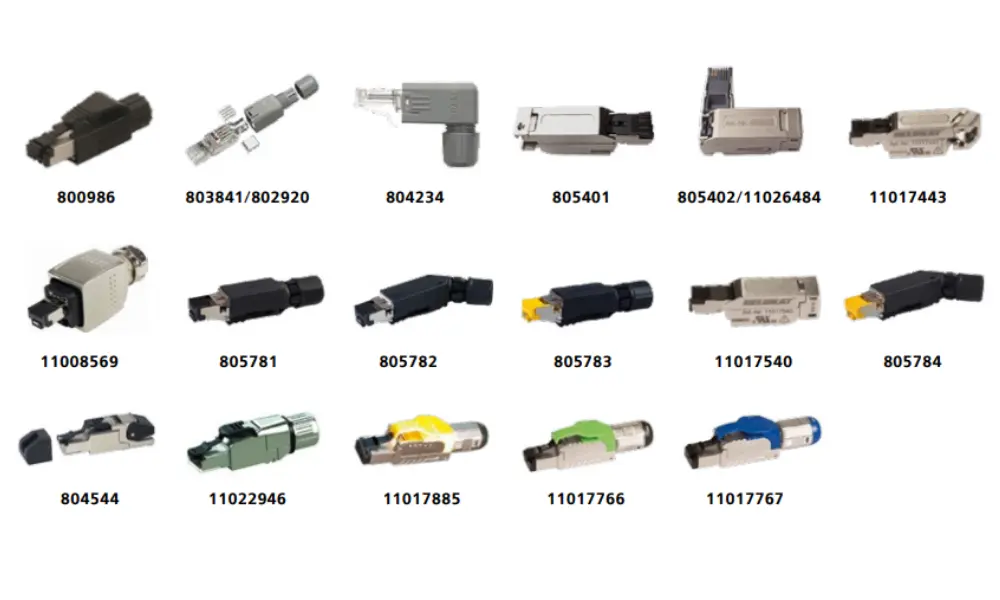
Some of HELUAKBEL's RJ45 connectors
As digitalization and automation continue to evolve, stable and reliable network connectivity plays a crucial role in most industrial, commercial, and residential applications. HELUKABEL offers a comprehensive range of RJ45 solutions, including RJ45 connectors, RJ45 cables, and crimping tools, ensuring optimal performance, durability, and flexible connectivity under all working conditions.
6.1 RJ45 copper connectors
HELUKABEL provides a wide variety of RJ45 connectors with multiple design options, compatible with industry standards such as PROFINET, TIA 568A, and TIA 568B:
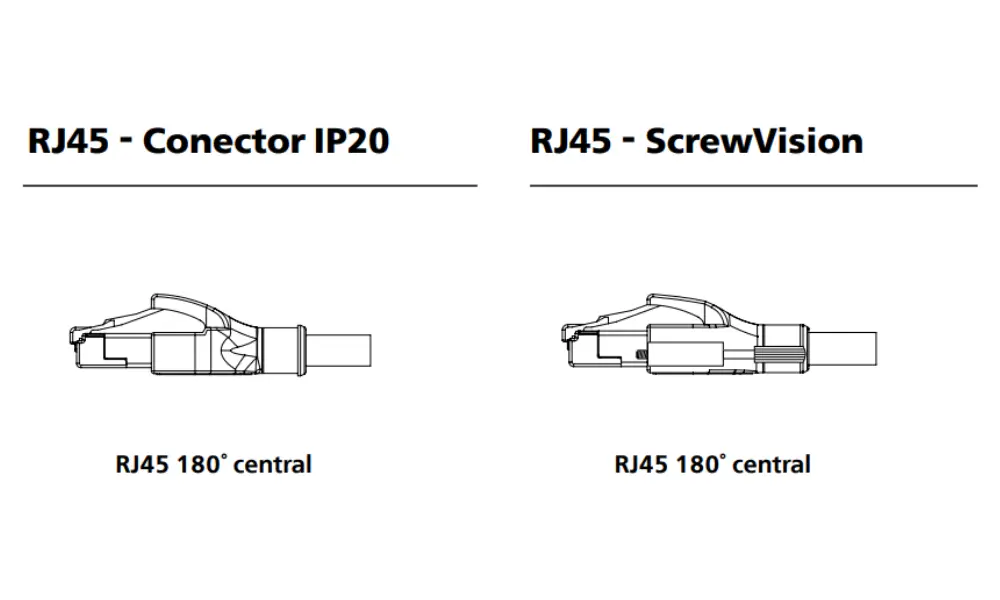
- Design variants: Available in straight connectors, angled connectors (45°, 90°, 180°), and Push-Pull connectors.
- Water and dust protection standards: IP20, IP67.
- Number of contact pins: Options include 4-pin or 8-pin connectors, depending on the networking standard.
- Compatibility with core diameters (Ø) from 1.0 mm to 1.6 mm and overall cable diameters (Ø) from 4.5 mm to 10.0 mm.
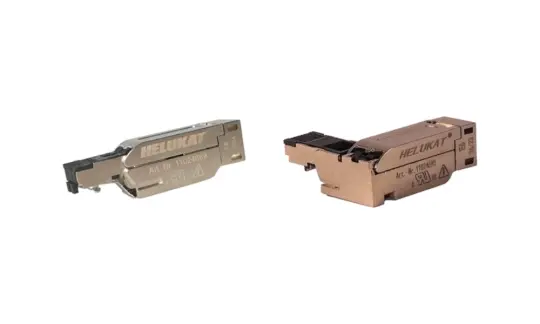
6.2 HELUKAT PROFINET® RJ45 cable connector
The HELUKAT PROFINET® Quick Contact (SK) field-installable RJ45 connector is designed for PROFINET and EtherCAT applications in industrial environments. Featuring an IDC (Insulation Displacement Contact) clamping mechanism, the connector enables quick, tool-free assembly with no loose parts that can be lost—significantly reducing on-site installation time.
The product is available in two cable exit angle versions: 180° straight and 90° right-angle, offering flexible adaptation to cable routing requirements within electrical cabinets and equipment. The metal housing ensures high mechanical durability and withstands harsh industrial environments. This connector supports PROFINET cable lengths of up to 100 m between Ethernet devices.
6.3 RJ45 cables
HELUKABEL offers a wide range of Ethernet cables compatible with RJ45 connectors, including:
- HELUKAT® 1000IND CAT.7A S/FTP PUR ROBUSTFLEX
- HELUKAT® 600IND CAT.7 S/FTP PUR ROBUSTFLEX
- HELUKAT® 200IND CAT.5e SF/UTP PUR ROBUSTFLEX
- HELUKAT 500IND CAT.6A SK S/FTP PVC STATIC
- HELUKAT® 200 CAT.5e Shielded/Unshielded PVC Static
- HELUKAT® 600IND CAT.7e S/FTP PUR STATIC
- HELUKAT® 600S CAT.7 SF/FTP PUR CHAIN
Which Ethernet / RJ45 Cable Standard Do You Need?
| Cable standard | Maximum Speed | Frequency | Features | Compatible with... |
| Cat5e | 1 Gbps | 100 MHz | UTP | Standard office/home LAN, budget installs |
| Cat6 | 10 Gbps (up to 55m) | 250 MHz | UTP/STP | Enterprise LAN, small data centers |
| Cat6A | 10 Gbps (up to 100m) | 500 MHz | STP | Data centers, IP cameras, smart buildings |
| Cat7 | 10 Gbps | 600 MHz | S/FTP | Industrial networks, high-EMI environments |
| Cat8 | 25–40 Gbps | 2,000 MHz | S/FTP | Server rooms, high-performance data centers |
Note on connectors: Standard RJ45 plugs are compatible with Cat5e–Cat6. Cat6A and above require dedicated Cat6A/Cat7 plugs with separate conductor channels for full interference rejection.
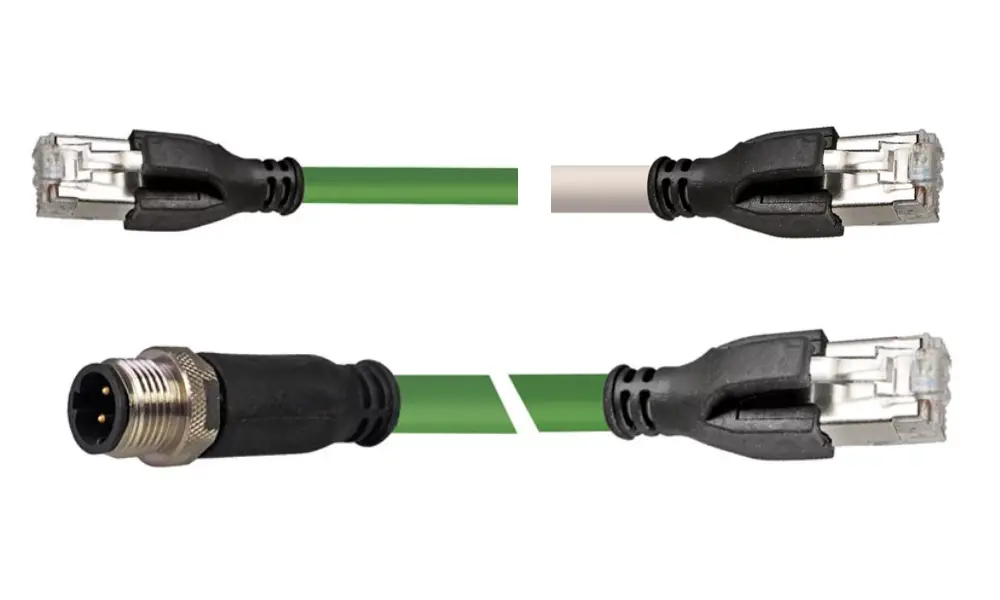
RJ45 network cable patch cord
6.4 Patch cable (patch cord) with RJ45 connectors
In addition to Ethernet cables, HELUKABEL also provides pre-assembled RJ45 patch cords. These patch cords ensure fast, easy, and reliable connections without the need for manual assembly:
- PROFInet A Patch Cables
- PROFInet B Patch Cables
- PROFInet C Patch Cables (PUR)
- PROFInet C Patch Cables (PVC)
In addition to standard RJ45 patch cords, HELUKABEL also offers hybrid patch cords featuring RJ45 connectors on one end and M12 D-coded connectors on the other.
View the full catalog of industrial network cables: HELUKAT® Industrial Ethernet Cable
6.5 RJ45 Modular System
Some of HELUKABEL's products include:
6.6 RJ45 patch panels
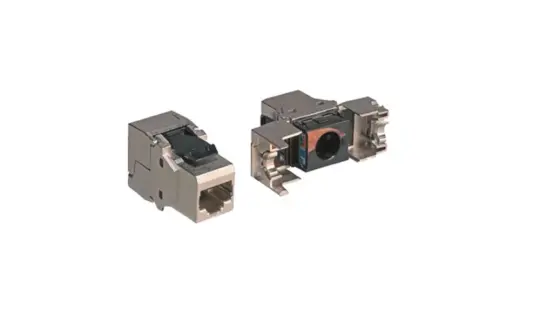
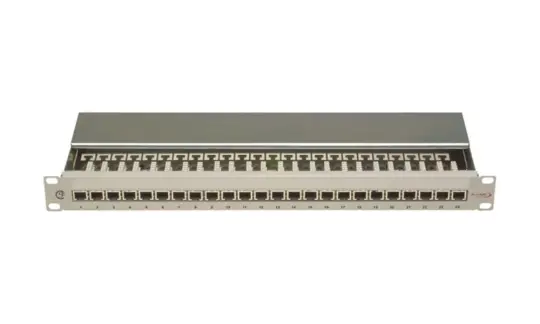
An RJ45 patch panel is a centralized network cable management device installed in a rack cabinet to connect and distribute Ethernet cables from multiple endpoints to a single point. Instead of connecting each cable directly to a switch, the patch panel creates a flexible intermediate layer—allowing network configurations to be changed simply by swapping patch cords without needing to modify the fixed cabling system. Some of HELUKABEL’s products include:
RJ45 CAT.5e / Class D 24-Port Patch Panel
24-Port RJ45 Patch Panel, CAT.6EA, 500 MHz
6.7 RJ45 accessories
Some of HELUKABEL's RJ45 accessories include:
RJ45 Outlet, Class E, 2-Pole, Horizontal
7. FAQs about RJ45 cables and RJ45 connectors
An RJ45 cable is an Ethernet cable fitted with RJ45 (8P8C) connectors at each end, used to connect network devices — computers, switches, routers, IP cameras — over a wired LAN. RJ45 cables come in different categories (Cat5e, Cat6, Cat6A, Cat7, Cat8), with each category supporting higher speeds and bandwidth. The connector and cable category must be matched for optimal performance.
T568A and T568B are two wiring schemes for the 8 conductors inside an RJ45 connector — they differ only in the position of the orange and green pairs (pins 1/2 and 3/6). Both work identically in terms of network performance. T568B is the most common standard in commercial and enterprise environments. The critical rule: both ends of the same cable must use the same wiring scheme (straight-through cable).
For new installations, Cat6 is recommended: it supports 10 Gbps up to 55m, offers 250 MHz bandwidth, and costs only marginally more than Cat5e. Cat5e remains suitable for 1 Gbps networks under 100m. For 10 Gbps at full 100m runs or high-EMI environments, use Cat6A with matching Cat6A plugs and keystone jacks.
Discover the differences between Cat5, Cat6, and Cat7 network cables
A standard RJ45 connector: cable terminates inside the plug body; crimping forces the contacts into the cable conductors. A pass-through (feed-through) connector: cable extends fully through the plug before crimping — allowing visual verification of wire color sequence before crimping. Pass-through connectors reduce wiring errors and are preferred in professional installations and high-volume deployments.