LDPE, HDPE, XLPE, PE Foam — Comparing the properties of PE insulation materials
Article content:
If you’ve read HELU’s article “What Are Insulating Materials? ”, you'll recall that PE (Polyethylene) was mentioned as one of the most common insulation materials for electrical cables. What few people notice, though, is that "PE" is not actually a single material — depending on how it's manufactured, PE can take on at least four distinct forms: LDPE, HDPE, XLPE, and PE foam, each with its own properties and applications in cable construction. Whether you need to choose the right type of PE for a specific application, or you're simply curious why datasheets list different specs under the same "PE insulation" label, this article takes a closer look at each type.
1. Why are there so many variations in PE materials used for cable insulation?
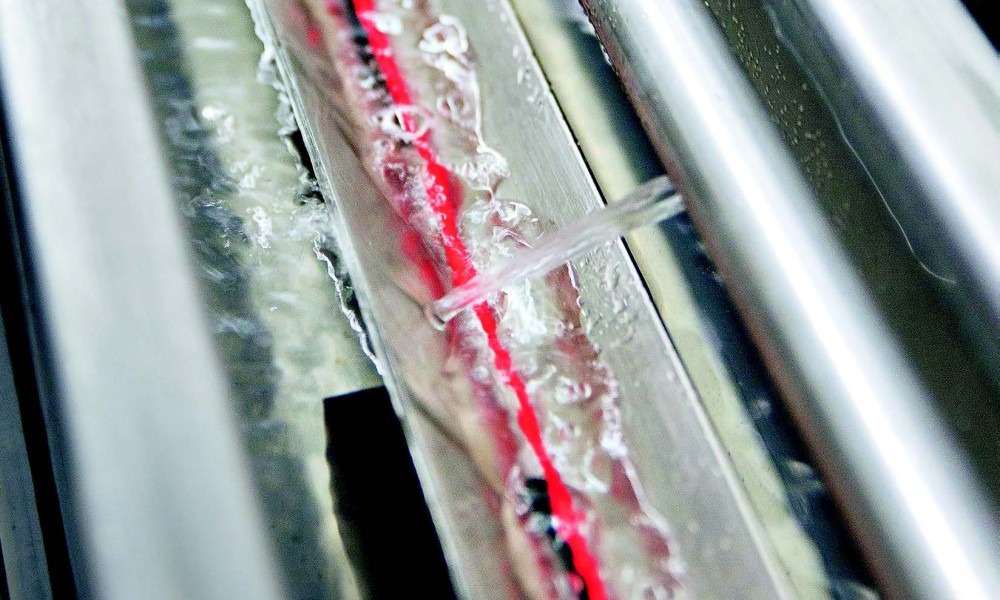
Cable flows through cooling trough filled with water
1.1 Molecular structure determines everything
The key lies in molecular structure. PE is essentially a polymer chain built from repeating ethylene units, but depending on the reaction conditions (pressure, temperature, catalyst), these chains can arrange themselves into neat straight chains or messy branched ones — and this difference is what determines the density, stiffness, and heat resistance of the finished material. PE can also be further processed after extrusion (such as cross-linking to become XLPE or foaming to become PE foam) to gain properties the base PE doesn't have on its own.
1.2 Electrical properties — why PE is so widely used in cables
The whole PE family is popular as cable insulation because of its excellent shared electrical properties: high dielectric strength, low dielectric constant, and a low dissipation factor across all frequency ranges. This is why PE is used to insulate a wide variety of cables — from telephone cables, high-speed data transmission cables, and high-frequency signal cables to control cables, low/medium/high-voltage power cables, overhead line conductors, and service drop cables.
1.3 Fire resistance and mechanical properties
The main drawback of unmodified PE is its poor flame resistance — which can be significantly improved by adding flame-retardant additives (either halogenated or halogen-free). PE can also be compounded with additives to improve UV resistance, weathering resistance, and resistance to chemical degradation. Mechanically, PE is a rigid, abrasion-resistant material, which is why it's commonly used as an outer sheath; where greater flexibility is needed, manufacturers can blend in a small amount of butyl rubber or EPR (ethylene propylene rubber). PE's toughness also makes it well suited for direct-buried cables.
1.4 Operating temperature range
Standard PE typically operates in the range of -65°C to +75°C — but once cross-linked into XLPE (covered in Section 4), this range can extend up to +90°C.
2. Properties and applications of LDPE (Low-Density Polyethylene)
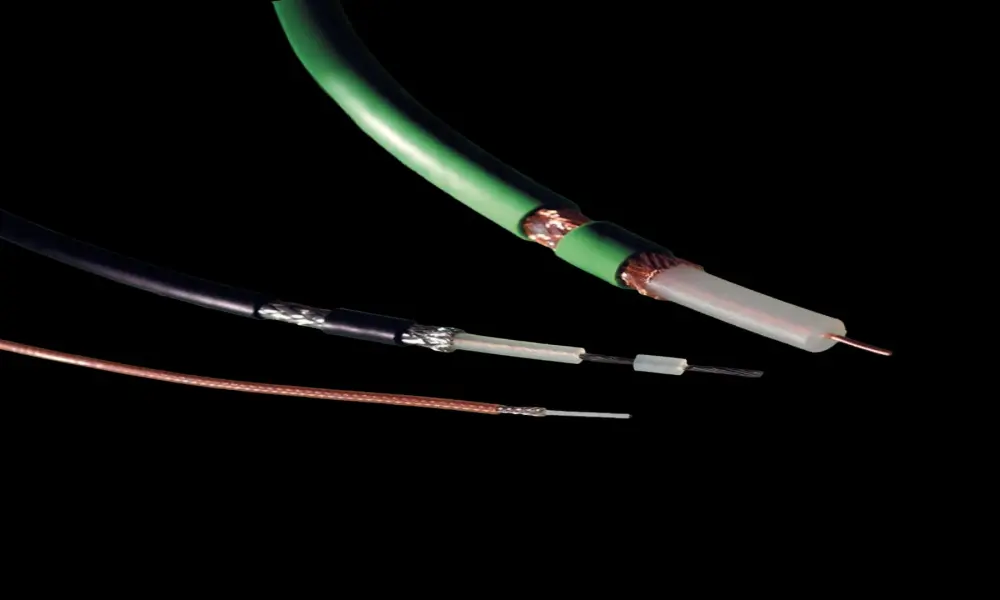
Thanks to its low dielectric constant and good moisture resistance, LDPE is widely used in coaxial cables, Ethernet cables, and other applications...
2.1 Properties of LDPE
LDPE has a density of about 0.92–0.94 g/cm³ and a melting point of around 105–110°C. Structurally, LDPE has a heavily branched molecular chain (both short and long branches), which prevents the polymer chains from packing tightly together the way straight-chain PE does. This is why LDPE is more flexible and more transparent (the clearest of the PE family) but also has lower mechanical strength and heat resistance than the higher-density variants.
LDPE is chosen as an insulation material mainly for two properties: high flexibility (it bends without cracking and is easy to shape) and good chemical resistance (withstanding acids, bases, and oils), along with good moisture resistance — which helps cables last longer in high-humidity environments.
2.2 Applications of LDPE in electrical cables
LDPE is used in many types of electrical cables for a variety of purposes:
- Primary insulation for low-voltage power cables and communication cables (preventing current leakage and keeping signals stable).
- Protective outer sheath against physical damage, moisture, and environmental exposure.
- Coating for signal/communication cables — with a dielectric constant of about 2.3, helping to reduce signal loss.
- Thanks to its low dielectric constant and good moisture resistance, LDPE is also widely used in coaxial cables, Ethernet cables, telephone cables, and even submarine/underwater cables, where durability and moisture resistance are essential requirements.
3. Characteristics of HDPE (High-Density Polyethylene)

In addition to electrical cables, HDPE is also used to make underground cable conduits due to its high tensile strength
3.1 Advantages of HDPE
HDPE has a density of 0.94–0.98 g/cm³ and a much higher melting point than LDPE, around 130°C. Structurally, HDPE has very low branching, with molecular chains that are nearly straight, allowing the polymer chains to pack much more tightly together — which is why the intermolecular forces in HDPE are considerably stronger than in heavily branched PE types like LDPE.
As a result, HDPE has significantly higher tensile strength than LDPE and better heat resistance, but it is also stiffer and less flexible.
3.2 Applications of HDPE insulation materials
HDPE is used in multiple layers within the cable structure:
- Outer sheath against moisture, UV exposure, and mechanical impact.
- Insulation for low/medium-voltage cables thanks to its high dielectric strength.
- For submarine/underwater cables, HDPE offers strong water resistance and can withstand the pressure at depths of up to 3,000 m.
- In telecommunications cables, HDPE provides both insulation and mechanical protection for the transmission core inside.
- HDPE is also used to make underground cable conduits thanks to its high tensile strength.
4. Characteristics of XLPE (Cross-Linked Polyethylene)
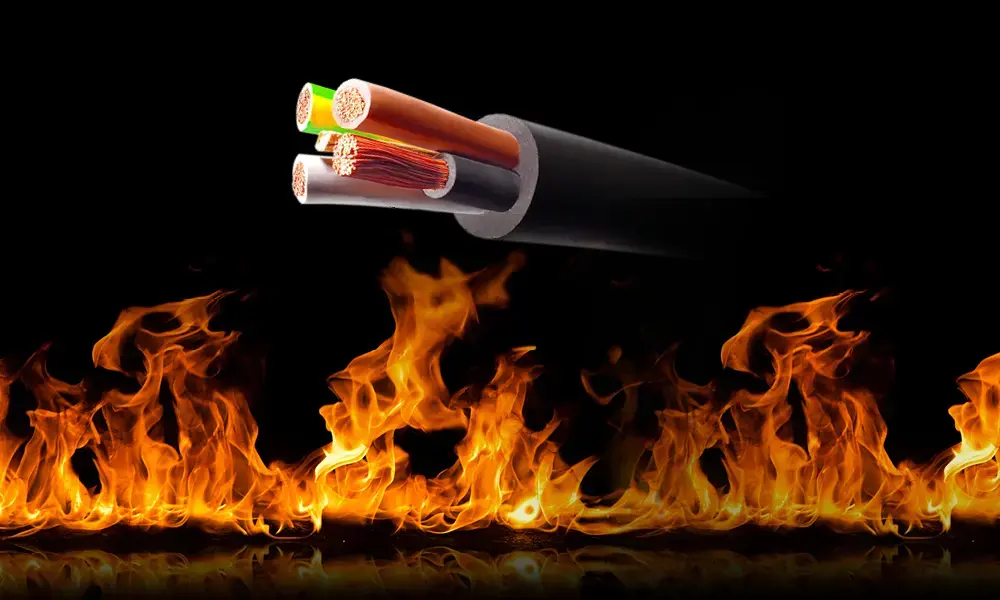
XLPE-insulated cables offer superior heat resistance
4.1 Key advantages of XLPE insulation material
XLPE is polyethylene that has undergone chemical treatment (cross-linking) to improve its properties. The core difference lies in its cross-linked network structure, which gives XLPE far better heat resistance, chemical resistance, and mechanical stress resistance than standard PE — while still maintaining structural integrity even in harsh environments.
Compared to non-cross-linked materials, XLPE has three distinct advantages:
- Higher temperature resistance without quality degradation
- Good chemical resistance (resisting corrosion from oils, acids, etc.), suitable for harsh industrial environments
- Higher mechanical strength (resisting abrasion, impact, and environmental stress), extending cable service life under demanding operating conditions
4.2 Applications of XLPE materials
XLPE power cables are widely used in three main application groups:
- Medium- and high-voltage power cables: thanks to its high heat resistance and strong insulating properties, ensuring safe, efficient power transmission over long distances
- Telecommunications cables: thanks to its resistance to signal interference and stable performance across a range of environmental conditions
- Industrial wiring systems: used for machinery, control systems, and other applications that require both mechanical strength and heat resistance
5. Properties of Foamed PE
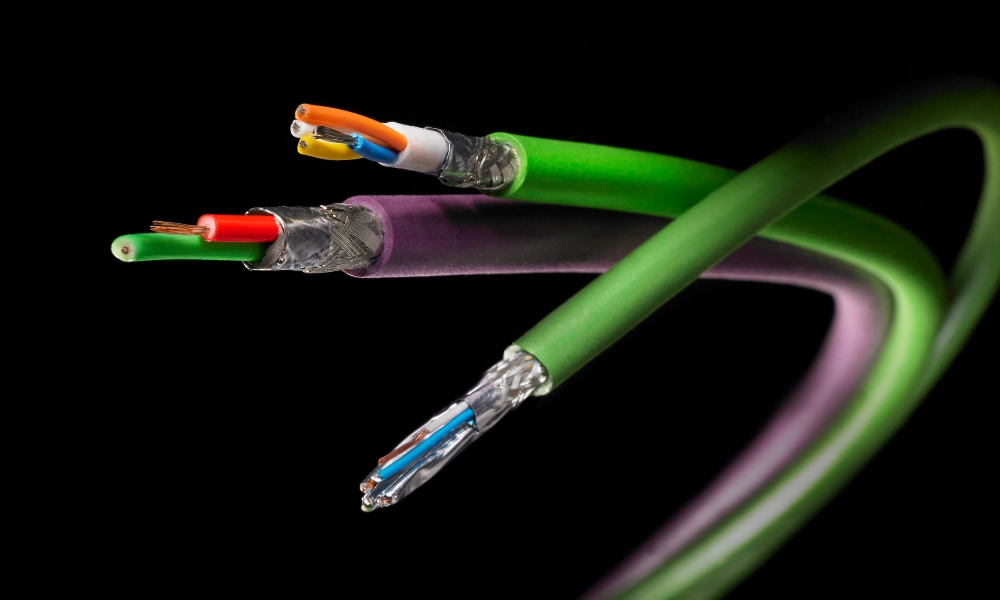
PE foam is commonly used to insulate twisted-pair cables, helping each conductor maintain a stable impedance and minimize crosstalk.
5.1 Characteristics of PE foam insulation material
PE foam is a dielectric insulation material produced by injecting gas into molten PE to form a uniform cellular structure. Compared with solid PE, PE foam contains countless microscopic air pockets, which significantly reduce both its density and its dielectric constant.
This foamed structure allows signals to travel with minimal loss, delivering better electrical performance while retaining good mechanical flexibility. In Ethernet cables, PE foam is commonly used to insulate twisted pairs, helping each conductor maintain a stable impedance and minimizing crosstalk during data transmission.
Another practical benefit: because the trapped air lowers the dielectric constant, foamed insulation can be made thinner while still achieving electrical performance equivalent to solid insulation — useful for space-constrained applications.
5.2 Applications
A lower dielectric constant means lower signal loss and higher transmission speeds — which is why PE foam is commonly used as insulation for:
- Coaxial cables such as RG-6 and RG-11 (used in cable TV and satellite systems) are valued for their low attenuation at high frequencies.
- Ethernet cables , which carry high-frequency electrical signals that are highly sensitive to impedance, capacitance, and external interference — so the insulation around each conductor directly affects signal transmission quality. Solid PE is durable but has a relatively high dielectric constant, which tends to increase latency and signal loss; PE foam strikes a balance between insulation durability and electrical performance, helping Ethernet cables achieve longer transmission distances, higher frequencies, and more stable bandwidth.
- Bus cables : PE foam insulation keeps a fixed distance between conductors, while its dielectric constant is closer to that of air than solid plastic. If ordinary solid insulation were used instead, the cable would fail to meet bus cable specifications.
6. Comparison Table: LDPE vs HDPE vs XLPE vs Foamed PE
| Specifications | LDPE | HDPE | XLPE (VPE) | PE Foam (O2Y) |
| Density (g/cm³) | 0.92–0.94 | 0.94–0.98 | 0.92 | ≈0.65 |
| Dielectric strength (kV/mm, 20°C) | 70 | 85 | 50 | 30 |
| Volume resistivity (Ω·cm, 20°C) | 10¹⁷ | 10¹⁷ | 10¹²–10¹⁶ | 10¹⁷ |
| Dielectric constant (50Hz, 20°C) | 2.3 | 2.3 | 4–6 | ≈1.55 |
| Dissipation factor tan δ | 2×10⁻⁴ | 3×10⁻⁴ | 2×10⁻³ | 5×10⁻⁴ |
| Continuous operating temperature (°C) | -50 to +70 | -50 to +100 | -35 to +90 | -40 to +70 |
| Short-term temperature (°C) | +100 | +120 | +100 | +100 |
| Melting temperature (°C) | 105–110 | 130 | – | 105 |
| Fire resistance | Flammable | Flammable | Flammable | Flammable |
| Limiting Oxygen Index, LOI (%O2) | ≤22 | ≤22 | ≤22 | 18–30 |
| Calorific value H0 (MJ/kg) | 42–44 | 42–44 | 42–44 | 42–44 |
| Thermal conductivity (W/(K·m)) | 0.3 | 0.4 | 0.3 | 0.25 |
| Corrosive gases when burned | No | No | No | No |
| Max. radiation resistance (Mrad) | 100 | 100 | 100 | 100 |
| Tensile strength (N/mm²) | 10–20 | 20–30 | 12.5–20 | 8–12 |
| Elongation at break (%) | 400–600 | 500–1,000 | 300–400 | 350–450 |
| Shore hardness | 43–50 (D) | 60–63 (D) | 40–45 (D) | – |
| Abrasion resistance | Medium | Good | Medium | – |
| Water absorption (%) | 0.1 | 0.1 | 0.1 | – |
| Weathering resistance | Medium (better with black compound) | Medium (better with black compound) | Good | – |
| Cold resistance | Good | Good | Good | Good |
7. HELU's cable range by PE insulation type
7.1 XLPE cable range
- Low-voltage cables: N2XY ( 32850), N2XCY ( 33212), NA2XY ( 33113)
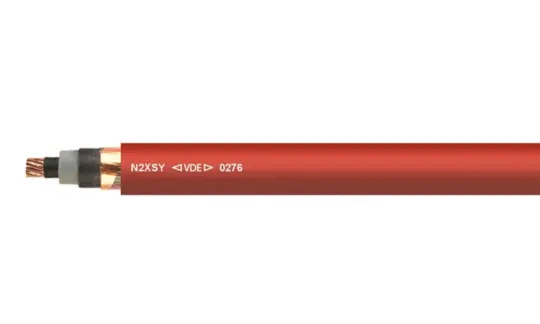
- Medium-voltage cables: NA2XS(F)2Y ( 32600), N2XS2Y ( 32480), N2XSY ( 32400)…
- Instrument cable: HELUDATA® PLTC UL13 XLPE/LS0H OS 300 ( 11018400), HELUDATA® EN-50288-7 FIRE RES OSA 500 ( 11016406), HELUDATA® EN-50288-7 XLPE/PVC IOSA 500 ( 11013113)
7.2 Foamed PE cable range
- Ethernet cables: HELUKAT® 600S CAT.7 SF/FTP PUR CHAIN ( 805614), HELUKAT® 600 CAT.7e S/FTP FRNC STATIC ( 80810), HELUKAT® 600IND CAT.7 S/FTP FRNC SHIPLINE ( 11021853), HELUKAT® 500IND CAT.6A SK S/FTP PVC STATIC ( 803693), HELUKAT® 100T CAT.5e S/UTP PUR TORSION ( 802186), HELUKABEL® EtherCAT-P100S-M CAT.5e SF/UTP PUR CHAIN ( 11007523), HELUKAT® SPE Type C 1000BASE-T1 THICK SF/UTP PUR CHAIN ( 11018068)
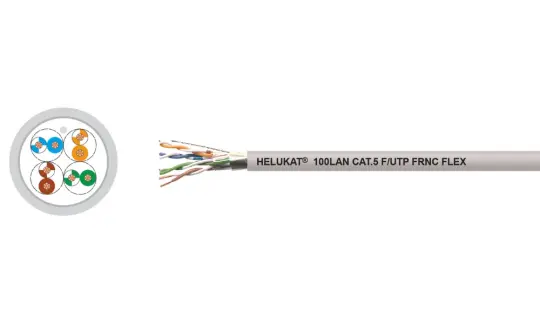
- LAN cables: HELUKAT® 100 CAT.5 F/UTP FRNC FLEX ( 81278), HELUKAT® 200 CAT.5e SF/UTP FRNC STATIC ( 81123), HELUKAT® 600LAN CAT.7e S/FTP FRNC STATIC ( 80810)
- Coaxial cable: COAXIAL CABLE RG 213 U LL PVC black ( 400168), SAT/BK COAXIAL CABLE A+ ( 400197), SAT COAXIAL CABLE black 1.13/5.0 ( 40021)
- Bus cables: Profibus SK PUR Drag Chain ( 801659), CAN-Bus 0.5 mm² 1-Pair PUR Chain ( 805685)
- Audio cables: HELUSOUND® AES/EBU DMX SC BLUE ( 400031), HELUSOUND® AES/EBU DMX SC BLACK ( 400032), HELUSOUND® DMX + POWER ( 400151), HELUSOUND® AUDIO CABLE DIGITAL TP PVC ( 400025)
7.3 Other HELU PE cable lines
Servo motor cables: TOPFLEX®-EMV-2YSLCY-J (22084), TOPFLEX® 600 VFD (63139), TOPSERV® 600 VFD (62607)
Data cables: PAAR-TRONIC-Li-2YCYv (21129), DATAFLAMM®-C (52365), RE-2Y(St)Yv (20099), HELUDATA® UL 2919 PVC-TP GREY (18024379)
8. Frequently Asked Questions (FAQ)
The core difference lies in molecular structure: LDPE has a heavily branched chain, making it flexible but less durable, while HDPE has a nearly straight chain, making it stiffer with better strength and heat resistance (density of 0.92–0.94 g/cm³ versus 0.94–0.98 g/cm³).
Because the air pockets in PE foam lower the insulation's effective dielectric constant (≈1.55 versus ~2.3 for solid PE), reducing signal loss and increasing transmission speed.
PE Foam has the lowest dielectric constant of the four types (≈1.55, compared with 2.3 for LDPE/HDPE and 4–6 for XLPE) — which is why PE foam is widely used in Cat6a-and-above Ethernet cables and bus cables, where maintaining stable impedance and reducing crosstalk are essential.
XLPE withstands a higher continuous operating temperature (90°C versus 70–80°C for PE), offers better resistance to electrical treeing and water treeing, and has longer-lasting mechanical strength. As a result, XLPE delivers greater reliability and higher current-carrying capacity in cable systems operating under demanding conditions, up to the 35 kV voltage class.