PAAR-TRONIC-CY shielded cable: Constructions & applications
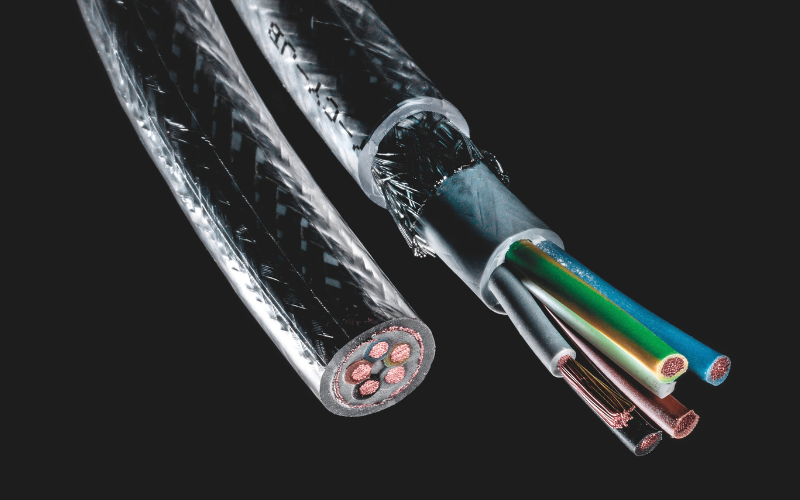
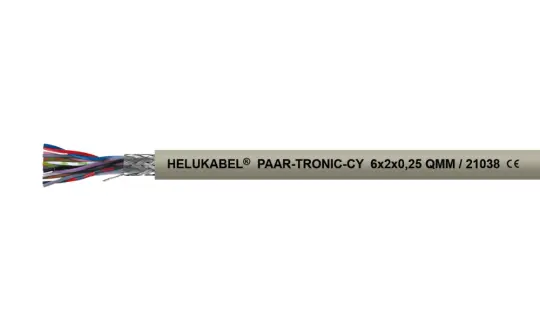
PAAR-TRONIC-CY is a PVC data cable manufactured by HELU, consisting of copper conductors twisted into pairs, wrapped in a metal foil shield with a ground wire and a tin-plated copper braid providing approximately 85% coverage. The twisted-pair structure combined with the double shielding ensures stable transmission of control and measurement signals in environments with high levels of electromagnetic interference, even when run parallel to other cables.

Article content:

1. What does PAAR-TRONIC-CY mean?
| Designation | Meaning |
| PAAR | In German, it means "pair"—the cores are twisted into pairs |
| TRONIC | HELU's line of signal and data cables |
| C | Braided copper shielding layer |
| Y | PVC outer sheath |
The cable is designed in accordance with the DIN VDE 0812 standard for PVC data cables.
2. Construction of the PAAR-TRONIC-CY cable
The PAAR-TRONIC-CY shielded cable consists of:
- Conductor: bare copper, finely stranded in accordance with DIN VDE 0295 Class 5
- Insulation: PVC in accordance with DIN VDE 0207-363-3.
- Twisted pairs: two conductors are twisted into a pair with an optimal lay lenghth; different lay lengths per pair reduce crosstalk.
- Foil wrapping over the stranded pairs
- Drain wire: tinned copper – used to ground the shield.
- Screen: braided tinned copper wire, providing approximately 85% coverage.
- Outer sheath: Grey PVC (RAL 7032), with length markings in meters.
3. Why does the PAAR-TRONIC-CY cable offer good EMC protection?
The cable series’ ability to resist interference, particularly crosstalk, is due to:
3.1 Twisted pairs
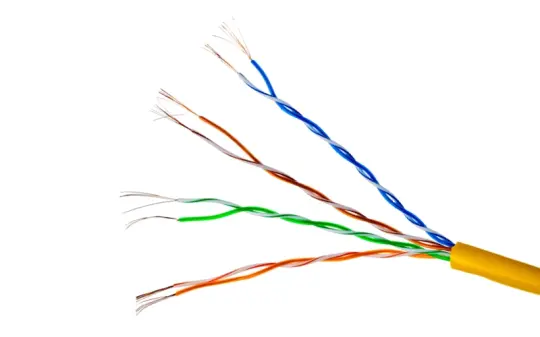
The inner cable cores of the PAAR-TRONIC-CY are twisted in pairs, which reduces the electromagnetic radiation generated from the two cables themselves. Besides, the signals of the two wires will be in opposite phase, limiting the possibility of signal interference, while also helping to reduce crosstalk between the two pairs of wires and improving the ability to eliminate electromagnetic interference from the outside. The design of twisting the cores together also increases the flexibility of the cores as well as the cable as a whole.
3.2 Optimal lay-length
The cores of PAAR-TRONIC-CY anti-interference signal cable are twisted with an optimal lay-length, helping to increase the anti-interference ability between wires and twisted pairs.
3.3 Tinned drain wire
The design with tin-plated interference conductor brings many positive effects in limiting interference when operating such as:
- Electromagnetic interference elimination: The drain wire is made from tin-plated copper, which is connected to an anti-interference layer that conducts the interference signals running around the wire to the ground, increasing the cable's resistance to interference.
- Effective earthing solutions: During machine operation, it is inevitable that residual charges will be generated. This tinned drain wire is also capable as an earthing wire, helping to transmit the residual charges from the device to the ground, ensuring user safety.
4. Technical specifications of the PAAR-TRONIC-CY cable
| Specifications | Value |
| Cross-section | 0.14 – 0.25 – 0.34 – 0.5 – 0.75 – 1.0 – 1.5 mm² |
| Number of pairs | From 1 to 61 pairs |
| Temperature – Flexible | -5°C to +80°C |
| Temperature – Fixed | -30°C to +80°C |
| Peak operating voltage | 350 V (not for use in power circuits) |
| Core-to-core test voltage | 1,200 V |
| Test voltage for core/screen | 800 V |
| Breakdown voltage | 2,400 V |
| Core-to-core capacitance (800 Hz) | ~100 pF/m (0.14–0.25 mm²) · ~150 pF/m (0.34–1.5 mm²) |
| Core/screen capacitance (800 Hz) | ~240 pF/m (0.14 mm²) · ~270 pF/m (0.25 mm²) |
| Minimum bending radius | Flexible: 10 × outer diameter · Fixed: 5 × outer diameter |
See the PAAR-TRONIC-CY cable data sheet for other technical specifications
5. When to use and when not to use PAAR-TRONIC-CY cables
5.1 Applications of the cable
With its excellent EMC protection, the PAAR-TRONIC-CY is suitable for use in the following applications:
- Measurement and control: Connecting sensors, transducers, and measuring devices to PLCs and controllers.
- Differential signals and serial communication such as RS422/RS485 over short distances – See the RS485 cable catalog for more information .
- Electrical cabinets and large machinery where signal cables must be routed in the same cable tray as power cables and inverters.
- Electronic devices and industrial computers require stable data transmission.
Installation requirements: flexible application, free movement, no tensile forces or forced movement; suitable for use in dry, damp, and wet environments.
5.2 Situations in which PAAR-TRONIC-CY should not be used and alternative solutions
PAAR-TRONIC-CY cables are not suitable for use in the following situations:
| Scenario | You should choose |
| Outdoor installation, UV exposure |
PAAR-TRONIC-Li-2YCYv (UV-resistant) |
| Continuous motion in cable chains and robots |
SUPER-PAAR-TRONIC-340-C-PUR
|
| Long-range transmission, low capacitance required |
PAAR-TRONIC-Li-2YCY
(PE insulation) |
| Each pair should have its own screen | PAAR-TRONIC-CY-CY |
| Halogen-free area required |
DATAFLAMM-C-PAAR
|
| Power transmission | Do not use—peak voltage is only 350 V |
👉 See the full comparison of the 11 variants
PAAR-TRONIC cable series: Comparing variants and how to choose
6. FAQs
PAAR-TRONIC-CY features twisted-pair conductors with additional shielding and ground wires, making it suitable for differential signals and high-noise environments. TRONIC-CY features single-layer twisted conductors, making it suitable for multi-conductor control signals.
Flame-retardant in accordance with IEC 60332-1-2—the flame does not spread along a cable. Fire-resistant cables maintain electrical continuity in the event of a fire.
Approximately 78 Ω. For a system requiring a 120 Ω impedance, you should select a dedicated bus cable from the RS485 cable catalog .
No. For outdoor applications, use the PAAR-TRONIC-Li-2YCYv with a UV-resistant property.
-5°C to +80°C for flexible installation, -30°C to +80°C for fixed installation.