How do I choose the right conductor material for cables and wires?
Copper, aluminium, or fibre optics? Find out which conductor material is best suited for cables and wires and what you should look out for when making your choice.
Article content
The conductor material is the heart of a cable or wire. It forms the core and ensures efficient transmission of energy, signals, or data. Depending on the area of application, the right choice is crucial for the reliability, service life, and performance of a cable.
Theoretically, many materials come into question. In practice, however, copper and aluminium are the most commonly used conductor materials. There are good reasons for this: both metals have high electrical conductivity as well as different advantages and disadvantages. Optical fibres (fibre optics) have also become an indispensable part of modern data transmission.
In this article, we explain which properties distinguish a good conductor material and which factors play a role in the selection.
1. Overview of conductor materials
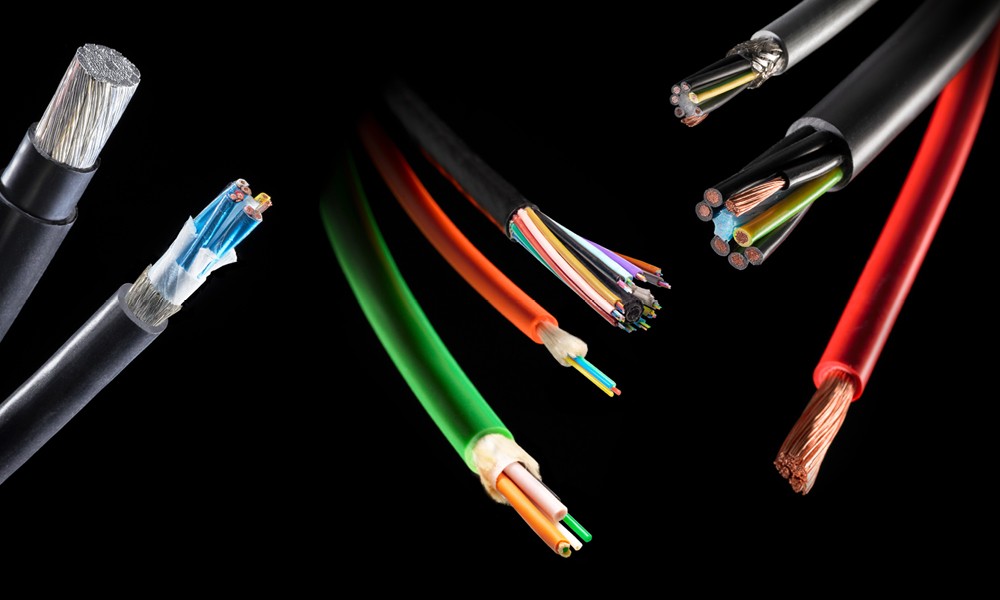
There are many different types of conductive materials, such as copper, aluminum, and optical fiber...
1.1 What are conductor materials?
Electrical conductors are materials that contain free electrons or free ions capable of conducting electric current when an electric field is applied. A material’s ability to allow electric current to pass through it is called electrical conductivity. In contrast to conductors are insulators, which are materials that have almost no or very few free electrons, preventing electric current from passing through them.
The electrical conductivity of a material depends on:
- Atomic structure
- Ambient temperature
- Impurities present in the material
- And other external factors.
Metals such as silver and copper are excellent conductors of electricity because they have many free electrons, which allow electric current to flow easily. In contrast, nonmetals such as rubber and glass have very few free electrons and therefore do not conduct electricity; they are often used as insulating materials.
In addition, there is a group of materials with electrical conductivity that falls between that of conductors and insulators, known as semiconductors. Semiconductors play a very important role in the electronics and computer technology industries.
1.2 The differences between conductor and insulation materials
Insulators are materials that prevent free electrons from moving from one atom to another within the same element. When an electric charge is applied to any point on an insulator, the charge does not spread across the entire surface but remains concentrated at the point of application.
| Criteria | Conductor | Insulator |
| Electrical or thermal conductivity | A material that allows electricity or heat to pass through easily | A material that does not allow the passage of electricity or heat |
| A typical example | Silver, aluminum, iron | Paper, wood, rubber |
| The movement of electrons | Electrons move freely within the material | Electrons do not move freely within the material |
| Electric field | The electric field exists on the surface but is zero inside the material | The electric field is virtually nonexistent in the material |
>>Learn more: Characteristics of insulation materials and common types of insulation materials
2. Properties of conductor materials
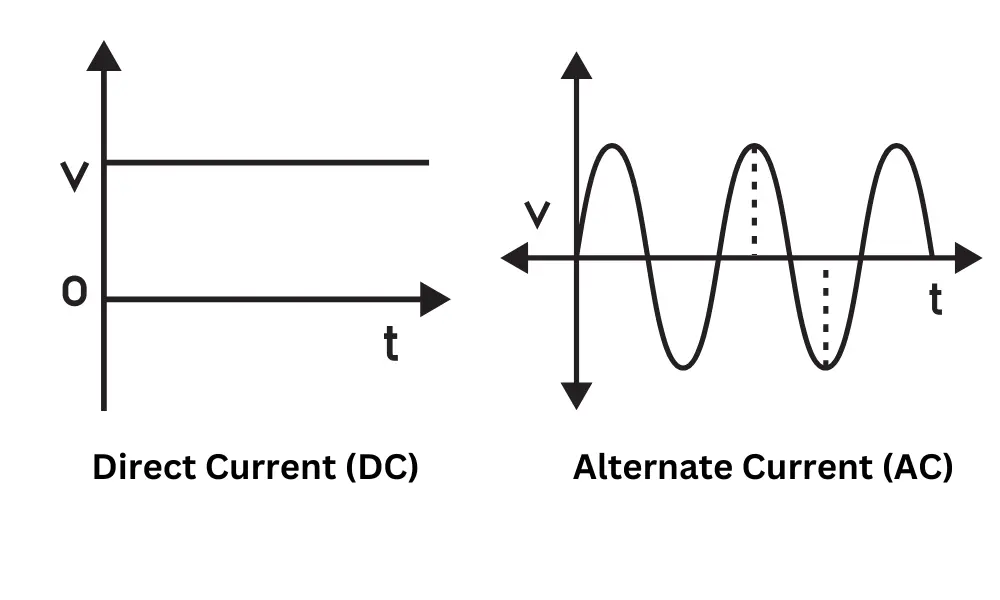
Conductor materials allow electric current to flow easily due to the presence of free electrons. In addition to their ability to conduct electricity, conductive materials possess many unique physical properties that you should understand before selecting them for industrial or residential applications.
2.1 Resistance – A factor contributing to energy loss
Resistance is a quantity that indicates the degree to which a conductor impedes the flow of electric current. This value depends on:
- Resistivity of materials – an intrinsic property of each type of metal
- Length of the cable
- Cross-section
- Ambient temperature
Conductors such as copper and aluminum typically have low electrical resistance, allowing electric current to flow easily. However, resistance still generates a certain amount of heat when current flows through it—a phenomenon known as Joule heating or ohmic heating.
2.2 Inductance – The presence of a magnetic field
When the current in a conductor changes, it generates a magnetic field around it, causing electromagnetic induction. Self-inductance depends on:
- Shape and size of the conductor
- Wiring Diagrams and Instructions
This phenomenon generates an electromotive force opposite to the original current, known as self-inductance or mutual inductance when it occurs between two conductors in close proximity. Self-inductance affects the efficiency of power transmission, particularly in alternating current (AC) systems.
2.3 The charge density inside a conductor is zero
In an ideal conductor, free charges do not exist inside the material but are distributed only on its surface. The reason is that electrostatic repulsive forces drive the charges out of the core, causing:
- The conductor has no charge
- The surface becomes the only place where free charges exist
2.4 Electric charges exist only on the surface of conductors
All free charges will be pushed to the surface of the conductor and distributed uniformly based on:
- Shape, size, and material
- The magnitude and direction of the external electric field
- This feature helps optimize signal transmission and protect the system from electrical interference.
2.5 The electric field at the surface is always perpendicular to the surface
The electric field at the surface of a conductive material is always perpendicular (at a 90° angle) to the contact surface. If a parallel component exists, the electrons will move to cancel it out, ensuring that the electric field has only a perpendicular component.
This helps keep the conductive surface stable and uniform, preventing uneven charge buildup that could cause electrical discharge.
4. Characteristics of a good conductor
The conductor material determines how efficiently a cable can transmit electrical energy, signals, or data. Simply put, the higher the conductivity, the lower the electrical resistance and the lower the energy loss during transmission.
But other properties also play an important role in the selection of the right conductor material:
- Mechanical strength
- Flexibility
- Weight
- Cost
Depending on where the cable is used and the application, these factors can be weighted to varying degrees, for example, in moving applications, long cable routes, or particularly high current loads.
5. Advantages and disadvantages of various types of conductor materials
5.1 Copper – the standard material for conductor materials
Electrical cables used to transmit power, signals, or data can be made from a variety of conductive materials. One of the most well-known and widely used materials is copper (Cu). This metal has very high electrical conductivity and low electrical resistance, which makes it highly effective for transmitting electrical current.
In addition, copper has many notable advantages:
- Mechanical strength: Copper has high ductility and toughness, which makes it easy to deform without breaking even under mechanical stress. This property enables the production of both solid and highly flexible conductors and contributes to the high bending and fatigue strength of cables and wires.
- High temperature resistance: Copper can withstand high temperatures without losing its mechanical and electrical properties.
- Flexibility: Copper is a relatively soft metal and can be used and processed in a variety of ways.
- Sustainability: Copper can be recycled and reused several times.
Because of these properties, copper is suited for a wide range of applications in industry, building technology, mobility, or energy supply. For special applications, copper cables can also be tinned, nickel-plated or silver-plated. This allows individual properties to be specifically adapted to the respective requirements.
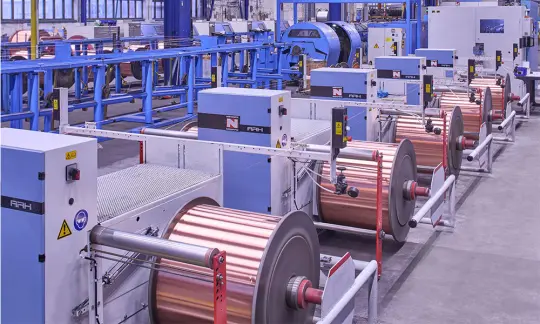
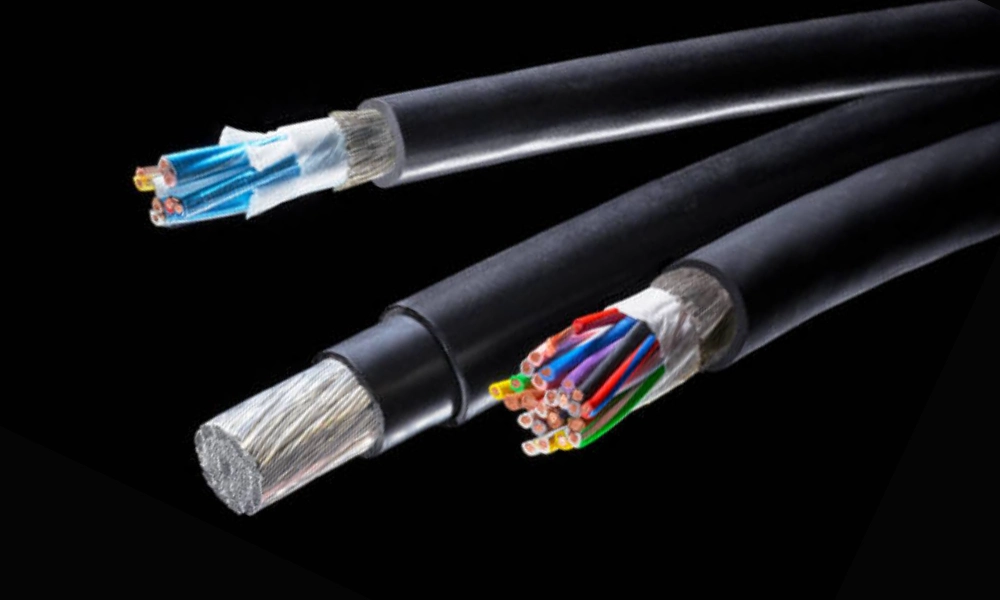
Aluminum is the second most common electrical conductor after copper
5.2 Aluminium—light and economical
Aluminium is the second most common conductor material after copper. Compared to copper, aluminium only has a conductivity of about 63 percent. Nevertheless, aluminium offers two main advantages.
- Weight: Aluminum is about 30% lighter than copper.
- Cost: Aluminum is significantly less expensive than copper.
For these reasons, aluminium is often used when weight and material costs play a particularly important role. Often, for example, in the energy sector, in long power lines, or in medium-voltage cables. Since the conductivity is lower, larger cross-sections (cross-section factor approx. 1.6) must be used to achieve the same current-carrying capacity.
However, aluminum also has some limitations:
- Brittle than copper
- More susceptible to corrosion
- Lower mechanical strength
Therefore, the use of aluminum cables requires appropriate installation techniques, connection technology, and specialized tools.
5.3 Silver, gold, or steel: Can they be used as conductor materials?
- Silver: Silver has the highest electrical conductivity of all metals. However, it is very expensive: the cost is many times higher than copper. For this reason, silver is usually only used for special applications where special performance and efficiency are required, such as in the high-end audio sector. Often, silver is not used as a solid conductor, but as a coating on copper conductors. Silver-plated copper conductors also exhibit impressively high conductivity and corrosion resistance.
- Gold: Gold is rarely used as a conductor material. In addition to its very high cost, gold’s electrical conductivity is also lower than that of silver and copper.
- Steel also has a significantly lower conductivity compared to copper or aluminium, which is why it is not very suitable as a conductor material at first glance. But steel has other advantages: It is an extremely strong and tensile material. This is why steel is used in military applications and aerospace, for example, often in combination with other materials such as aluminium.
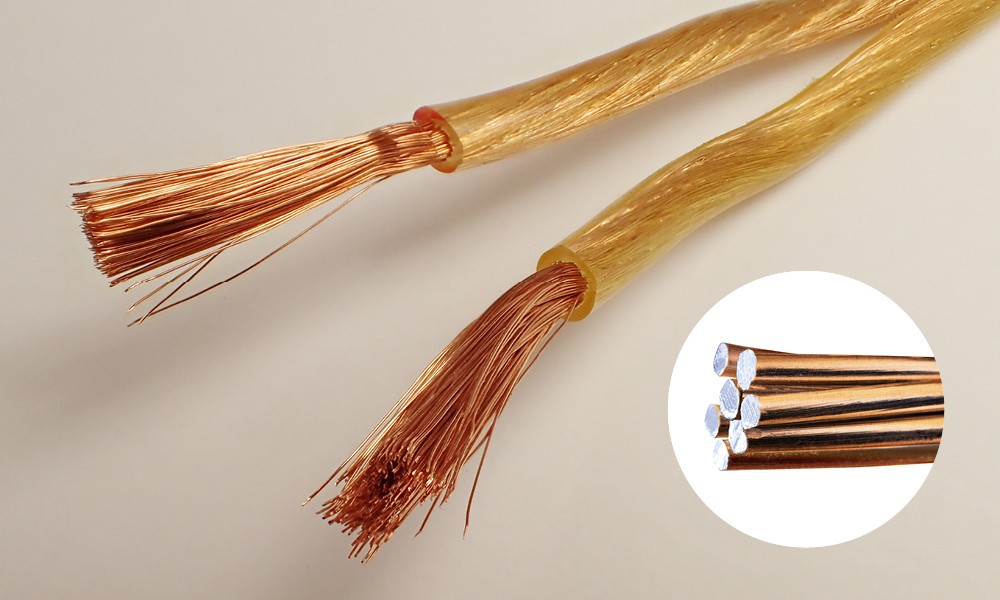
CCA cable consists of an aluminum core covered with a thin layer of copper on the surface (copper-clad).
5.4 CCA – Copper-clad aluminum: A compromise solution?
CCA stands for Copper-Clad Aluminum. This type of conductor consists of an inner aluminum core and a thin outer layer of copper.
Originally, this technology comes from antenna manufacturing. There, it was developed as a cost-effective alternative to high-frequency lines. The reason for this lies in the so-called skin effect, whereby at high frequencies (>/= 10 kHz), the current flows predominantly on the surface of the conductor.
In the electricity sector, however, CCA should be viewed critically, as the conductivity is significantly lower than that of pure copper. Nevertheless, CCA cables are increasingly being offered in the low-price segment, especially by Asian manufacturers.
Some common applications:
- Speaker cable
- Power cables for car hi-fi
- Network cable (patch cables)
Limitations that are often overlooked:
- A 2.5 mm² CCA wire is only equivalent to a 1.5 mm² copper wire
- Higher voltage drop and increased heat generation when using “Power over Ethernet” (PoE)
- There is a risk of fire in the car audio system if proper protection is not in place
- Does not meet the standards for use in enterprise networks (prohibited by TIA and IEC)
5.5 Fiber-optic cables: High-speed data transmission
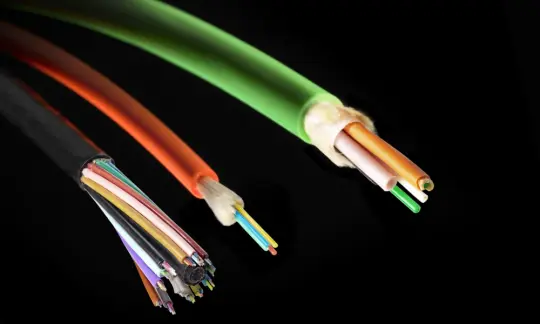
In addition to metallic conductors, there is another technology for signal transmission in the form of optical fibres. Here, information is not transmitted as an electric current, but as optical signals in the form of light pulses.
Fiber optic cables are made of very thin glass or plastic fibers and offer many advantages:
- Extremely high transmission speed, low signal loss
- Long-range transmission
- Not susceptible to electromagnetic interference
- Galvanic isolation
As a result, fiber-optic cables are widely used in telecommunications, data networks, healthcare, and aerospace. However, fiber optic cables are not suitable for transmitting electrical power.
6. Factors to consider when selecting conductor materials for cables and wires
The question of the "best" conductor material cannot be answered so easily, as it always depends on finding the right solution for the different factors of the application.
The optimal choice should be based on:
- Respective applications
- Operating conditions
- Ambient temperature
- The effects of chemical loads
- Mechanical stress
- Electromagnetic interference
In addition to the conductor material, other features of the cables are also very important:
- Conductor structure
- Conductor cross-sectional area
- Stranding
- Insulation materials
- Screening
- Outer sheath material
The interplay of factors determines whether a cable or wire reliably meets the requirements of an application in the long term.
Therefore, when selecting cables and wires , it is best to consult with a technical expert to ensure that the chosen solution meets all practical requirements reliably, safely, and economically.
If you still have questions, don’t hesitate to contact the HELU Vietnam engineering team for detailed answers.
HELU Vietnam Contact Information
| HELU Vietnam 905 Nguyen Kiem Street, Hanh Thong Ward, Ho Chi Minh City, 700000, Vietnam | Phone:
+84 28 77755578 Email: info@helukabel.com.vn | Connect with us on |
| Order through our online channels: Tiki | Shopee | Lazada | Product Finder | ||