How to assess electrical cable quality before purchase & use?
When selecting electrical cables, many people often pay attention to the selling price, cross-sectional area, or appearance of the product. However, these are not enough to determine whether a cable is of good quality or suitable for an electrical system. To make the right choice, cables should be checked based on multiple criteria, from technical specifications to actual product quality.
1. Why is it necessary to check and assess electrical cable quality?
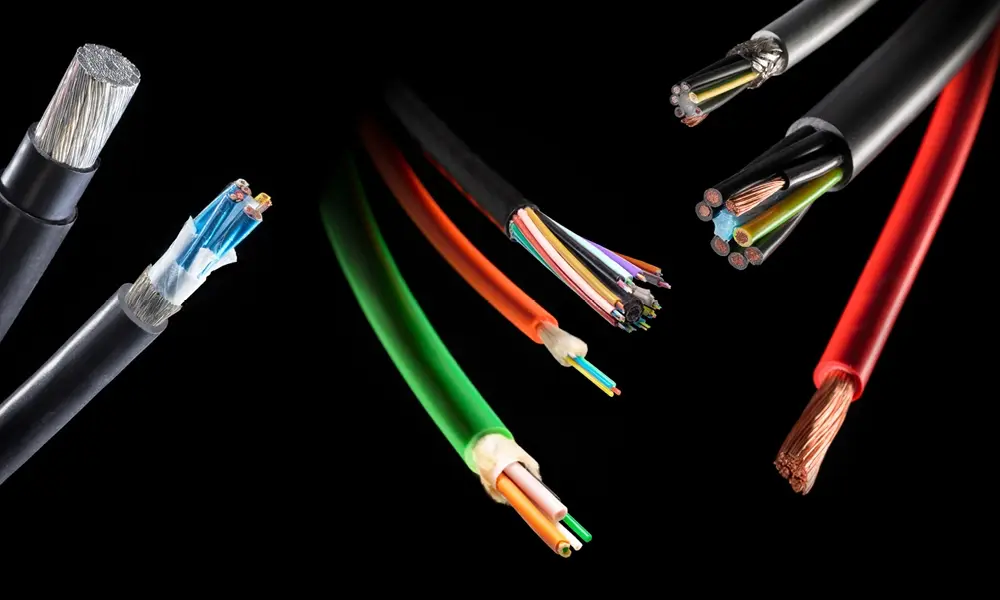
Electric cables are an important part of power transmission and distribution systems. The quality of electrical cables affects the conductivity, safety, and stability of the system throughout its service life. If an unsuitable or non-compliant cable is selected, several problems may arise, such as:
- The conductor has high resistance, increasing power loss and heat generation.
- The conductor cross-sectional area is not suitable for the load.
- The insulation layer is degraded or does not have sufficient voltage withstand capability.
- The cable sheath is prone to cracking, abrasion, or damage in the operating environment.
- The cable does not meet requirements for temperature, oil, water, UV exposure, or mechanical impact.
- Increased maintenance, repair, and replacement costs in the long term.
In particular, for projects where electrical cables are installed inside walls, ceilings, cable trays, conduits, or underground, replacement after completion can be complicated and costly. Therefore, checking the cable before purchase can help reduce risks from the outset.
2. Determine the correct technical requirements before purchasing electrical cables
Each electrical system has different usage requirements, so identifying the required technical specifications and suitable application is an important step when selecting electrical cables.
2.1. Determine the basic specifications of the electrical cable
The first step before ordering an electrical cable is to establish a clear technical specification as a common reference for the supplier and inspection team to compare the product. Some minimum technical specifications to determine include:
- Conductor material
- Nominal cross-sectional area
- Conductor class
- Number of cores
- Insulation and sheath material
- Rated voltage
- Core or cable identification color
- Applicable standard (IEC, EN, BS, UL, or another appropriate standard)
- Cable length per drum/reel
If the cable has a special construction, additional requirements for armor, shielding, or other protective layers should be specified.
2.2. Determine the installation conditions
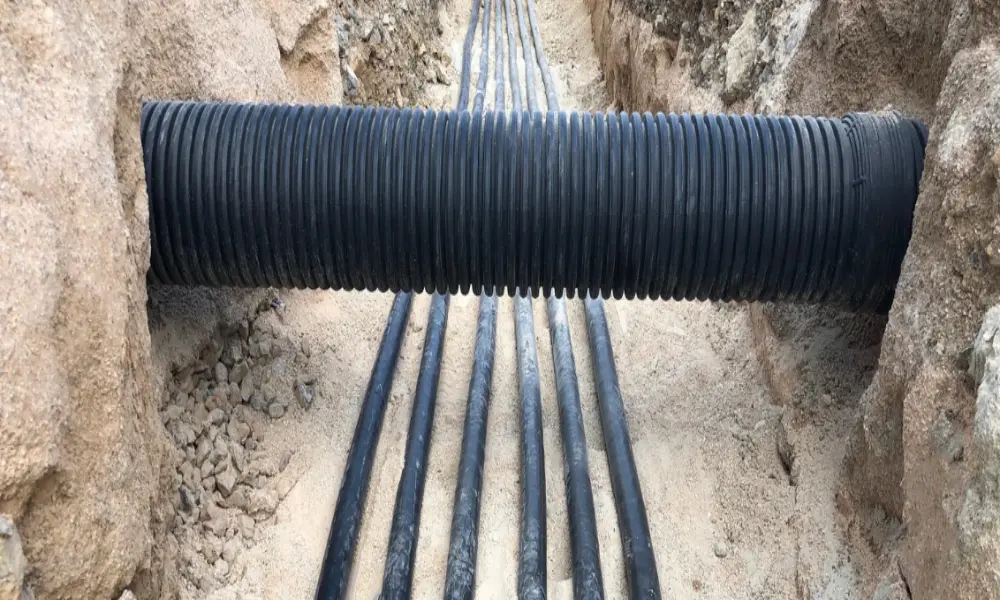
In addition to construction specifications, you also need to determine the actual installation conditions to identify the right type of electrical cable to purchase:
- Installed indoors or outdoors
- Installed in conduits or cable trays
- Buried underground or installed in technical systems
- Installed permanently or subject to frequent movement
- Used in environments with oil, water, chemicals, or UV exposure
- Operated at high temperatures or in conditions with vibration
In addition, for long cable routes or high loads, you should also consider the current-carrying capacity, voltage drop, and short-circuit withstand capability of the electrical cable.
3. Check product information and origin
Once the technical specifications have been determined, the next step is to verify the product and supplier.
3.1. Check the marking on the cable
The information printed or marked on the cable should be clear, easy to read, and traceable against the product documentation. Depending on the cable type, the marking may include:
- Manufacturer’s name or brand
- Product code or designation
- Rated voltage
- Number of cores and cross-sectional areas
- Applicable standard
- Approval or certification information, if any
- Production batch or product identification information
If you need to check the product before purchase, you can ask the supplier to provide a cable sample for comparison with the information above.
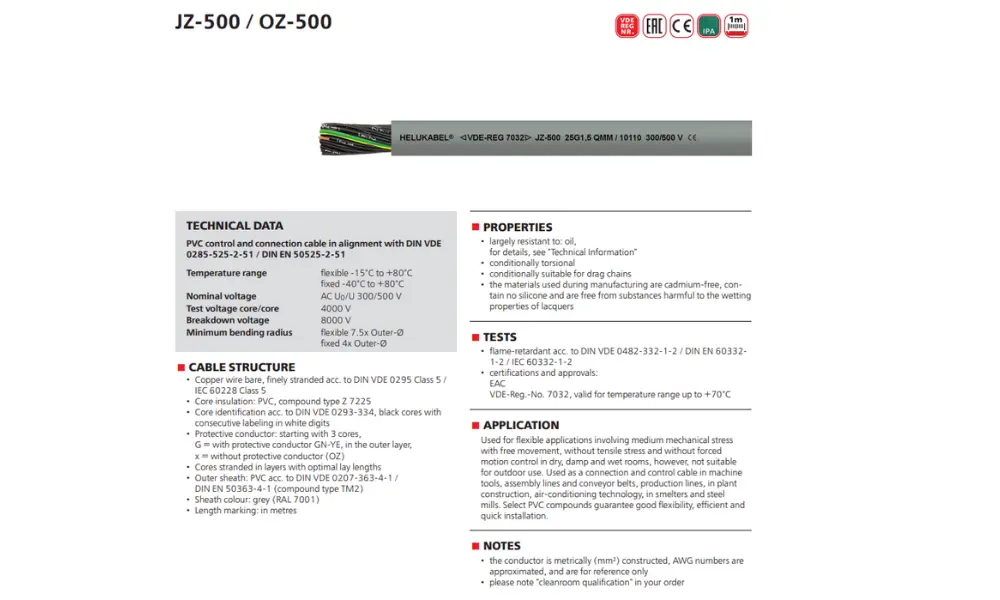
For example, the datasheet for the JZ-500 cable series.
3.2. Compare the product with the datasheet
The product name is only the initial information and is not sufficient to determine whether the product meets the requirements. Comparing the information on the cable with the datasheet and order requirements helps confirm that the actual product matches the agreed specifications. The information to be checked includes:
- Conductor: Material, construction
- Number of cores: Actual number of cores
- Insulation: Material type, thickness
- Cable sheath: Material and characteristics
- Voltage: Rated voltage
- Cross-sectional area: Diameter, thickness of layers
- Length: Nominal/actual length
- Standard: Applicable product standard
3.3. Check documentation and traceability
For project orders or large quantities, you should request documents that can be linked to the specific delivered batch. The information that can be checked includes:
- Test report
- Certificate of conformity
- Lot or batch number
- Drum/reel number
- Manufacturing date
- Delivery note and related documents
Providing complete batch identification information makes receiving inspection more convenient and supports traceability if an issue arises during use.
4. Check electrical cable quality by visual inspection
Visual inspection is a simple step that can be performed when receiving the products. However, this is only a preliminary inspection and cannot replace technical tests.
4.1. Check the cable sheath surface
The cable surface should be inspected along its length to identify abnormalities such as:
- Cracks, cuts, or deep scratches
- Blisters, small holes, or surface defects
- Abnormal deformation or discoloration
- Visible particles or impurities on the sheath
An uneven surface or defects during the extrusion process may be a sign that further inspection is required. Under certain conditions, damage to the sheath can also allow moisture to enter and affect the inner layers.
4.2. Check the uniformity of the insulation and sheath
The insulation and sheath should be evenly covered around the core according to the designed construction. If the coating appears uneven, too thin, misaligned, or deformed, an appropriate measurement method should be used instead of relying only on visual inspection. For multi-core cables, you should also check whether the cores are correctly identified and arranged according to the construction.
4.3. Check the conductor
The conductor is the part of the cable that carries electrical current. When the conductor can be observed, check its material, cross-sectional area, and the condition of the conductor strands. For stranded conductors, the strands should have a uniform structure and show no signs of breakage, deformation, or damage. The conductor material and cross-sectional area should also be compared with the information provided by the manufacturer.
However, visual inspection of the conductor is only preliminary. Appropriate measurements are required to accurately determine the conductor cross-sectional area, resistance, and characteristics.
5. Check cable electrical performance using measuring equipment
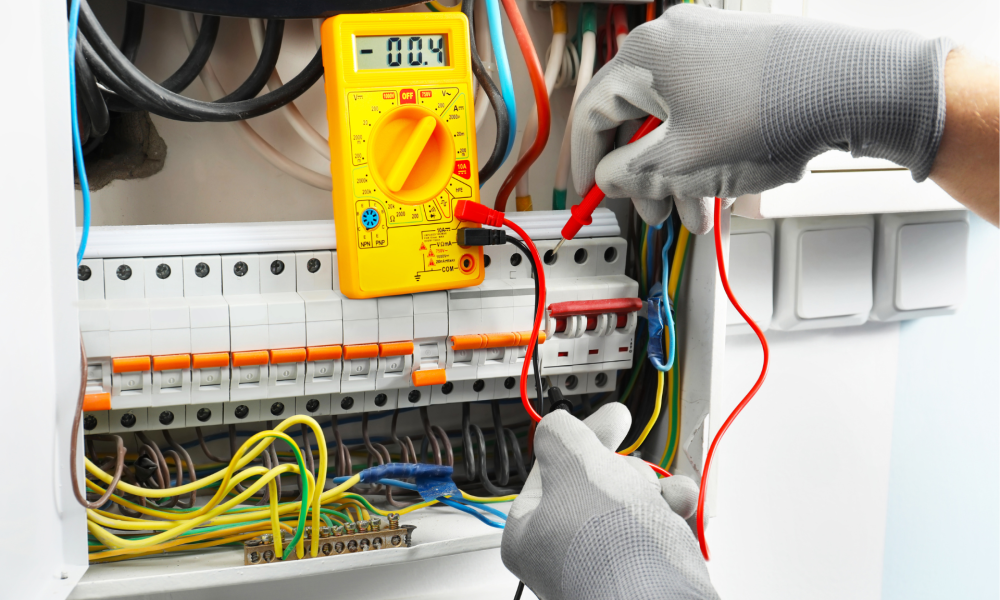
This step moves from visual inspection to data-based assessment, helping determine the cable’s conductivity and safety. Measuring resistance with calibrated equipment helps check the DC resistance of the conductor. Abnormally high resistance may indicate an insufficient conductor cross-sectional area, material that does not meet requirements, or damaged conductor strands, while also increasing heat generation when the cable carries a load, accelerating insulation aging, and increasing the risk of fire.
In addition, where conditions permit, you can perform a continuity test to confirm that the electrical path in the conductor is not interrupted, and a high-potential/hi-pot test to assess the dielectric strength of the insulation.
6. Check the mechanical durability of the cable
Mechanical durability indicates the cable’s ability to withstand impacts during installation and operation. Bend and flex testing evaluates the ability to withstand repeated bending or twisting without damaging the conductor, insulation, or sheath. Abrasion resistance shows whether the sheath can withstand friction against cable trays, bulkheads, or supporting structures while continuing to protect the inner layers. Meanwhile, impact testing evaluates resistance to crushing forces or sudden mechanical impacts, helping limit conductor deformation and insulation cracking when the cable is subjected to force.
7. Should cable samples be taken for quality inspection?
For large electrical cable orders or orders with specific technical requirements, checking a sample before placing the order is a useful step that gives customers a basis for assessing the actual product. The cable sample allows the construction, dimensions, marking, and relevant characteristics to be compared with the specified technical requirements, thereby minimizing discrepancies before placing the order.
We HELU Vietnam can quickly provide cable samples for available cable types when you request them, allowing you to directly check the construction, dimensions, and relevant characteristics before selecting the product.
For special requirements such as flame resistance, UV resistance, oil resistance, or flexing capability, you can also request additional relevant documents and test evidence as a basis for product assessment.
8. Warning signs when purchasing electrical cables
An abnormal sign does not necessarily mean that the cable is definitely counterfeit or unsafe, but it should be checked further before acceptance:
- Marking is unclear or inconsistent.
- Packaging does not match the ordered product.
- The insulation or sheath has cracks, blisters, holes, or defects.
- The conductor strand structure is uneven or shows signs of damage.
- The actual length is shorter than required.
- The weight is unusually low compared with the expected specifications.
- The cable end is exposed and shows signs of moisture exposure.
- The price is significantly lower than products with the same specifications without a clear explanation.
- Invoices, delivery notes, or product identification documents are missing.
9. Suggested checklist for checking electrical cable quality
After understanding the important criteria for checking electrical cable quality, you can use the checklist below to easily review the cable before purchase and use.
| Category | Items to check |
| Technical requirements | Application, load, voltage, route length |
| Supplier | Origin, manufacturing capacity, and quality control |
| Marking | Manufacturer, cable code, cross-sectional area, voltage, standard |
| Documentation | Datasheet, catalogue, test report, certificates |
| Conductor | Material, cross-sectional area, strand construction |
| Insulation | Material, thickness, surface condition |
| Cable sheath | Uniformity, cracks, blisters, cuts, deformation |
| Dimensions | Diameter, layer thickness, construction |
| Length | Compare actual length with documentation |
| Packaging | Drum, label, sealing, cable ends |
| Electrical characteristics | Resistance, continuity, insulation resistance |
| Mechanical characteristics | Bending, tensile, abrasion, impact when required |
| Installation conditions | Temperature, oil, water, UV, chemicals, vibration |
Looking for electrical cables that meet your project’s technical requirements? We HELU Vietnam provide high-quality cable solutions and cable samples for available products upon request. Contact us for consultation and to find the right cable for your application.