What are plastic drag chains? Types, constructions, and applications
In modern automation systems, cables and hoses must move continuously along with machinery, robots or production lines. After thousands or even millions of bending cycles, unprotected cables are prone to fracture, abrasion or tangling, leading to unplanned downtime, production interruptions and significant repair costs. This is precisely why plastic drag chains (also known as energy chains or cable carriers) have become an indispensable component in automation, CNC, robotics and any industry involving moving machinery.
-
1What are plastic drag chains?
-
2The construction of a plastic chain
-
3Advantage of plastic chains #1: Lightweight
-
4Advantage of plastic chain #2: Multi-cable management
-
5Advantage of plastic chain #3: Chemical resistance
-
6Advantages of plastic chain #4: Clean Room version, Ex...
-
7Classification of plastic chains by structural shape
-
8Classification of plastic chains by motion type
-
9Special motion configurations of plastic drag chains
-
10Classification of plastic chains by size
-
11Applications of plastic cale chains
-
125 steps to choosing the right plastic cable chain
-
13Important notes for cable installation in drag chains
-
14FAQs about plastic cable chains
1. What are plastic drag chains?
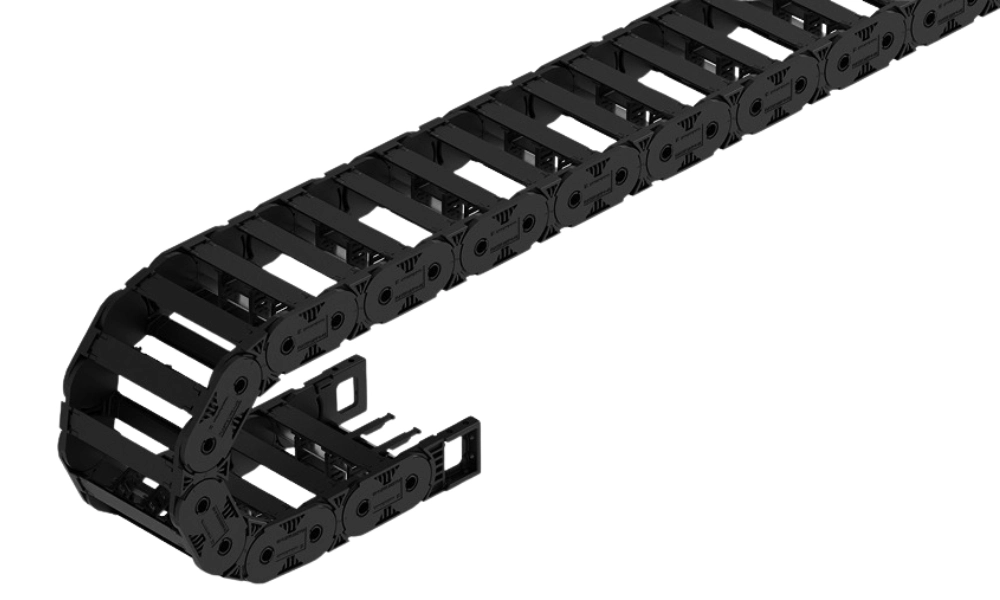
HELUCHAIN® PLASTIC LINK 4-45 plastic chain
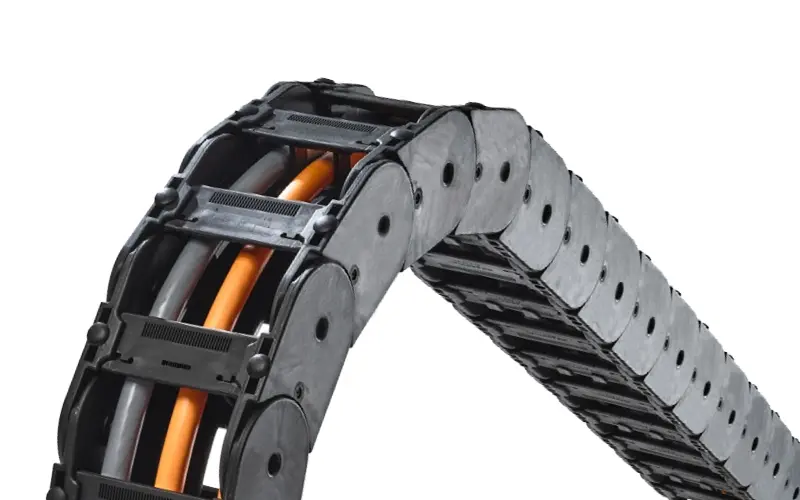
A plastic drag chain is a cable guidance and protection system designed for applications involving continuous linear motion. Its purpose is to organize, secure and protect power cables, pneumatic hoses and hydraulic lines from tangling, abrasion, excessive tension and breakage during machine operation.
Plastic drag chains are widely used in CNC machines, industrial robots, automated production lines, packaging equipment, conveyor systems and many other types of modern moving machinery. They are considered a critical component for ensuring stable operation, reducing machine downtime and optimising maintenance costs.
Drag chains are known by several names in the industry. The term "drag chain" emphasizes the chain's ability to guide cables through a dragging motion. "Energy chain" reflects the system's role in delivering power, signals and media to the moving parts of a machine. "Cable carrier" describes the product's core function: carrying and protecting cables. In some regions, they are also referred to simply as cable chains or cable track systems.
Modern plastic drag chains are preferred over traditional steel chains thanks to their lighter weight, superior resistance to oils and chemicals, and better corrosion resistance. These properties help improve operational efficiency, reduce energy consumption and extend the service life of the entire machine system.
Learn the basics about the functions and features of cable chains
2. Construction of a plastic drag chain
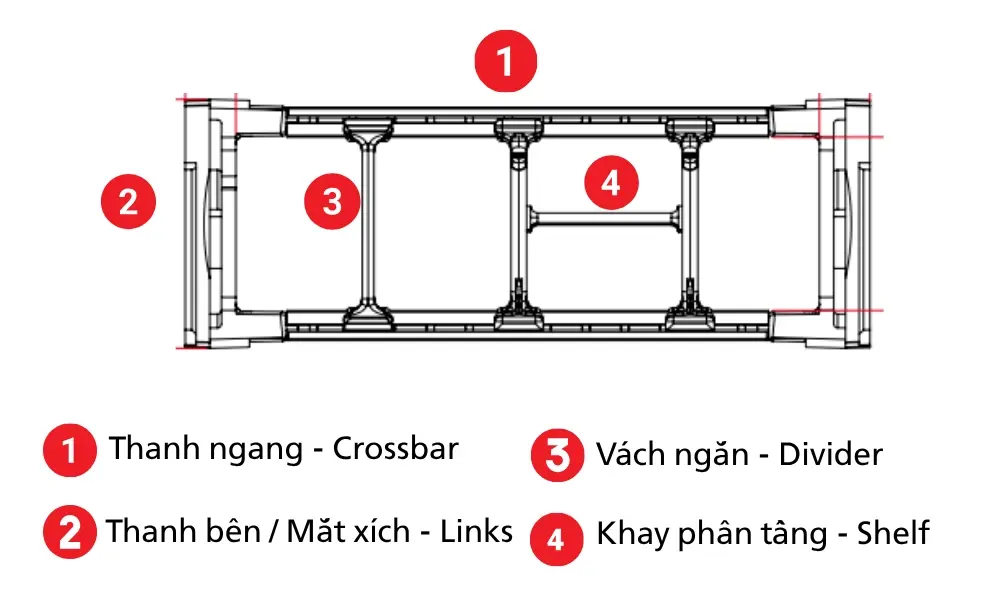
Some basic components of the HELUCHAIN® PLASTIC LINK 4-45 plastic cable chain
Structurally, a plastic drag chain (cable chain) consists of multiple links connected by crossbars or connecting plates, forming a flexible system that can bend along a defined radius as the machine moves. This mechanism ensures that the cables and hoses inside always follow a stable, controlled trajectory, minimising mechanical damage and extending the system's service life.
2.1 Upper crossbar (Lid)
The upper crossbar is the component located on top of each chain link. It functions as a closure that secures the cables inside the chain. In many modern drag chain designs, the crossbar can be opened from the inside or outside without disassembling the entire chain, making cable installation, inspection and replacement significantly faster.
In fully enclosed chain types, this component is commonly referred to as the "lid", providing enhanced protection against dust, oil, metal chips and other external mechanical impacts.
2.2 Lower crossbar (Bottom)
The lower crossbar forms the base of the drag chain and supports the entire cable and hose system inside. Together with the upper crossbar, it creates a stable cable compartment that prevents cables from shifting during continuous motion.
In tube-type or fully enclosed chains, the bottom section typically features a more robust design to increase mechanical strength and load-bearing capacity.
2.3 Side parts — Inner and outer links
These are the main structural elements that give the plastic drag chain its flexibility. The links are connected in a hinge-like arrangement, allowing the chain to bend along a defined radius during machine operation.
The side parts are typically manufactured from high-strength engineering plastics with excellent abrasion resistance and impact strength. This design enables the chain to operate reliably in industrial environments with continuous, high-frequency motion.
2.4 Dividers / Separators
Dividers are components used to divide the interior space of the chain, keeping different types of cables and hoses in separate compartments. Proper divider placement prevents cables from crossing over each other, reduces friction and eliminates cable-to-cable contact during motion.
Dividers are usually designed as vertical dividers, and users can install one or more depending on the number and size of cables inside the chain.
2.5 Shelves
Shelves are horizontal dividers that create multiple tiers within the drag chain's interior. When combined with vertical separators, shelves form individual cable compartments, optimizing the management and protection of complex wiring systems.
This arrangement is particularly useful in applications with multiple signal cables, power cables and hoses operating simultaneously, as it helps reduce signal interference and extends cable service life.
2.6 Mounting brackets
Both ends of a plastic drag chain are secured using mounting brackets or integrated brackets. These components connect the chain to the stationary part (fixed point) and the moving part (moving point) of the machine.
3. Materials and key advantages of plastic drag chains
The majority of high-quality drag chains available today are manufactured from engineering-grade polyamide (PA), specifically Polyamide 6 reinforced with 35% glass fibre (PA6 GF35). The addition of glass fibre significantly increases rigidity, load-bearing capacity and mechanical stability, while maintaining a considerably lighter weight compared to steel chains of the same size.
3.1 Lightweight design and reduced energy consumption
One of the most significant advantages of a plastic drag chain is its substantially lower weight compared to a steel chain of equivalent size and capacity. As a result, the drive system requires less pulling force, reducing motor loads and lowering energy consumption during operation.
The lighter weight also reduces vibration and minimizes mechanical wear on moving machine components, which is particularly beneficial in high-speed or long-travel applications.
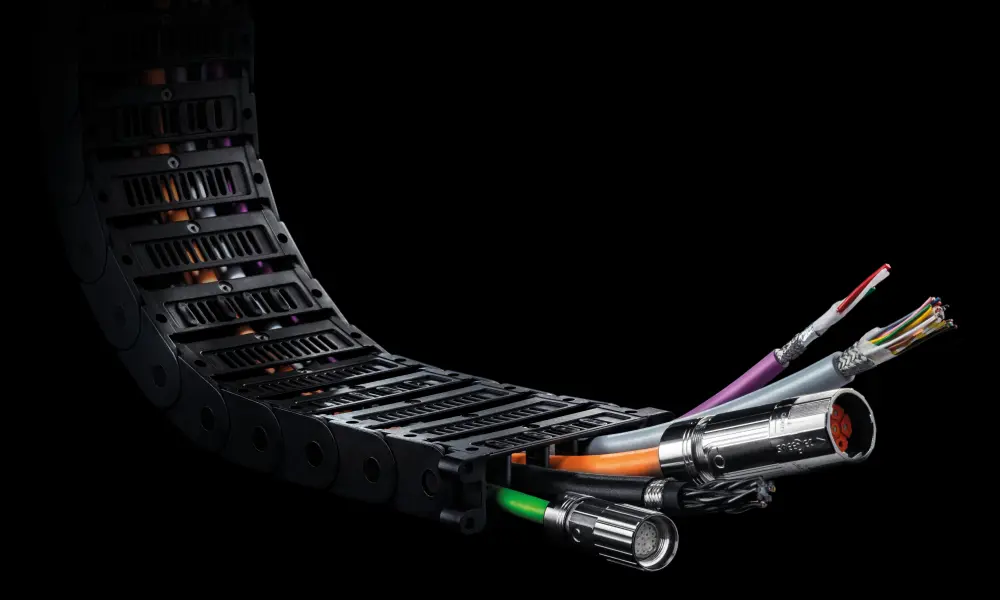
Plastic cable chains can accommodate power cables, signal cables, pneumatic tubing, and hydraulic tubing all within the same system
3.2 Quick installation and multi-cable management
Plastic drag chains are designed with a modular plug-in system, allowing the crossbars to be opened from the inside or outside without removing the entire chain assembly — significantly reducing installation and maintenance time compared to traditional steel chains.
Unlike cable drums, which can only guide a single cable at a time, plastic drag chains can simultaneously accommodate power cables, signal cables, pneumatic hoses and hydraulic lines within one system. Internal separators and shelves keep the different cable types organised, reduce friction and minimise signal interference.
This is also a major advantage over busbar systems (conductor rail systems), which can only transmit electrical power and cannot guide other media such as compressed air or hydraulic fluid.
3.3 Operating temperature range and chemical resistance
Plastic drag chains operate reliably within a continuous temperature range of approximately −20 °C to +100 °C, which is suitable for the vast majority of industrial environments. Polyamide also offers good resistance to oils, abrasion and moisture, enabling durable operation in manufacturing plants, food processing facilities and outdoor environments without the oxidation or corrosion issues associated with steel chains.
However, this material can be affected by concentrated acids or alkalis. For particularly demanding chemical environments, manufacturers may use polyolefin or other specialised plastic compounds to improve chemical resistance.
3.4 Application-specific variants
To meet specialized industrial requirements, plastic drag chains are available in several enhanced variants: high-impact (HI), food-grade (FDO), flame-retardant (V0), anti-static (ESD), explosion-proof (EX) and clean-room rated. Additionally, the thermoplastic materials used in modern drag chains are recyclable — an important advantage for companies pursuing sustainable manufacturing practices.
4. Types of plastic drag chains
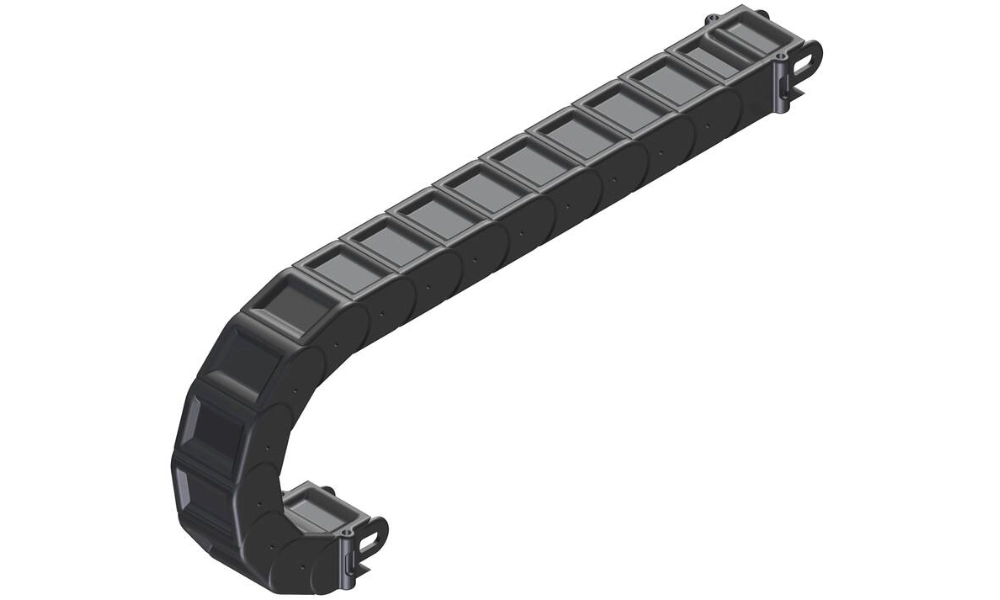
HELUCHAIN® PLASTIC LINK 1-PF plastic chain, closed type
Plastic drag chains are designed in a variety of form factors, structures and motion configurations to meet the diverse requirements of industrial automation systems.
4.1 Classification by structural design
- Closed type
Enclosed drag chains feature a fully enclosed design that almost completely surrounds the cable system inside, providing enhanced protection against dust, metal chips, oil and other contaminants from the industrial environment.
This type is commonly used in CNC machines, metalworking facilities and any environment requiring a high level of cable protection.
- Open type
Open drag chains have an open structure with easily removable crossbars, making cable routing, maintenance and replacement faster and more convenient. The open design also offers several additional benefits: improved heat dissipation, reduced overall system weight, and easy visual inspection of the cables inside.
- Tube type
Tube-type drag chains feature a fully closed tubular or pipe-like construction, providing 360° cable protection against dust, sparks, metal chips and severe mechanical impacts. This type is typically used in welding robots, laser cutting machines and other harsh operating environments.
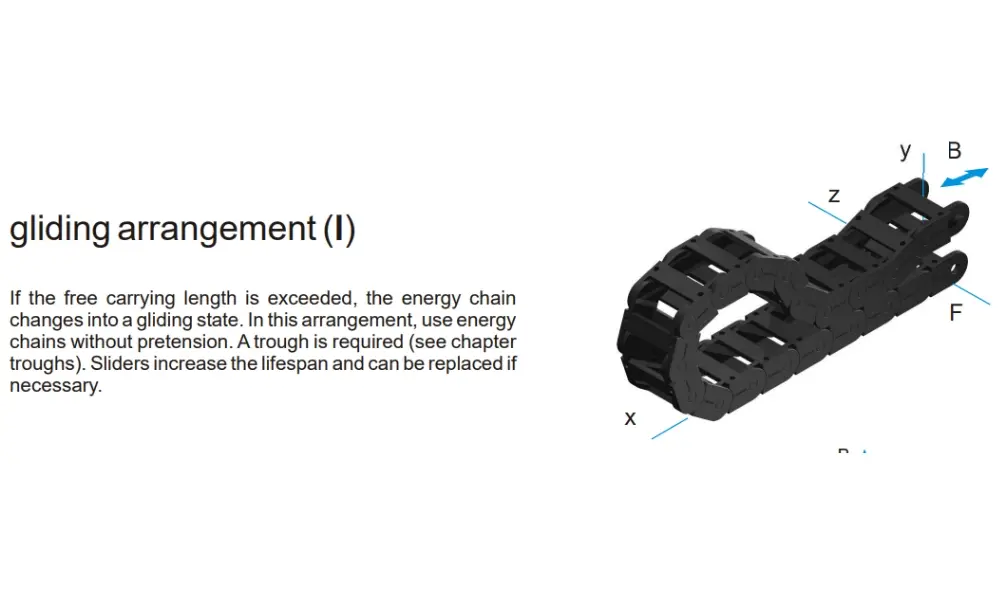
Plastic cable chain with a gliding arrangement
4.2 Classification of plastic chains by motion type
- Gliding arrangement
- Roller type
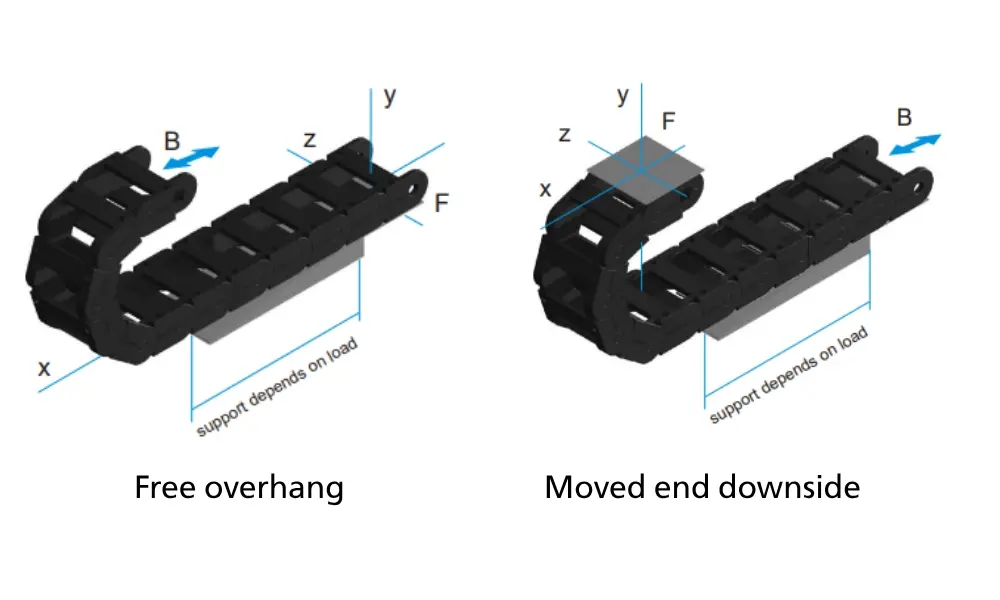
Some types of free-hanging plastic chains
- Unsupported type
In this arrangement, the drag chain operates in a suspended state without — or with only partial — support from a substructure underneath. Depending on the direction of travel and the mounting orientation, several variants exist:
- Free overhang: The lower strand of the chain is only partially supported by a substructure. Due to the high weight load on the lower strand, this arrangement only allows a significantly reduced travel distance compared to the standard configuration.
- Vertical hanging: The chain hangs vertically and travels up and down. Typically used for cargo lifts, automated storage and retrieval systems (AS/RS).
- Move end downside: The moving end is positioned below the fixed end — the reverse of the standard arrangement. Used in applications where the moving component is located underneath the stationary structure.
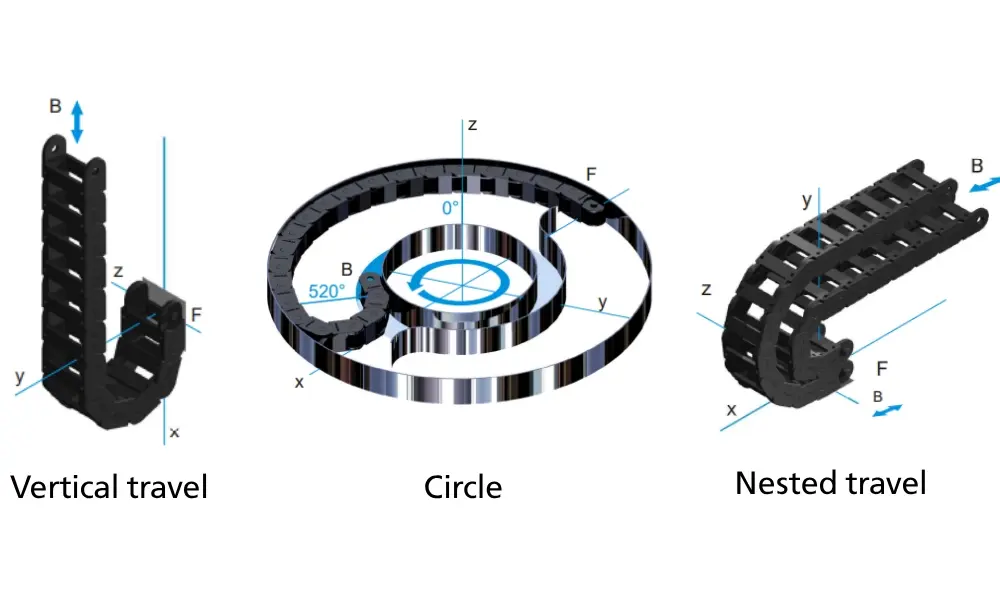
Special motion patterns of plastic cable-wrapping chains
- Special motion configurations
Beyond the basic types, plastic drag chains can also be configured for specialized motion patterns depending on the specific application:
- Normal arrangement: standard configuration for high-speed linear motion
- Multi-axial movement: multi-axis motion along X, Y and Z directions
- Vertical travel: straight vertical movement
- Horizontal on the side: sideways mounting when vertical space is limited
- Opposite running: two chains running in parallel or symmetrical configuration
- Circle: rotational motion of up to 500° or more
- Nested travel: multiple chains nested inside each other to manage large cable quantities
- Hanging multiaxial: A suspended chain arrangement combined with multi-axis movement, allowing simultaneous travel in multiple directions while remaining in a free-hanging state.
- Driving apart: Two chain systems move away from each other starting from a common point.
These configurations are commonly found in industrial robots, multi-axis automation systems and specialised machinery requiring complex motion profiles.
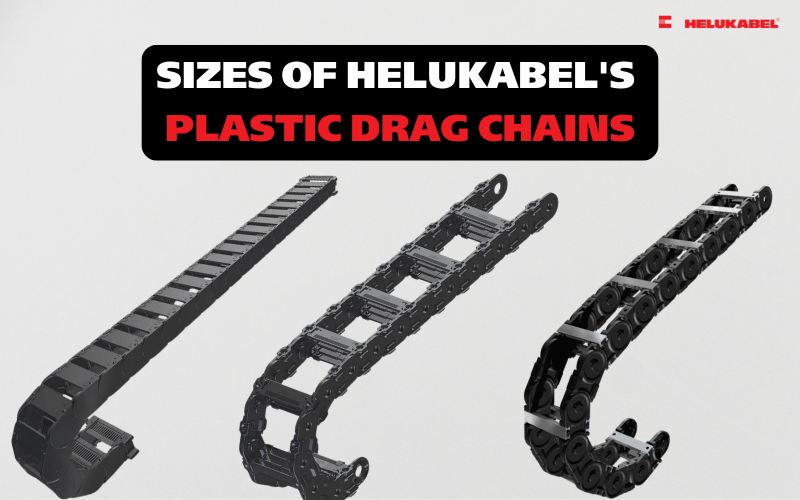
4.3 Classification by size
Plastic drag chains are available in a wide range of sizes to accommodate different cable quantities and diameters. Common sizes include:
| Dimensions | Meaning |
| 7x7 | 7 mm inner height × 7 mm inner width |
| 10x10 | 10 mm inner height × 10 mm inner width |
| 10x20 | 10 mm inner height × 20 mm inner width |
| 15 x 30 | 15 mm inner height × 30 mm inner width |
| 18x25 | 18 mm inner height × 25 mm inner width |
| 25x38 | 25 mm inner height × 38 mm inner width |
| 35x75 | 35 mm inner height × 75 mm inner width |
Among these, the 18×25 size is one of the most widely used for CNC machines, laser engraving systems and small-to-medium automation applications. With inner dimensions of 18×25 mm, this drag chain can accommodate several signal cables and small power cables simultaneously.
With so many different styles, designs, and sizes available, choosing the right type of plastic cable chain for your system is not always straightforward. If you are unsure which type to choose, contact the HELU Vietnam engineering team for a free consultation — we can help you select a complete chain-and-cable package tailored to your specific application.
>>Learn more: What sizes are available for HELU's plastic drag chains?
5. Applications of plastic drag chains
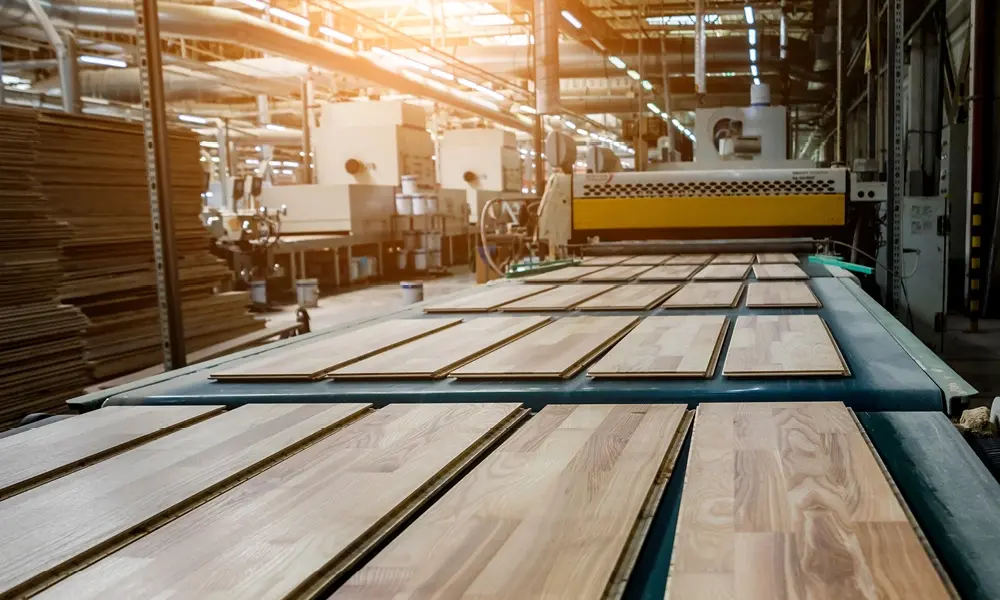
Plastic cable chains are used in most industries that utilize automated machinery
Plastic drag chains are found in virtually every industry where machinery involves automated movement. Below are the most common applications:
- CNC machines: Drag chains guide control cables and encoder cables along the X and Y axes, with travel distances ranging from 500 mm to over 3,000 mm. Enclosed types are preferred for their ability to keep out metal chips and swarf — the two most damaging contaminants for cables in machining environments.
- Industrial robots and robotic arms require lightweight drag chains with small bending radii, capable of withstanding high accelerations. The chain simultaneously carries power cables, encoder cables and pneumatic hoses for the gripper.
- Overhead cranes use drag chains with very long travel distances. For outdoor cranes, the chains must also withstand UV exposure and wide temperature fluctuations.
- Industrial 3D printers use small-sized drag chains to route power cables to the hot end and filament tubing. Open types are preferred for better heat dissipation.
- Automated conveyor systems in logistics warehouses use drag chains to supply power to moving components such as diverters and mobile barcode scanners, keeping cables organized and preventing line stoppages.
6. How to select the right plastic drag chain
Choosing the wrong drag chain leads to cable damage, machine downtime and costly replacements. The following five steps will help you determine the correct chain for your system — based on the HELU technical consultation process.
6.1 Step 1 – Determine the installation arrangement
First, identify how the chain will be mounted, as each arrangement involves entirely different load conditions:
- Gliding: the chain rests on a trough and slides back and forth
- Unsupported / Hanging: the chain hangs freely without a support trough
- Standing vertically: the chain travels up and down
- Sideways: the chain moves horizontally
- Circular: the chain follows a curved path
6.2 Step 2 – Determine the operating parameters
These parameters determine the chain size and type:
| Parameter | Symbol | Meaning |
| Maximum travel distance | L (mm) | Longest distance the chain must cover |
| Travel speed | V (m/s) | Higher speeds require lighter chains with robust joints |
| Acceleration | a (m/s²) | Higher acceleration requires chains with greater tensile strength |
| Lateral acceleration | a_q (m/s²) | Critical for hanging/unsupported arrangements |
| Ambient temperature | °C | PA6 is rated up to approx. 100 °C; PA66 withstands higher temperatures |
Additionally, document any special environmental conditions: indoor or outdoor operation, exposure to oil, acids, dust or clean-room requirements — as these factors determine the chain material (plastic, steel or stainless steel).
6.3 Step 3 — Calculate the dimensions
List all cables and hoses to be routed, recording the outer diameter (Ø mm) and minimum bending radius of each one. Note that cables must have at least 10% clearance relative to their diameter inside the guide channel to move freely — for example, a cable with Ø20 mm requires a minimum channel width of 22 mm. The internal chain dimensions (height × width) depend on the number of cables, their arrangement and the type of separators used. Download the HELU technical checklist for an accurate calculation tailored to your project.
Download HELU’s cable chain technical checklist to make accurate calculations for your project
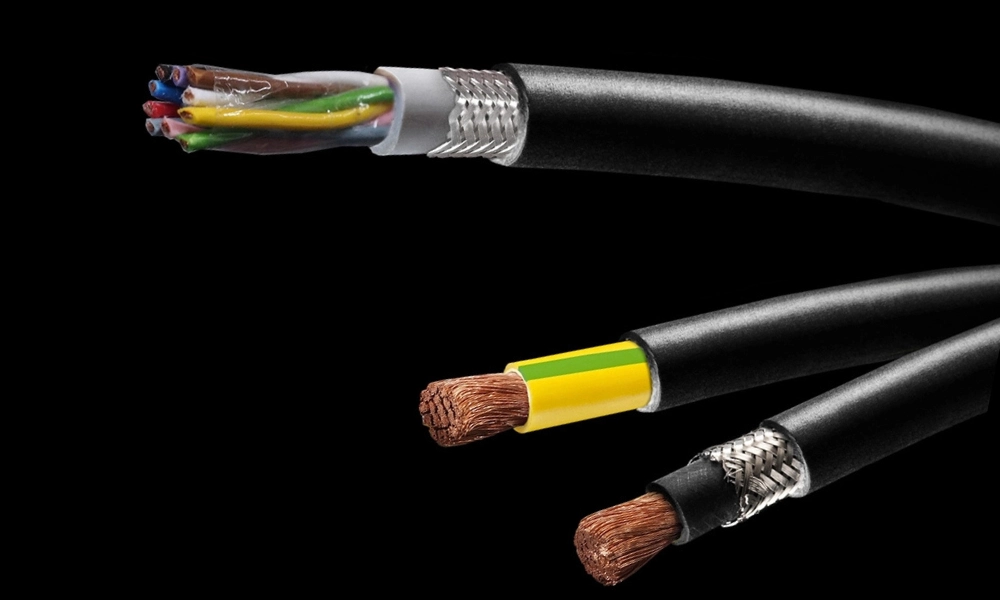
HELU offers a full range of control cables, servo cables, Ethernet cables, bus cables, feedback cables, and more—all specifically designed for cable chains.
6.4 Step 4 — Choose the construction
Based on the environment and Steps 1–3, select the appropriate cable chain:
- Material: Plastic (lightweight, most common) / Steel (heavy loads, high temperatures) / Stainless steel (corrosion resistance, food industry)
- Design: Enclosed (dust and chip protection) or Open (easy cable access, better heat dissipation)
- Installation conditions: verify the maximum available width and height at the mounting location
6.5 Step 5 — Select drag chain-compatible cables
This is the most critical step — and the one most often overlooked. Standard cables are not designed for continuous motion; their conductors will break after just a few thousand bending cycles. Cables specifically designed for drag chains must meet the following requirements:
- Finely stranded copper conductors for maximum flexibility (no solid or coarsely stranded cores)
- Rated for millions of bending cycles
- Special PVC/PUR/TPE outer sheath for superior abrasion and oil resistance
HELU supplies a complete range of drag chain-compatible control cables, servo cables and shielded signal cables, and can advise on a complete chain-plus-cable solution for any application. Download the complete technical checklist here to share with the HELU technical team.
Important guidelines for installing cables in drag chains
Selecting the right chain is only half the job — incorrect cable installation will cause the system to fail prematurely. The following installation rules are based on HELU's production experience.
- Always use dividers: Never route round and flat cables together without a divider. Cables of different diameters will abrade against each other during movement if left in direct contact.
- 10% free space rule: Cables must have at least 10% free space relative to their diameter inside the guide channel. For example, a Ø20 mm cable requires a minimum channel width of 22 mm. If cables are packed too tightly, friction increases dramatically and the jacket wears out many times faster.
- 10% extra length rule: Cables must be at least 10% longer than the total chain length. This slack allows the cables to sit loosely without being pulled taut when the chain bends — the leading cause of internal conductor breakage.
- Arrange cables by weight: Place heavier cables on the outer edges and lighter cables in the centre. This keeps the chain balanced and prevents uneven wear caused by the chain pulling to one side.
- Split multi-core cables: When many signal conductors are needed, use several smaller cables (e.g. three 12-core cables) rather than a single large cable with more than 25 cores. Smaller cables are more flexible and far less likely to fail inside a drag chain.
- Never twist during installation: Cables must be laid out straight on a flat surface before being fed into the chain. Never pull cable over the top of a reel or drum, as this introduces hidden twists that lead to conductor failure after only a few thousand cycles.
7. FAQs about plastic cable chains
A cable tray is a stationary support structure used to organise cables in buildings or factories — the cables remain fixed and do not move. A drag chain, on the other hand, is specifically designed for continuous-motion applications, with interlinked chain segments that allow repeated bending over millions of cycles. In simple terms: cable trays are for static cables; drag chains are for dynamic cables.
Standard plastic drag chains made from PA6 operate reliably within a temperature range of −20 °C to +100 °C. For higher-temperature environments (e.g. near furnaces or die-casting areas), steel or stainless-steel chains should be selected instead. It is also important to note that ambient temperature affects the cables inside the chain — heat-resistant cables should therefore be considered at the same time.
The minimum bending radius depends on the chain size and the type of cables inside. The general rule is: the bending radius of the chain must be equal to or greater than the minimum bending radius of the cable with the most stringent requirement. Exact specifications are provided by the manufacturer for each specific chain model.
In standard applications, the fixed connector is positioned at the midpoint of the travel distance, and the moving connector travels horizontally over the fixed connector between both end positions. The required length of the energy chain — measured from the first to the last pivoting link — is calculated as follows:
L = LV/2 + 4R
Where: L is the chain length, LV is the travel distance and R is the bending radius of the chain.
If the fixed connector is not centred but offset by a distance x, the chain length must be extended accordingly: L = LV/2 + 4R + x.
After calculating L, round up to the nearest link pitch — this is the ordering length. Additionally, the overall connector height is: HA = 2R + c (where c is the link height of the chain).
If you're unsure about the specifications, download HELU's technical checklist and fill in the travel distance, radius, installation type, etc.—our technical team will calculate the exact figures for you.
Not every cable can be used in a drag chain. Standard cables with solid or stranded conductors will fail after only a few thousand bending cycles. Drag chain-compatible cables usually have finely stranded copper conductors, an anti-torsion construction, a special PVC/PUR/TPE outer sheath for abrasion resistance and a flexing endurance of millions of cycles. HELU provides a full range of control cables, servo cables and shielded signal cables specifically designed for cable chain applications.
If you still have questions, don’t hesitate to contact the HELU Vietnam engineering team for detailed answers.
HELU Vietnam Contact Information
| HELU Vietnam 905 Nguyen Kiem Street, Hanh Thong Ward, Ho Chi Minh City, 700000, Vietnam | Phone:
+84 28 77755578 Email: info@helukabel.com.vn | Connect with us on |
| Order through our online channels: Tiki | Shopee | Lazada | Product Finder | ||