VDE-certified cables: Distinguishing between VDE, DIN VDE, and the VDE Registration Number
On the jackets of many types of European cables, you will often see markings such as “DIN VDE 0276-603,” “VDE,” “HAR,” or “VDE-Reg.-Nr.” These markings look similar but have very different meanings. Some simply indicate that the cable was designed in accordance with the standard, while others serve as proof that the cable has been independently tested and continuously monitored by a third party. This article helps engineers, contractors, and purchasing departments distinguish between these types and learn how to verify whether a cable truly meets VDE standards.

Article content:
-
1What is VDE?
-
2DIN VDE vs. VDE Mark, HAR vs. the VDE Registration Number
-
3Guide to reading the markings on cable
-
4Does a cable code that starts with H mean it's a HAR cable?
-
5VDE standard groups
-
6VDE standards related to electrical cables
-
7VDE standards related to structure and testing
-
8VDE standards related to installation
1. What is VDE?
VDE (Verband der Elektrotechnik Elektronik Informationstechnik) is the German Association for Electrical, Electronic, and Information Technology, headquartered in Frankfurt am Main, with more than 35,000 members. VDE has two distinct roles:
- Standard development: VDE and DIN (the German Institute for Standardization) operate the DKE committee, which drafts and publishes electrical engineering standards under the DIN VDE designation. The standards collection currently comprises more than 3,500 documents, many of which are harmonized with IEC and EN standards.
- Testing and certification: The VDE Testing and Certification Institute (VDE Prüf- und Zertifizierungsinstitut GmbH, Offenbach) is an independent organization. It tests products, conducts factory inspections, issues certification marks, and serves as a Notified Body for the EU.
Therefore, a cable manufactured to the DIN VDE standard and a cable with VDE certification are two different things. Many types of cables are manufactured to the DIN VDE standard but do not bear the VDE mark.
DIN VDE standards are not laws either. Standards become mandatory only when they are referenced in laws, regulations, contracts, or bidding documents. This is a common situation in European FDI projects in Vietnam.
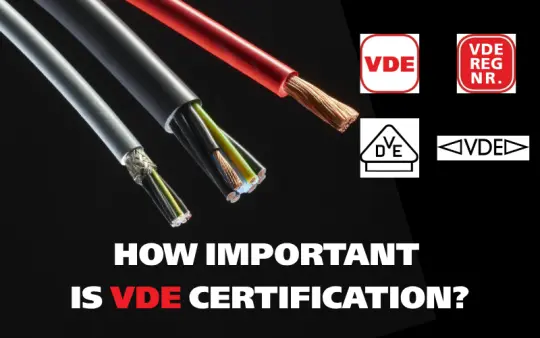
VDE Logo
VDE cable mark
VDE Registration No.
2. Distinguishing between DIN VDE, the VDE Mark, HAR, and the VDE Registration Number
Only marks issued by the VDE Institute constitute certification; the "DIN VDE xxxx" code is merely a manufacturer's design commitment.
2.1 Summary table
| Symbol | The nature | Periodic monitoring | Meaning for buyers |
| DIN VDE xxxx (for example, DIN VDE 0276-603) | Technical standard code | No | Manufacturers self-declare that their cables are designed in accordance with this standard; third-party certification is not yet required. |
| VDE Cable Mark <VDE> | Safety marks for cables, wires, heat-shrink tubing, and cable management systems | Yes | The cable has met all testing requirements, and the factory undergoes periodic inspections; the mark is printed or embossed on the jacket |
| VDE HAR Mark <VDE><HAR> | European Harmonized Cable Conformity Mark, based solely on the EN/HD standard | Yes | Harmonic cables (H-code) have been tested by a national institute in accordance with EN structural standards and have been awarded HAR certification; the HAR mark is always accompanied by the mark of the certifying institute (VDE, IMQ, etc.). The letter “H” in the cable code does not constitute the HAR mark. |
| VDE Registration Mark (VDE Reg. No. XXXX) | Registration mark; each design variant has a 4-digit code | Yes | Granted when a product meets standards only for a specific application, when no current standards exist, or when deviations from the standard are permitted without compromising safety. Example: HELUKABEL’s JZ-500 control cable, bearing VDE-Reg.-Nr. 7032 |
2.2 Decoding the markings printed on a cable
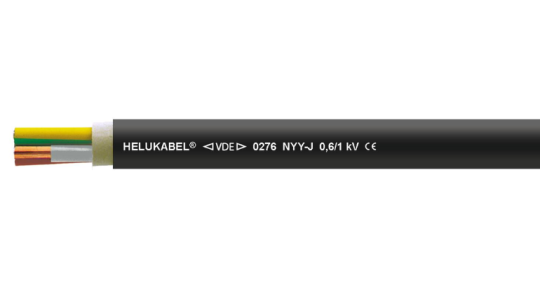
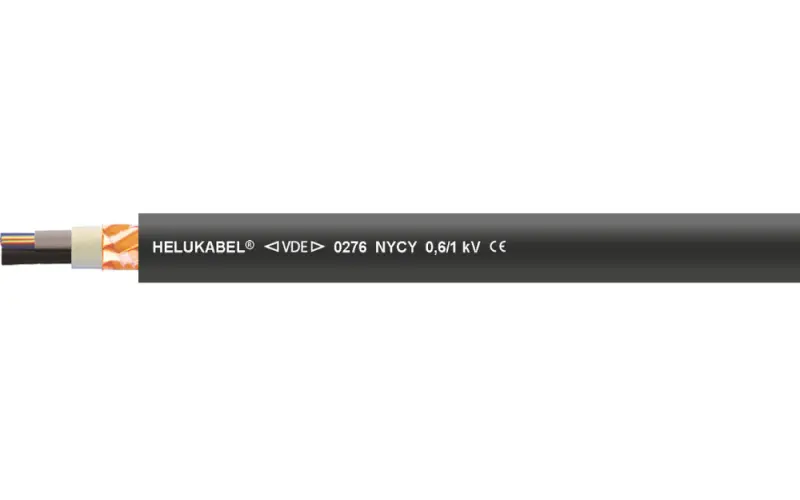
Take HELUKABEL NYY-J 4x16 RM 0.6/1 kV <VDE> 0276 as an example:
<VDE> is the VDE certification mark. 0276 is the classification code under VDE Standard 0276 (power cables), printed immediately after the mark. This rule applies to cables in the VDE 0262, 0265, 0266, 0271, and 0276 groups.
Note: If the cable jacket is labeled only with "DIN VDE …" without the <VDE> symbol, and contains only an identification number or registration code, the cable was manufactured in accordance with VDE standards but may not necessarily have VDE certification.
2.3 Are cables with codes starting with "H" HAR cables?
No. The letter "H" indicates that the manufacturer self-certifies that the electrical cables are manufactured in accordance with EN structural standards; the HAR mark is the third-party certification.
| Designation | Meaning | Example |
| H… | European-standard structured cabling manufactured in accordance with EN standards; self-declared by the manufacturer | H07V-K (EN 50525-2-31), H05VV-F (EN 50525-2-11), H1Z2Z2-K (EN 50618) |
| H… accompanied by <VDE><HAR>, <IMQ><HAR>… | Tested and certified by the National Institute as HAR | H05VV-F <VDE><HAR> |
| Remove the letter H | Although manufactured according to the standard, there are differences—for example, the cross-section or color is not specified in the standard—so it should not be marked with an "H." | 07V-K, 05VV-F |
| (H) or X instead of H | Old or alternative spelling; similar meaning—omitting the letter "H" | (H)07V-K |
Some important information:
- HAR certification is voluntary; it is not mandatory. Many manufacturers sell H-rated cables without HAR certification.
- The certification body is determined by the country where the factory is located; manufacturers do not choose it themselves: factories in Germany work with VDE, and those in Italy with IMQ.
- The HAR mark applies only to cables manufactured in the EU and Turkey. H-code cables manufactured outside this region cannot bear the HAR mark; they can only obtain separate certifications such as VDE, IMQ, etc. Therefore, H-code cables manufactured outside Europe that are labeled "HAR" should be carefully inspected.
- Some other cable types with different certifications: H1Z2Z2-K solar cables are typically certified by TÜV Rheinland in accordance with EN 50618 rather than HAR.
Useful information: Decoding the markings of
3. VDE standard groups
Each VDE standard has a 4-digit code beginning with 0; the second digit indicates the group. For example, VDE 0276 belongs to Group 2 (cables), VDE 0100 belongs to Group 1 (power systems), and VDE 0815 belongs to Group 8 (information technology).
| Group | Field |
| 0 | General principles |
| 1 | Energy systems, electrical installations |
| 2 | Cables and wires |
| 3 | Insulating materials |
| 4 | Measurement, Control, Testing |
| 5 | Electric motors, transformers, batteries |
| 6 | Installation Supplies, Switchgear |
| 7 | Household Appliances and Office Equipment |
| 8 | Information Technology and Telecommunications |
4. Important DIN VDE standards for cables
4.1 Product standards
| Standards | Scope | HELUKABEL product examples |
| DIN VDE 0207 | Insulation & sheath materials | General application |
| DIN VDE 0250 | Cables and wires for power systems (Installation cables, heavy-duty rubber cables) | NYM-J (0250-204), NSGAFÖU (0250-602), NSSHÖU (0250-812), NSHTÖU (0250-814) |
| DIN VDE 0266 | Halogen-free, flame-retardant cable | NHXMH-J/-O |
| DIN VDE 0271 | PVC cables up to 3.6/6 kV | — |
| DIN VDE 0276-603 | 0.6/1 kV distribution cable | NYY-J/-O, NAYY-J/-O, NYCY, NAYCY, NYCWY, NAYCWY, NAY2Y |
| DIN VDE 0276-604 | 0.6/1 kV cable with special fire-resistant properties (power plant) | N2XH-J/-O |
| DIN VDE 0276-620 | Medium-voltage cables from 3.6/6 kV to 20.8/36 kV | N2XS…2Y, NA2XS…Y |
| DIN VDE 0281 / 0282, now DIN EN 50525 (VDE 0285-525) | Harmonized cables: PVC (0281), rubber/silicone (0282) | H05VV-F (EN 50525-2-11), H07V-K (EN 50525-2-31), H05SS-F, H05SST-F |
| DIN VDE 0815 / 0816 | Indoor and outdoor telecommunications cables | J-Y(St)Y, J-H(St)H, A-2Y(L)2Y, A-2YF(L)2Y |
4.2 General standards for cable design and testing
| Standards | Scope |
| DIN VDE 0292 | Rules for assigning Harmonized cable (H05…, H07…) |
| DIN VDE 0293 | Wire color coding |
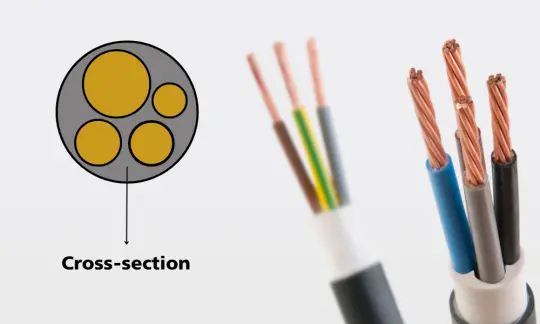
| DIN VDE 0295 (IEC 60228) | Conductor class 1/2/5/6 |
| DIN VDE 0298 | Cable applications: Cable selection, current-carrying capacity |
| DIN VDE 0472 / 0473 | Test methods for cables and materials |
| DIN VDE 0482 | Fire testing, smoke density, halogen |
>>>Useful Information: Classification of conductors according to IEC 60228
4.3 Installation and operation standards
These standards specify how electrical systems should be designed and operated; they are not intended to evaluate the cables themselves.
| Standards | Scope |
| DIN VDE 0100 | Installation of low-voltage electrical systems up to 1,000 V |
| DIN VDE 0105-100 | Electrical system operation |
| DIN VDE 0113 (EN 60204) | Electrical components for industrial machinery |
| DIN VDE 0165 | Electrical installations in areas prone to fire and explosions |
| DIN VDE 0185 | Lightning protection |
| DIN VDE 0701-0702 | Inspection of electrical equipment after repairs and periodic inspections |
5. Decoding cable markings according to DIN VDE
The name of a DIN VDE cable is composed of letters that describe its structure, read from the inside out.
| Symbol | Meaning |
| N | Standard cables (Normtyp) in accordance with DIN VDE |
| A (after N) | Aluminum core, e.g., NAYY |
| Y | Insulation or PVC jacket |
| 2X | XLPE Insulation |
| H | Halogen-free materials |
| C | Concentric conduit (copper shield) |
| W | Wavy concentric cores, such as NYCWY |
| -J / -O | With / without a green-and-yellow core (grounding core) |
| RE / RM / SM | Solid round core / braided round core / braided fan-shaped core |
Example:NYY-J 4x16 RM 0.6/1 kV is a DIN VDE-compliant cable with PVC insulation and a PVC jacket, featuring a green-and-yellow ground conductor, four conductors with a cross-sectional area of 16 mm², round stranded conductors, and a voltage rating of 0.6/1 kV. Similarly, N2XH-J is an XLPE-insulated cable with a halogen-free jacket and a ground conductor.
6. Why is VDE certification important for electrical cables?
VDE certification demonstrates that electrical cables maintain consistent quality across every batch, not just in test samples.
- Independent testing: The VDE Institute, a third-party organization, tests the product rather than relying solely on the manufacturer’s claims.
- Continuous monitoring: The plant is evaluated periodically and random samples are taken after certification is granted.
- Advantages for the project: Many developers, construction supervision consultants, and European FDI projects require cables bearing the VDE or HAR mark in their bid documents.
- Safety and service life: Cables that meet standards maintain the correct conductor cross-sectional area, insulation thickness, and heat resistance, reducing the risk of overheating and short circuits.
7. How do you select electrical cables that meet VDE standards?
Before being released to the market, electrical cables are tested in independent laboratories, and VDE standards are used to evaluate their quality and ensure their safety. To select the right type of VDE cable, consider the following factors:
- Determine the correct application: fixed installation, installation in a conduit, continuous motion, outdoor use, or underground installation.
- Select the correct voltage rating, cross-sectional area, and operating temperature based on the design calculations (refer to DIN VDE 0298 regarding current-carrying capacity).
- Prioritize halogen-free, flame-retardant cables for buildings, basements, and areas with large crowds.
- Check the bidding documents to see if they require "in accordance with DIN VDE" or "VDE/HAR certified."
- Install the system in accordance with the manufacturer’s recommended bending radius and tensile strength, and perform regular inspections during operation.
Although VDE-certified cables have been tested and meet standards, this only partially ensures their safety. Therefore, safety also depends on other factors such as:
- Dielectric strength
- The features and construction of VDE cables are tailored to meet specific application needs
- Check the cable before use
- Read the technical specifications carefully and follow the manufacturer's recommendations
- Use in accordance with the instructions
- Storage and Regular Inspections
Therefore, when selecting cables, the following factors should be considered: power source, heat resistance, and fire resistance (including halogen-free options) to ensure human safety in the event of a fire.
In summary, VDE-certified electrical cables meet general standards for quality and safety during use. If you are looking for VDE-certified electrical cables, please contact HELUKABEL Vietnam for more detailed advice on how to select VDE-certified cables.
8. HELUKABEL’s portfolio of VDE-certified cables
More than 40 HELUKABEL cable types carry VDE certification, which includes two types: the VDE mark for cables conforming to DIN VDE/EN standards, and the VDE registration number (VDE-Reg.-Nr.) for control cables.
8.1 Cables with the VDE certification mark
| Group | Products | Standards |
| 0.6/1 kV low-voltage power cables | NYY, NAYY, NYCY, NAYCY, NYCWY, NAYCWY, NAY2Y | DIN VDE 0276-603 |
| Halogen-free power cables | N2XH, N2XCH | DIN VDE 0276-604 |
| Medium-voltage cables | N2XS…2Y, N2XS…Y, NA2XS…2Y, NA2XS…Y | DIN VDE 0276-620 |
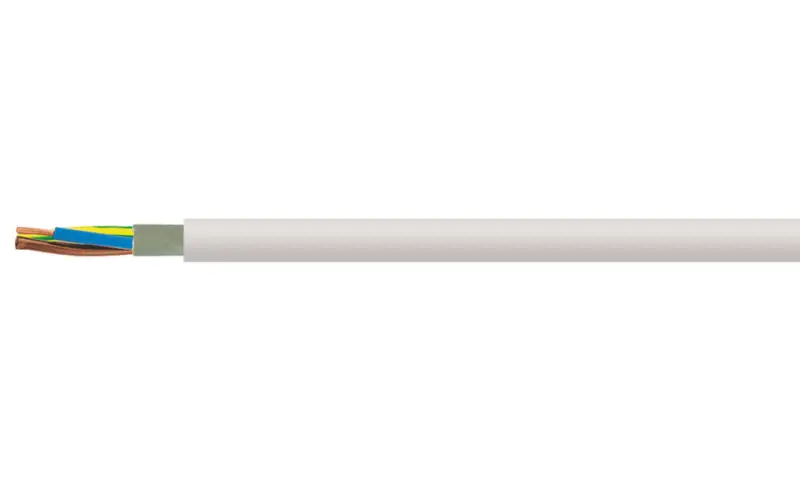
| Installation cables | NYM | DIN VDE 0250-204 |
| Heavy-duty rubber cable, crane | NSGAFÖU, NSHXAFÖ, NSHTÖU, NSSHÖU | DIN VDE 0250 |
| Harmonized cable (HAR) | H03VV-F, H05VV-F, H05VV5-F, H05VVC4V5-K, H05V-U, H05V-K, H05V2-K, H07V-U, H07V-R, H07V-K, H07V2-K | DIN EN 50525 |

8.2 Control cables with a VDE registration number (VDE-Reg.-Nr.)
HELUKABEL’s main control cable lines bear the VDE Registration Mark, with each group having a 4-digit registration code.
| VDE Registration No. | Products |
| 7032 | JZ-500, JZ-500-ORANGE, JZ-500-BLACK, OZ-500, OZ-500-ORANGE, OZ-500-BLACK, Y-CY-JZ, Y-CY-OZ, OZ-BL, SY-JZ, SY-OZ |
| 7034 | F-CY-JZ, F-CY-OZ, OZ-BL-CY |
Discover the features of the JZ-500 cable series with VDE-Reg.-Nr.


8.3 Cables and accessories manufactured in accordance with DIN VDE standards
HELUKABEL also offers many cable lines manufactured in accordance with DIN VDE in addition to the certification list above, such as J-Y(St)Y, JE-Y(St)Y, J-H(St)H, and A-2Y(L)2Y (DIN VDE 0815/0816) telecommunications and fire alarm cables, as well as NHXMH halogen-free cables. Specific certification information for each part number is included in the datasheet.
In addition, many of HELUKABEL's cable accessory products have also received VDE certification
Cables and accessories
Frequently Asked Questions
DIN VDE is a technical standard code issued by the DKE. VDE is the name of the association, and the VDE Institute is the certifying body. Cables labeled "DIN VDE" may not necessarily have VDE certification.
This is the 4-digit VDE Registration Mark code, issued when a product meets VDE standards for a specific application, when no current standard exists, or when deviations from the standard are permitted without compromising safety. Previously issued "VDE Reg. No." certifications remain valid.
The cable is manufactured in accordance with harmonized standards but has certain deviations. For example, a cross-sectional area or color not specified in the standard, so the manufacturer is not permitted to use the letter "H." "(H)" and "X" are older or alternative notations with the same meaning.
No. HAR certification is only granted to cables manufactured in the EU and Turkey. Cables manufactured elsewhere can only apply for VDE, IMQ, and other certifications separately.
Not exactly. Only cables bearing the <VDE> mark, identified by black-and-red color coding, or with a registration code are certified and monitored by the VDE Institute.
Yes. Many DIN VDE standards are harmonized with IEC standards, and VDE-compliant cables are often required in European FDI projects.
Need to verify the VDE/HAR certification for a specific cable model, or need advice on selecting a cable for your project? Please contact HELUKABEL Vietnam or download the datasheet for the product.