What is a hybrid solar power system? What is a hybrid inverter?
A hybrid solar power system combines the strengths of on-grid and off-grid systems, keeping homes and production lines powered by at least one of three sources — solar panels, battery storage, or the grid — even when the power goes out. So how does this system actually work? The answer lies in the hybrid inverter, which is the main focus of this article.
Article content:
1. What is a hybrid solar power system?
A hybrid solar power system combines two types of solar power systems : on-grid and off-grid. In this setup, the solar panels stay connected to the national grid while also charging a battery that stores excess energy — so your home can run on grid power, run independently, or use both at once, depending on what's needed.
Unlike conventional grid-tied systems (which loses power whenever the grid goes down) or a fully off-grid system (which relies on batteries alone), a hybrid system combines the advantages of both. That means your home always has power from at least one of three sources — solar, battery, or the grid — even on cloudy days or when the grid is unstable.
2. How a hybrid solar system is built and how it works
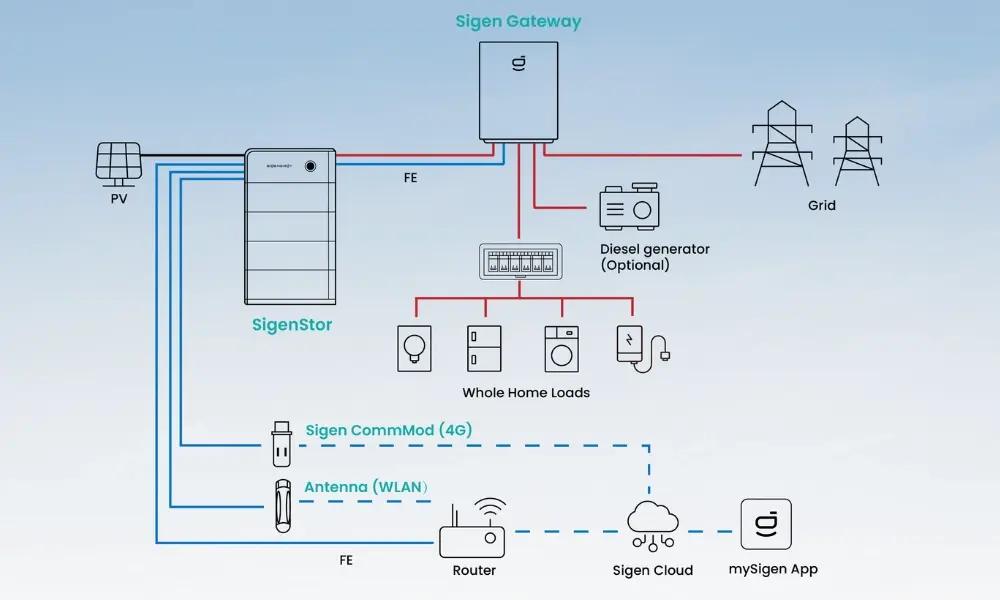
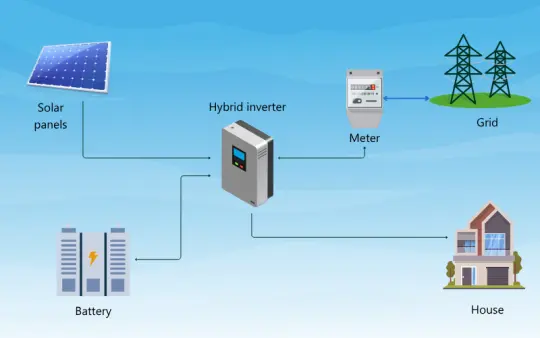
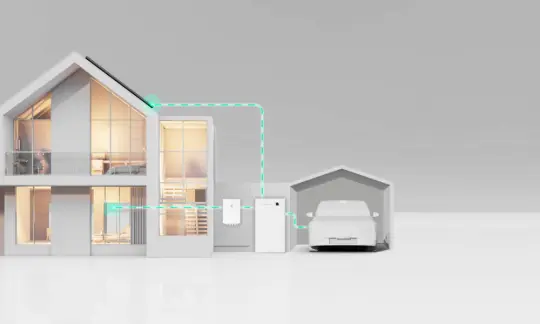
With a hybrid system, you always have power from at least one of three sources: solar power, storage batteries, or the utility grid
2.1 Key components of a hybrid solar power system
A hybrid solar power system is made up of several key components, each with its own role:
- Solar panels: generate direct current (DC) electricity from sunlight. A mounting frame on the roof or ground holds the panels at the right angle and direction to capture as much sunlight as possible.
- Hybrid inverter: converts DC power into AC power for household use. It also manages the flow of electricity between the grid, the battery, the solar panels, and the appliances in use.
- Battery storage: stores excess solar energy for later use. Battery systems usually come with a battery management system (BMS), which protects the battery by monitoring charging, discharging, temperature, and current.
- Grid connection: the national grid supplies power whenever solar and battery power aren't enough. If local regulations allow it, the grid can also buy back your excess solar power.
- Backup panel (optional): powers a set of pre-selected circuits during a power outage — typically the fridge, lighting, Wi-Fi, a few power outlets, and sometimes a small air conditioner.
💡Discover the role of inverters and battery storage solutions in solar power systems
2.2 How a hybrid solar system works
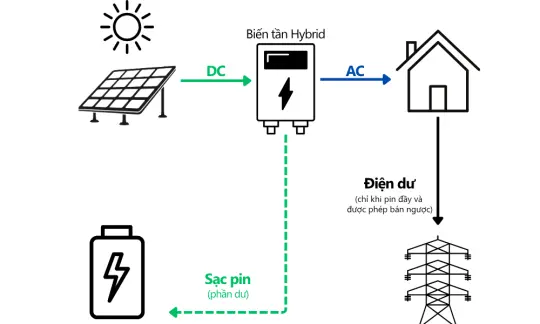
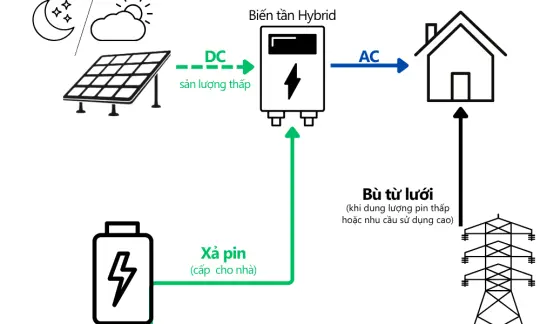
A hybrid solar system follows a simple order of priority: power the house first, charge the battery next, then export any leftover energy to the grid (if allowed). There are three typical operating scenarios:
- Sunny daytime: the panels generate DC power, which the hybrid inverter converts to AC for household use. The home uses solar power first. Once household demand is met, any surplus charges the battery. Only once the battery reaches its set charge level — and if grid export is allowed — does any remaining surplus get sent to the grid.
- Evening or cloudy weather: when there isn't enough sunlight, solar output drops. The battery then discharges to power the home. If the battery drops to a low threshold, or demand spikes, the grid steps in to cover the shortfall.
- During a grid outage: a standard grid-tied inverter must shut down automatically for safety, to prevent "islanding" (feeding power back into a de-energized grid). A hybrid system can keep running, but only if the hybrid inverter supports the right backup mode and the wiring is set up correctly. Many hybrid inverters can disconnect from the grid and form a self-contained "power island" for backup circuits in the home, so the battery and solar panels can keep supplying those circuits.
3. Hybrid inverter — The central component that governs the whole system
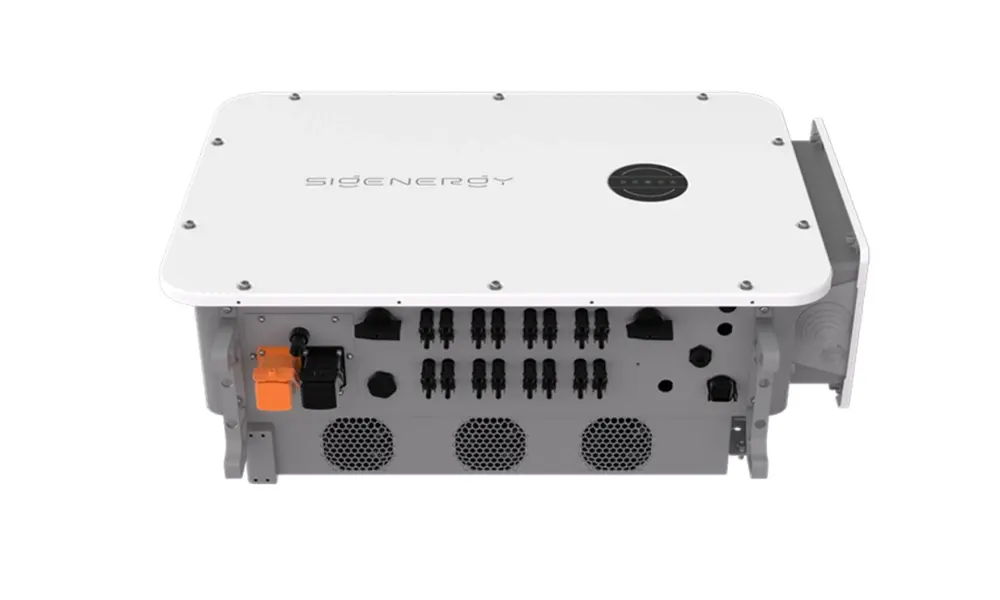
The Sigen Hybrid Inverter M1 features a backup port
A hybrid inverter combines the functions of a grid-tied inverter and an off-grid inverter in a single device. In other words, it's essentially a "two-in-one" inverter — acting as a grid-tied inverter to optimize electricity costs, and as a battery charger/inverter to provide backup power during an outage, something a standard grid-tied inverter can't do.
A hybrid solar inverter is a multi-function energy converter that combines four separate electrical functions into one device:
- DC-AC conversion from the solar panels (PV)
- Managing battery charging and discharging
- Syncing and interacting with the grid
- Providing backup power during a grid outage
4. Inside a hybrid inverter: How it's built
4.1 Main components of a hybrid solar inverter
Inside a hybrid inverter, you will find these main functional blocks:
- Solar input block: this is where the solar panels connect to the inverter. It converts the DC current from the panels into AC current while also tracking output to optimize performance. Newer hybrid solar inverters often support higher-voltage panel strings, which helps capture more energy.
- Battery management system (BMS): regulates the battery's charging and discharging, keeping it within safe limits to extend its lifespan, while also monitoring the flow of energy between the panels, the battery, and household appliances.
- Grid connection block: lets the inverter interact smoothly with the grid — allowing excess power to be exported, and drawing power from the grid to make up any shortfall from solar or battery. This block also keeps voltage and frequency stable for uninterrupted power delivery.
- Inverter circuit: the core component that converts DC to AC for household appliances. It includes safety protections such as overvoltage protection, surge protection, and short-circuit prevention.
- Monitoring and control interface: lets users track power output, consumption, and battery status in real time — usually through a mobile app or a dedicated display — making energy management simple and intuitive.
4.2 What are AC coupling and DC coupling in a hybrid solar system?
When designing a hybrid system, one key decision is how to connect the battery to the solar panels: DC coupling or AC coupling.
- What is DC Coupling?
In a DC-coupled setup, the solar panels connect directly to the battery using DC current — no need to convert to AC before charging the battery. This setup usually requires an additional charge controller to make sure the battery charges properly and safely.
The biggest advantage of DC coupling is high transfer efficiency. Because power flows straight from the panels to the battery without an extra conversion step, energy loss from conversion is minimized — which is especially useful when the main goal is storing solar power for later use. DC coupling also works well in both grid-tied and off-grid systems.
- What is AC coupling?
In an AC-coupled setup, DC power from the solar panels is first converted to AC, then either used directly or converted back to charge the battery. This setup requires inverters working in both directions: DC to AC for use, and AC back to DC for charging the battery.
Even though this extra conversion step means more energy loss than DC coupling, AC coupling has its own advantage: it's more compatible with existing grid-tied solar systems, making it a good fit if you want to add battery storage to an older system without replacing the whole setup.
5. How a hybrid inverter operates in each mode
A hybrid inverter can run in several different modes, automatically managing the flow of energy between solar, battery, connected loads, and the grid depending on what you need:
| Features | Self-consumption | UPS (Backup) | Peak shaving | Off-grid |
| Grid connection | Yes | Yes (auto-islands on outage) | Yes | No |
| Battery behavior | Stores excess solar, discharges when solar output is low | Kept nearly full as a standby reserve | Charges during off-peak hours, discharges during peak hours | Main power source whenever there's no sun |
| Power priority | Solar → Load → Battery → Grid | Solar+Grid → Battery; Battery → Load on outage | Off-peak: Grid/Solar → Battery; Peak: Battery → Load | Solar → Load → Battery (no grid) |
| Grid export | Yes, once the battery is full | Possible but not prioritized | Yes, surplus during peak-hour discharge | No |
| Best for | Maximizing solar self-use | Areas with frequent outages, critical loads | Large gaps between peak and off-peak electricity rates | Areas with no grid access |
5.1 Self-consumption mode
This is the default mode on most hybrid inverters, and it works on a simple principle: solar power is used on-site first, any surplus charges the battery, and only once the battery is also full does any remaining surplus get exported to the grid. At night, the system draws from the battery until the state of charge (SOC) hits a minimum threshold (usually around 10-20%), then starts drawing from the grid to cover the rest.
5.2 UPS (Backup) mode
The key difference with this mode is that the battery is always kept nearly 100% full, acting as an emergency reserve rather than being cycled for daily use. In exchange, when the grid goes down, the hybrid inverter automatically disconnects and switches entirely to battery power within just a few milliseconds — fast enough that sensitive equipment like refrigerators, medical devices, or networking gear won't experience any interruption.
5.3 Peak shaving mode
This mode runs on a schedule tied to your electricity rate plan: the battery charges from the grid and solar during cheap, off-peak hours, then discharges to power your loads during expensive peak hours, helping you avoid most of the high-rate charges. Because of this, the mode only really pays off where there's a big gap between peak and off-peak electricity prices, and it requires a battery large enough to cover the entire peak period — otherwise it will run out before peak hours end, forcing the system to fall back on expensive grid power.
5.4 Off-grid mode
This mode runs completely independent of the national grid: during the day, solar power both supplies the loads and charges the battery; at night, the battery handles the entire load. Since there's no grid to fall back on, off-grid systems need more careful design: the battery must have enough capacity to get through several days of low sunlight in a row, the inverter's peak power output must be high enough to start up motors or pumps, and a backup generator is often needed for rainy seasons or long stretches of low sunlight.
6. Advantages and disadvantages of a hybrid solar power system
6.1 Advantages of hybrid solar power
- Keeping your power supply stable even during a grid outage (as long as you choose a model with the right backup capacity)
- Making the most of the solar power you generate instead of wasting it, while also reducing your reliance on the grid thanks to having your own power source
- Scheduling battery charging and discharging around cheap/expensive rate periods to optimize costs
Many utilities offer net metering, letting you sell excess solar power back to the grid — cutting your electricity costs and even creating extra income - Reducing your carbon footprint compared to relying entirely on grid power
- Some models, like the Sigen Hybrid Inverter, use a fanless design for near-silent operation (around 25dB) and high conversion efficiency (up to 99% on the three-phase version)
💡Comparing the Pros and Cons of Hybrid Systems vs. Grid-Tied Systems
6.2 Disadvantages of hybrid systems
- Higher upfront cost than a pure grid-tied system, due to the added cost of battery storage
- Not every model can back up the whole house (many are limited to essential loads), and even with careful sizing, battery capacity is still limited — so during a long outage, the system may not have enough power to keep the whole house running the entire time
- Batteries also have a limited lifespan, so they will eventually need replacement or servicing, adding to long-term running costs
7. Hybrid solar inverter from HELU
HELU Vietnam currently offers the Sigen Hybrid Inverter across several power ranges:
- Residential version with built-in EMS: 3.0-12.0kW (single phase) or 5.0-30.0kW (three phase)
- Standalone version paired with SigenStor BAT batteries: 2.0-6.0kW (single phase) or 3.0-12.0kW (three phase)
- Commercial and industrial version: 50-125kW
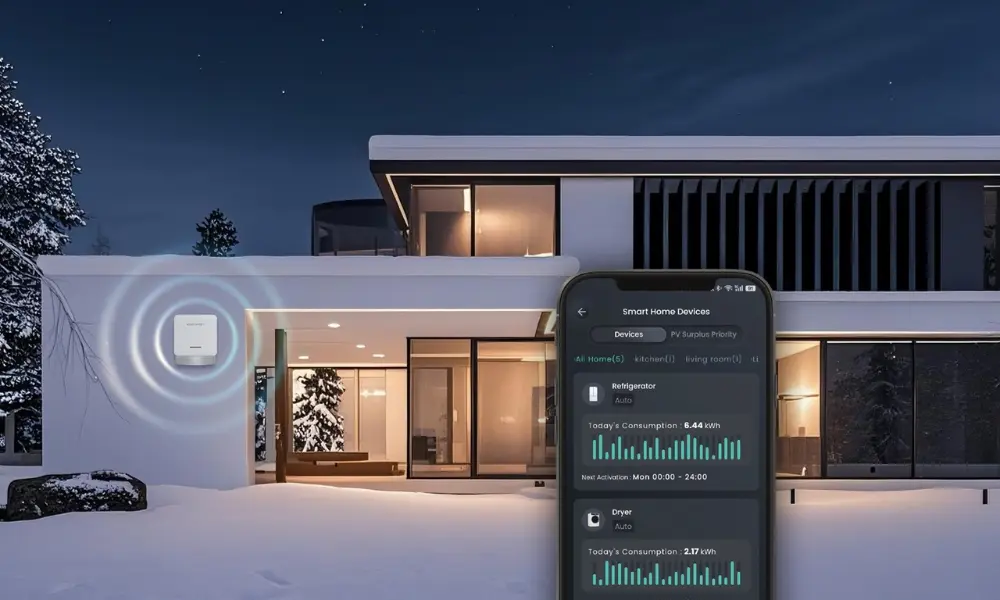
It operates at a noise level of just 25 dB—virtually silent—and does not interfere with daily activities.
7.1 Hybrid solar inverter for residential systems
Sigen Hybrid Inverter — a hybrid inverter built for homes, balancing living-space comfort with performance:
- At just 99mm thick, it mounts neatly on a wall without taking up much space. It also runs at an almost silent 25dB, so it won't disrupt everyday life at home.
- Rated IP66, with a wide operating temperature range (-30°C to 60°C), making it well-suited to Vietnam's year-round hot, humid climate.
- Reaches a maximum conversion efficiency of up to 99% — among the best in the industry. It can also deliver peak output of up to 200% of rated power in off-grid mode, and supports a DC/AC ratio of up to 200%.
- When paired with a Sigen Energy Gateway and Sigen Battery, the switchover time to backup mode can reach 0ms. It also comes with a full set of safety protections: reverse DC polarity protection, insulation and residual current monitoring, DC arc-fault detection, Type II surge protection for both DC and AC, and anti-islanding protection.
- A wide power range to fit different home sizes: single-phase from 2.0-6.0kW and three-phase from 3.0-12.0kW, weighing as little as 11.5kg (single-phase version).
- Comes with multiple remote-monitoring connection options — WLAN, Ethernet, RS485 , and Sigen CommMod for 4G/3G/2G mobile networks — so you can monitor your system even in areas with weak Wi-Fi.
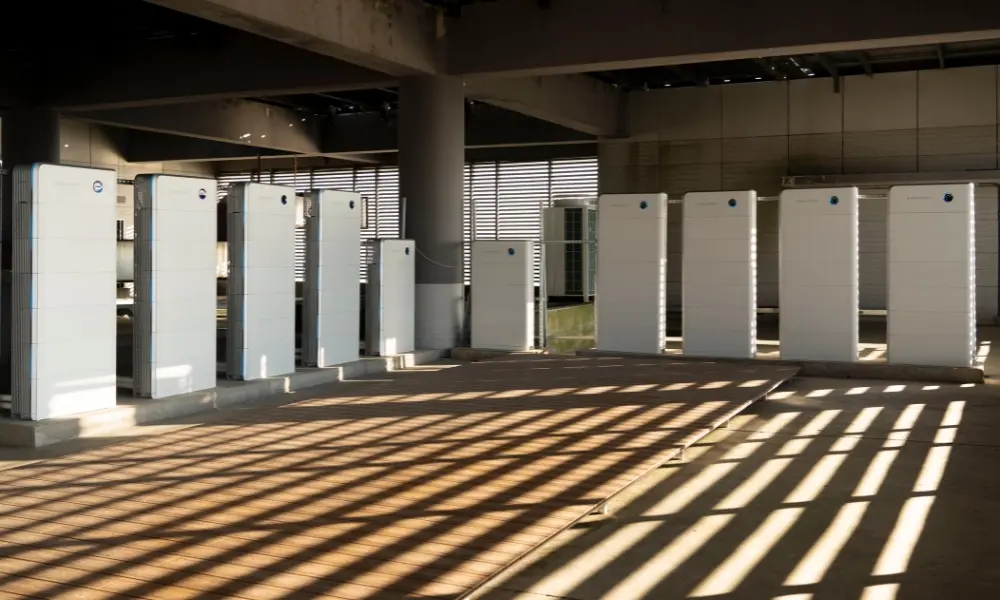
Inverter + storage solutions for C&I systems
7.2 C&I hybrid inverter, scaling flexibly from kW to MW
For this segment, the Sigen C&I Inverter comes in a wide power range — 50.0, 60.0, 80.0, 100.0, 110.0, and 125.0 kW — covering everything from mid-sized production facilities to buildings with large power demands:
- One standout feature: you can install the inverter first and add battery storage (PV + BESS) at any point later, so businesses don't have to invest in everything upfront and can still plan their hybrid solar power system's expansion on their own terms.
- Every inverter comes with a built-in EMS (energy management system), supporting up to 100 units running in parallel without needing a separate data logger. Its arc-fault detection (AFCI) range reaches up to 500m — among the best in the industry.
- Ensures seamless switchover with just 0ms of load-side disruption, along with the ability to handle 150% overload for 10 seconds to smoothly manage demanding loads — so equipment starts up smoothly without disrupting the production line.
- When you need to scale up, the system supports connecting multiple units through an Energy Gateway, letting you expand flexibly from tens of kW all the way up to the MW range, without being limited to a single inverter.
8. Cable solutions for UPS and BESS
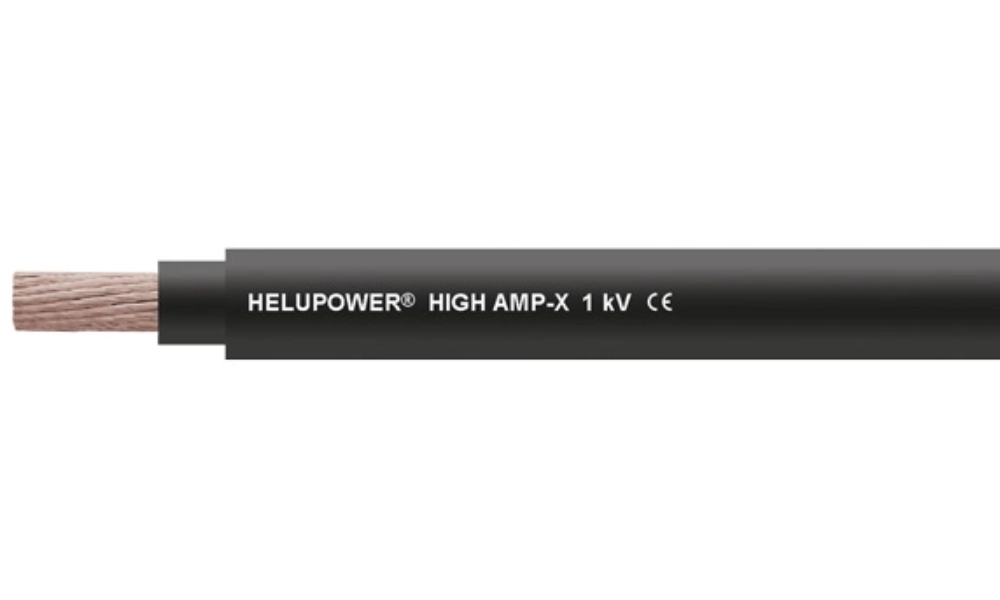
HELUPOWER® HIGH AMP-X Single-Core Cable for BESS Storage Systems
A complete hybrid system needs more than just the right inverter and battery — it also needs cabling that meets the technical requirements of each part: backup power (UPS) and battery storage (BESS) connections.
8.1 Cables for Uninterruptible Power Supplies (UPS)
For uninterruptible power circuits, cables need to meet several criteria: lower energy loss thanks to higher DC operating voltage, suitability for direct burial, halogen-free construction for better fire safety, and resistance to UV, ozone, weather, and water. HELU currently offers two cable lines that meet these criteria:
- HELUPOWER® HIGH AMP-X (11030011) — a power cable optimized for UPS applications, suitable for direct burial, halogen-free, resistant to UV/ozone/weather/water, and also available with an aluminum conductor for cost-sensitive projects.
- NSHXAFÖ 1.8/3 kV (38517) — withstands short-circuit and earth-fault conditions up to 1,000V, oil-resistant, halogen-free, and built for higher mechanical stress — well-suited to demanding industrial environments.
8.2 Cables for battery storage and backup systems
HELU also offers a full range of power, control, data, and specialty cables covering the entire backup power chain — not just UPS/BESS, but the related functional areas as well:
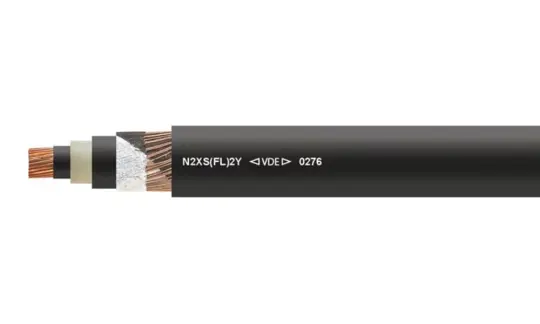
- Grid/medium-voltage connection: N2XS(FL)2Y (33054), NA2XS(FL)2Y (38062)
- Transformers, switchgear (medium-voltage/low-voltage): cables for the main low-voltage distribution panel.
- UPS and battery systems/BESS: Specialized cables for uninterruptible power supplies and battery energy storage systems.
- Emergency backup power systems: N2XH (53558), N2XCH (53200)
💡Discover medium-voltage underground cable solutions for the energy sector
9. FAQs
No, you don't. With models like the Sigen Hybrid Inverter, you can install the hybrid inverter first and add battery storage later when you need it, without having to replace the inverter.
It depends on your current inverter. If your existing grid-tied inverter doesn't have a battery connection port (no AC-coupled battery support), you'll typically need to replace it with a new hybrid inverter, or add a separate battery inverter running alongside your existing inverter in an AC-coupled setup — a common upgrade path internationally, since it doesn't require removing your existing grid-tied system.
It depends on the manufacturer. With the Sigen Hybrid Inverter (residential version), when paired with a Sigen Energy Gateway and Sigen Battery, the load-side disruption time can reach 0ms under standard test conditions.
It depends on the model. Many hybrid inverters can only back up essential loads (fridge, lighting, router...) due to the power limits of the backup port. Also, even when a system can back up the whole house, battery capacity is still limited — so during a long outage, the system may not have enough power to keep everything running the whole time.
Besides having a much higher power output (50-125kW versus 3-30kW), the industrial version also comes with a built-in EMS that lets hundreds of inverters run in parallel, arc-fault detection (AFCI) at ranges up to 500m, the ability to scale from kW up to MW through an Energy Gateway, and some newer models even support 150% overload for 10 seconds along with a 0ms backup switchover — making it better suited to factories and commercial buildings than a single home.
A grid-tied system consists only of solar panels and an inverter ; with no battery — so a grid outage means no power at all. An off-grid system isn't connected to the grid and has to be fully self-sufficient. A hybrid system combines all three components — solar panels, battery storage, and a grid connection — so it gets the cost savings of a grid-tied system and the backup power of an off-grid system.
Yes, if your local utility offers net metering — which lets you sell surplus solar power (after covering your own use and charging the battery) back to the grid, helping lower your electricity bill or even earn extra income.