What is on-grid solar system? How it works, its components, inverters, and battery storage
Many people assume all solar power systems work the same way. In reality, on-grid, off-grid, and hybrid systems operate on entirely different principles — differing in whether they need battery storage, and whether they can still supply power during a grid outage. Among the three, on-grid is the most common and the most cost-effective, but it's also the most misunderstood: many assume that installing an on-grid system means having power available at all times, even during a blackout. The truth is actually the opposite — most on-grid systems automatically shut down the moment the grid goes out, no matter how sunny it is. So why does this happen, and which inverter or system type should you choose? The article below has the full answer.
-
1What is on-grid solar power?
-
2How an on-grid solar system works
-
34 operating scenarios of an on-grid solar system
-
4Components of a grid-connected system
-
5What is an on-grid inverter? Types of inverters
-
6Comparison of string, micro, and hybrid inverters
-
7Feed-in (non-zero-export) on-grid system
-
8Zero-export (non-feed-in) on-grid system
-
9On-grid system with storage (Hybrid)
-
10Comparison of on-grid, off-grid, and hybrid solar systems
-
11Advantages and disadvantages of an on-grid solar system
-
12HELU products - DC cables
-
13HELU products - MC4 connectors and accessories
-
14On-grid inverters: 5 kW, 50, 60, 125, and 166.6 kW
-
15Battery storage
1. What is an on-grid solar system?
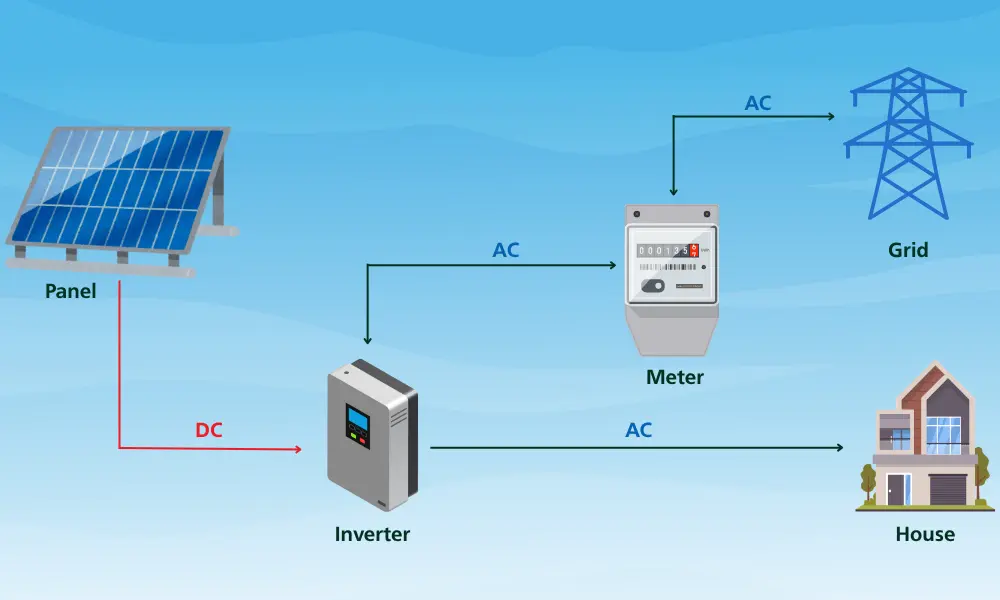
Components of a grid-connected solar power system (on-grid solar)
An on-grid solar system is a solar power system connected directly to the national electricity grid, with no independent battery storage. Solar panels (PV modules) absorb sunlight and generate direct current (DC); this current then passes through a grid-tie inverter, which converts it into alternating current (AC) matching the grid's voltage, frequency, and phase, so it can either power loads directly or be exported to the grid.
This is the most suitable solution in areas with a stable grid and few power outages — which is also why this type of system is the most common choice as a primary power source for homes, schools, factories, and commercial buildings.
In the market, on-grid systems go by several different names depending on the source or supplier: grid-connected solar system, grid-intertied solar system, or grid-direct solar system — all referring to essentially the same type of system.
The key factor that distinguishes an on-grid system from other types lies in the inverter: a grid-tie inverter must precisely synchronize its sine wave, frequency, and phase with the grid before feeding power into it. A high-quality modern inverter operates at a power factor close to 1 (unity power factor) with a phase deviation from the grid of within about 1 degree — if this level of synchronization isn't achieved, the current fed back could cause interference, overvoltage, or damage to nearby equipment.
2. How an on-grid solar system works
2.1 Operating mechanism
An on-grid system operates through a tightly coordinated sequence of steps, from the moment sunlight is absorbed to the moment the electricity is actually used:
- First, the solar panels absorb sunlight and generate direct current (DC): This happens continuously throughout daylight hours, whether the panels are mounted on a roof or on the ground, as long as the installation angle captures sunlight efficiently throughout the day.
- Converting DC to AC: since most household and business appliances run on alternating current (AC), the DC output from the panels must pass through the grid-tie inverter to be converted into AC that matches the grid's voltage, frequency, and phase — this is also the step that allows the power to feed into the grid and remain compatible with any standard equipment on-site.
- Powering appliances: once converted to AC, the electricity is used first to directly power on-site loads — lighting, air conditioning, production equipment, and so on — directly reducing the amount of electricity that needs to be purchased from the grid.
- Any surplus power left after on-site demand is met is not wasted; it is exported to the public grid and recorded through net metering, which offsets the electricity bill or is converted into an energy credit. Conversely, when solar output is low, the system automatically draws the shortfall from the grid — keeping the power supply continuous without any manual intervention.
2.2 Operating scenarios of an on-grid solar system
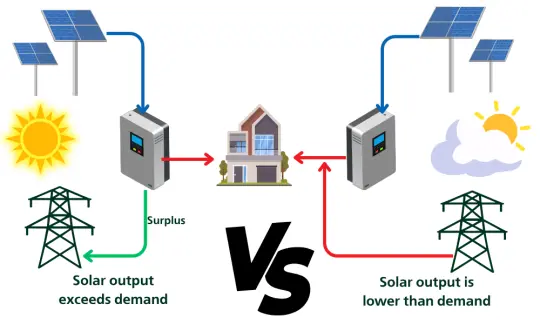
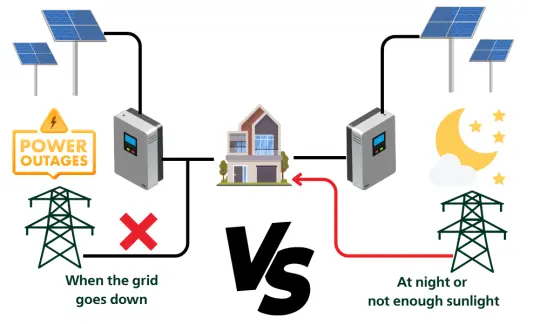
An on-grid system automatically switches between four main scenarios, depending on the balance between solar output and consumption demand at any given moment:
- When solar output exceeds demand: after on-site loads are fully covered, the surplus power is exported to the national grid. This is recorded and offset through net metering — the meter effectively runs backward to log the exported power, which is credited against the electricity bill or compensated according to the local utility's policy at the time.
- When solar output is lower than demand: all power from the solar system is used first; the shortfall is automatically and instantly supplemented from the grid, without any disruption to running equipment.
- When the grid goes down (outage or planned shutdown): once the grid is lost, the solar system stops operating. This is known as anti-islanding: the inverter continuously tracks the grid's phase and frequency signal through a phase-locked loop; when the grid disappears, the reference signal is lost, causing the inverter to detect the phase mismatch and disconnect within a few electrical cycles. This exists to ensure electrical safety and prevent equipment damage from unsynchronized power. As a result, a standard on-grid system (without battery storage) cannot supply power during a grid outage, even on a bright sunny day.
- At night or when there isn't enough sunlight: with no sunlight to generate power, all loads are supplied from the grid as usual.
3. Components of an on-grid solar power system
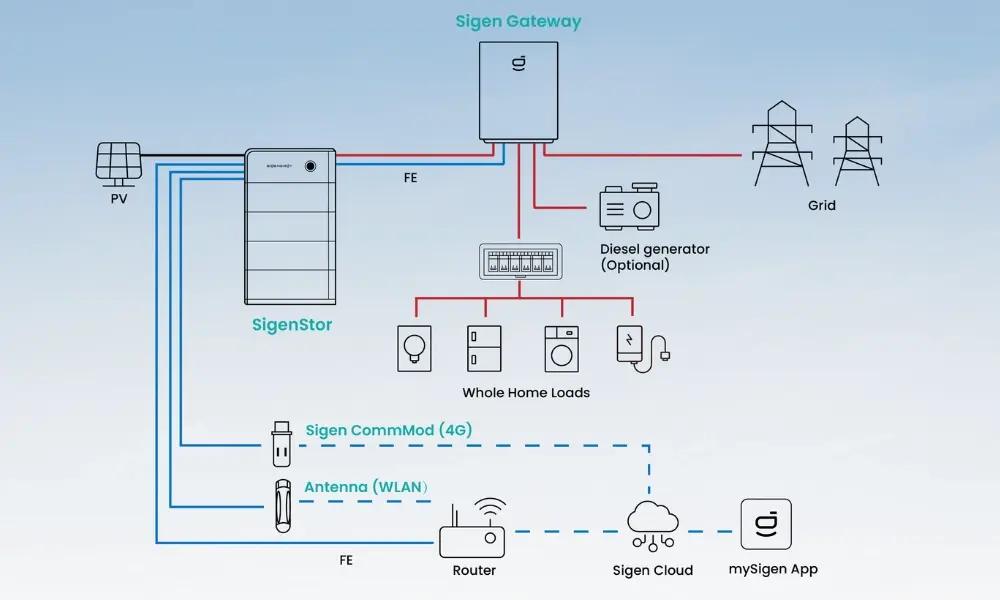
On-grid solar power systems can be equipped with a storage system to store excess electricity for later use or in the event of a power outage.
A complete on-grid PV system involves more than just solar panels — several other components work together to convert and deliver electricity safely:
- Solar panels (PV module/array): where sunlight is directly converted into DC electricity. Most modern panels include bypass diodes between cell groups to minimize the impact of partial shading and prevent "hot spots" that could otherwise lead to fire.
- Mounting structure: secures and orients the panels, categorized by installation location — roof-mount, ground-mount, or pole-mount — and must withstand wind, rain, and corrosion for decades.
- Grid-tie inverter with built-in MPPT: converts DC to AC and synchronizes with the grid.
- Storage system (battery, optional in hybrid setups): stores surplus power for later use or for outages.
- AC/DC distribution panels and protection devices (circuit breakers, surge protection, residual current protection) along with a bidirectional meter.
- DC/AC cables and dedicated connectors (such as MC4) to link panels into strings and carry power to the inverter.
4. Grid-tie inverters — Role and types
The inverter is considered the "brain" of a solar power system: beyond converting DC to AC, modern inverters also monitor the system and provide grid services such as reactive power adjustment and response to grid frequency fluctuations; for systems with battery storage, they can also operate independently during an outage if designed to do so.
Choosing the right type of grid-tie inverter depends on system size, power consumption, and actual installation conditions (whether the roof is shaded, available roof area, and whether battery storage is planned for the future). There are three main types of inverters commonly used in on-grid systems:
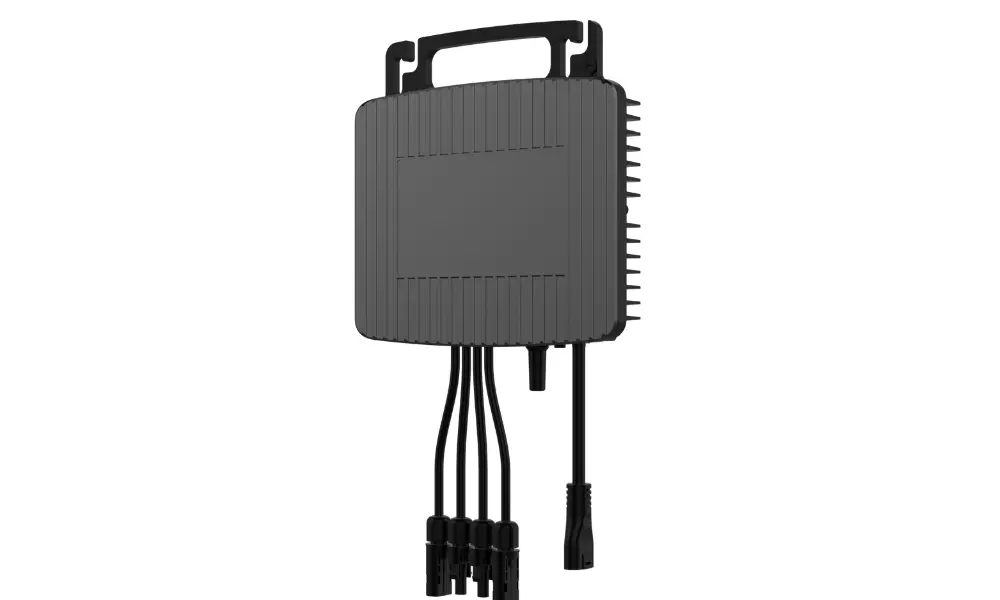
Sigen Micro Inverter with built-in EMS; no network gateway required
4.1 String inverter
Multiple panels are wired in series into a string, all feeding into a single shared inverter. This is the lowest-cost option, with moderate installation complexity, and suits large residential systems and commercial buildings with open, unshaded roofs.
4.2 Microinverter
Each panel is fitted with its own small inverter, allowing independent monitoring and performance optimization for every panel. This minimizes the impact of partial shading or complex roof layouts — at the cost of a significantly higher price per watt and more complex installation, since wiring and mounting must be done at each individual panel.
4.3 Hybrid inverter
In essence, a hybrid inverter is a standard grid-tie inverter combined with the ability to connect to battery storage. When the grid fails or supply falls short, the system can draw power from the battery to supply loads, giving homeowners or businesses more independence instead of relying entirely on the grid. This is the best option for anyone who wants to both save on electricity and have backup power available.
| Criteria | String inverter | Microinverter | Hybrid inverter |
| System size range | 3kW – 100kW+ | 200W – 500W/panel | 3kW – 15kW |
| Installation complexity | Moderate | High | High |
| Battery compatibility | No (requires a separate inverter) | No (requires a separate inverter) | Yes |
| Impact of shading | High | Low | Moderate |
| Maintenance requirements | Low | Very low | Moderate |
| System scalability | Limited | Very flexible | Moderate |
| Suitable applications | Large residential/commercial buildings | Complex roofs with partial shading | Sites needing storage & backup power |
5. Types of on-grid solar systems
5.1 Feed-in (non-zero-export) on-grid system
This is a solar system without battery storage, where all surplus power is exported straight to the grid. It's the lowest-cost type of on-grid system, but it loses power entirely during a grid outage.
This is the most common type of on-grid system: solar power is used for on-site loads first; any surplus is exported ("fed back") to the national grid through a bidirectional meter and recorded via net metering; when output falls short, the system automatically draws the difference from the grid. It's called "feed-in" because the direction of current flow when exporting to the grid is the exact opposite of the direction when drawing power from it.
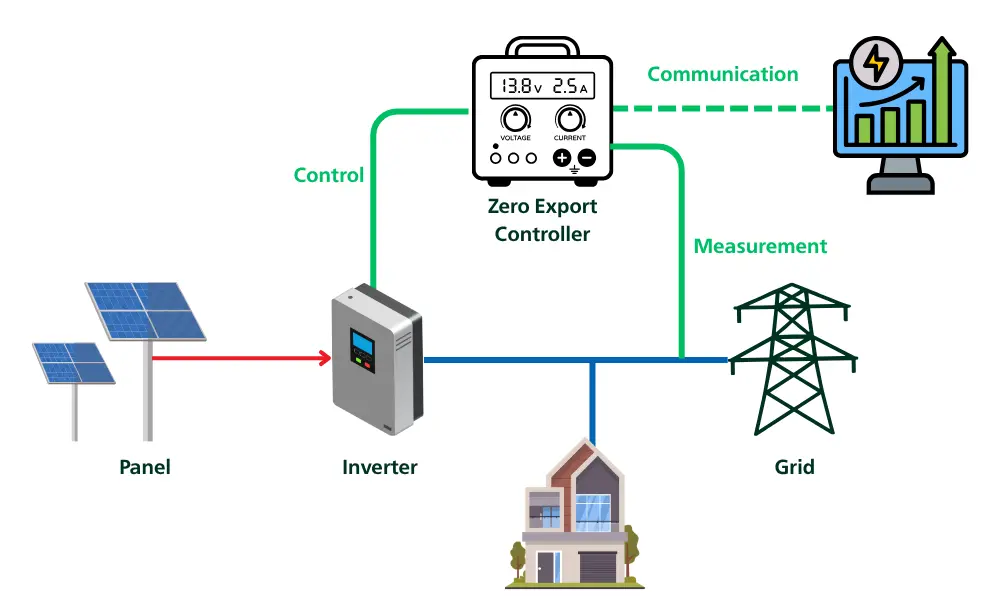
Zero-export (non-feed-in) on-grid system
5.2 Zero-export (non-feed-in) on-grid system
In this configuration, the system is set up to never export surplus power to the grid, no matter how much excess is generated — typically through an anti-reverse-flow relay or zero-export controller that continuously measures consumption and limits the inverter's output to exactly match the current load; any remaining surplus is simply curtailed rather than exported. When power falls short, the system still draws from the grid as normal. This setup is usually mandatory in areas or under utilities that don't allow, or strictly limit, power being exported back to the grid.
5.3 On-grid system with storage (Hybrid)
This is an add-on layer that can be integrated into either of the types above. With battery storage in place, the system becomes far more self-sufficient: it can operate independently and keep supplying loads even during a grid outage, an export restriction, or a technical fault. Because of this, storage-equipped systems are typically the preferred choice for loads that demand high reliability, such as emergency communication systems, medical equipment, gas stations, or lighting/signage at shelter sites.
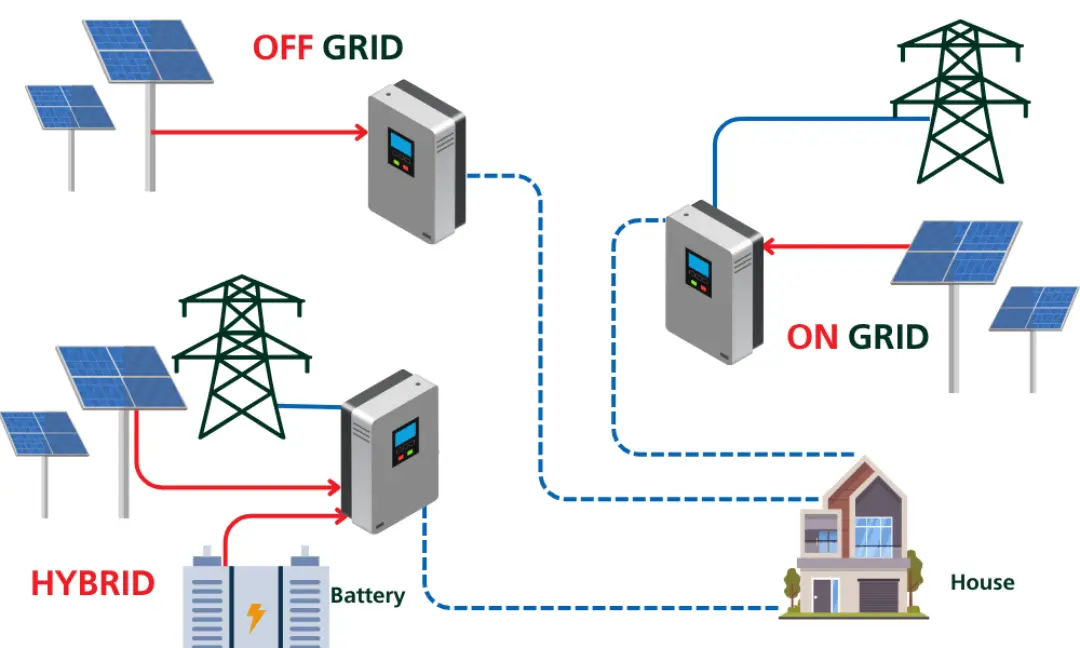
6. Comparison of on-grid, off-grid, and hybrid solar systems
| Criteria | On-grid | Off-grid | Grid-connected solar power system with storage (Hybrid) |
| Grid connection | Yes | No | Yes |
| Battery storage | No | Compulsory | Yes |
| Works during a grid outage | No (shuts down automatically) | Yes | Yes |
| Sells surplus power to the grid | Yes (net metering) | Not applicable | Yes |
| Upfront cost | Lowest | High | Highest |
| Suitable for | Areas with a stable grid | Areas without access to the grid | Sites that need backup power during outages |
- On-grid is the cheapest system but relies entirely on the grid: it has no battery storage, and the inverter simply follows the grid's signal and shuts down automatically when the grid goes out — in exchange, it can sell surplus power back through net metering.
- An off-grid system is the opposite — it isn't connected to the grid at all, requires battery storage to operate, and costs more upfront, but it always keeps you in control of your own power supply, making it suitable for areas with no grid access.
- Hybrid combines both: it's connected to the grid and has battery storage, so it can still power critical loads during an outage — but this also makes it the most expensive option.
7. Advantages and disadvantages of an on-grid solar system
7.1. Advantages
- Significantly lower upfront cost compared to hybrid or off-grid systems, since no battery or storage equipment is needed.
- Surplus power can be sold back to the grid through net metering.
- Helps ease pressure on the transmission grid during peak hours and reduces long-distance transmission losses, since power is generated and consumed close together.
7.2. Disadvantages
- Fully dependent on the grid: during an outage, the system is required to shut down for safety reasons (anti-islanding), unless battery storage is added in a hybrid configuration.
- Grid connection must comply with the technical standards and procedures set by the local utility.
- Not well suited to areas with frequent power outages.
8. HELU products for on-grid solar systems
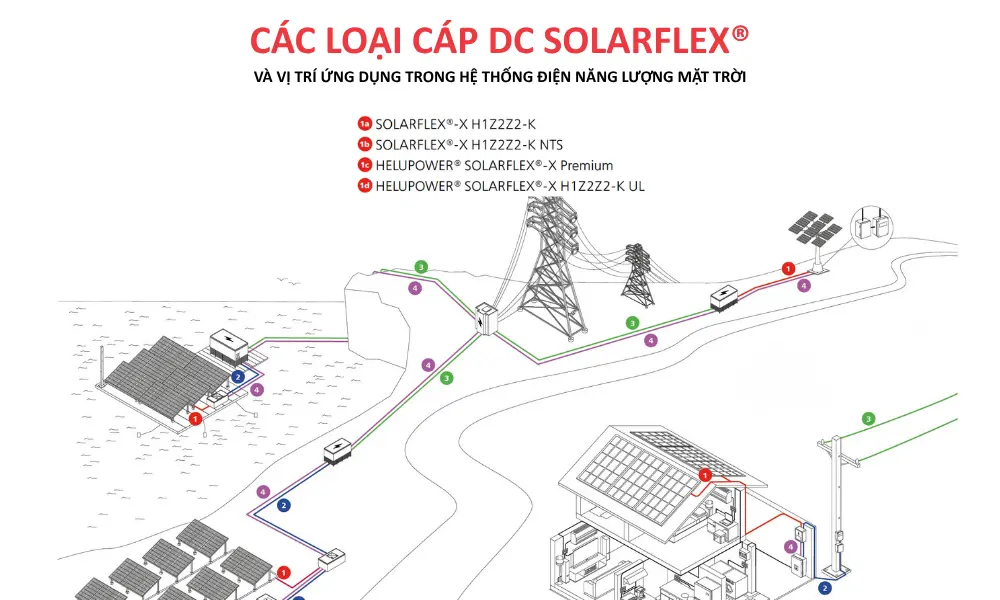
Applications of SOLARFLEX DC cables in grid-connected, rooftop, ground-mounted, and floating PV solar power systems
HELU Vietnam supplies everything needed to build a complete on-grid solar system — from cables and connectors to inverters and battery storage.
8.1 DC Cables
The DC cables connecting the solar panels to the inverter must withstand harsh outdoor conditions for 20–25 years: UV resistance, high heat tolerance, and flame-retardant properties, typically manufactured to dedicated PV cable standards (such as EN 50618 in Europe).
8.2 MC4 connectors and accessories
These are essential components for installing grid-connected solar power systems. Our product lineup includes:
- MC4-Evo2A DC cable connector : IP68-rated, operates reliably at altitudes of up to 5,000 m above sea level, ammonia-resistant as certified by TÜV Rheinland in accordance with 2 PfG 1911/03.2011, and meets Safety Class II standards
- UV-resistant corrugated tubing accessories specifically designed for solar power systems
- Cable lugs and terminal crimping pliers
- Ground wire
- Tool box
- Cable harnessing solutions
8.3 Grid-tie and hybrid inverters
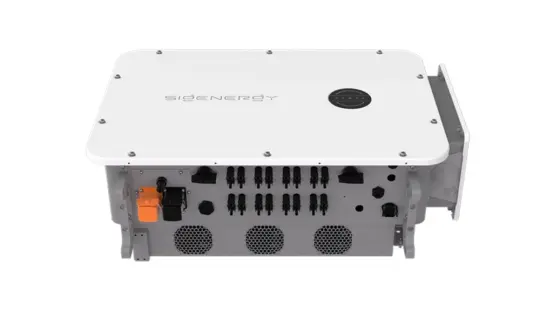
HELU distributes the Sigenergy inverter range, covering a variety of on-grid system needs:
- Sigen PV Inverter: a pure grid-tie string inverter, rated 50 – 166.6 kW, with peak efficiency of 98.8%, designed for commercial and industrial buildings.
- Sigen Hybrid Inverter: an inverter with a battery connection port. The residential version comes with a built-in EMS (Sigen Energy Controller / SigenStor EC) rated 3.0 – 12.0 kW single-phase or 5.0 – 30.0 kW three-phase; a standalone version paired with the SigenStor BAT battery is rated 2.0 – 6.0 kW single-phase / 3.0 – 12.0 kW three-phase. The commercial/industrial version is rated 50 – 125 kW.
- SigenMicro: a microinverter rated 400 – 1000W, with peak efficiency of 97.0 – 97.5%, suited to complex roofs or balconies.
💡Explore our full lineup of grid-tied, load-following inverters
8.4 Solar storage batteries
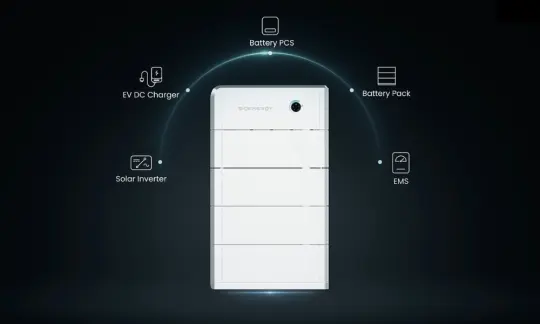
- SigenStor BAT (residential, modular): each module holds 6.02 or 9.04 kWh, with charge/discharge power of 3,000 – 4,600W, using LFP cells rated 314Ah with 10,000 cycles; up to 6 modules can be stacked per controller.
- SigenStack BAT 12.0 (commercial/utility, modular): each module holds 12 kWh, with 4–21 modules per system (equivalent to 48 – 252 kWh), and charge/discharge power of 55 – 137.5 kW depending on the paired inverter.
- SigenMate 2700 Ultra (2-in-1, plug & play): a built-in LiFePO4 battery with 2.688 kWh capacity, maximum PV input of 4,000W, and maximum discharge power of 1,400W — suited to apartments and balconies.
8.5 Integrated solutions and energy management solutions
- Sigen Energy Gateway: a central coordination hub that lets multiple inverters run in parallel and automatically switches between the grid, inverter, battery, and diesel generator with zero interruption to connected loads. Rated 12 – 30 kW for residential use (Gateway HomePro), scaling up to several hundred kW for industrial projects.
- Sigen Cloud & mySigen App: a remote monitoring and management platform for real-time tracking of energy production, consumption, and battery status.
- Sigen EVAC Charger: an EV charger integrated into the wider energy ecosystem, with bidirectional (V2X) charging support on select models.