What is off-grid solar power system? Components and applications
In our previous two articles, we looked at on-grid and hybrid solar systems — two common solutions for sites that already have a grid connection. This time, let's take a closer look at off-grid solar power systems — the right solution for areas without grid access, or anywhere you need a fully self-sufficient power source that doesn't depend on the national grid. This article explains exactly what this system is, what it consists of, how it works, and how to choose the right capacity for your actual needs.
Article content:
1. What is an off-grid solar power system?
An off-grid solar power system generates and stores its own electricity from sunlight, without connecting to or relying on the national grid. All the electricity used in the house or facility comes from solar panels and is stored in batteries, instead of being supplied by the local utility the way it is for ordinary households.
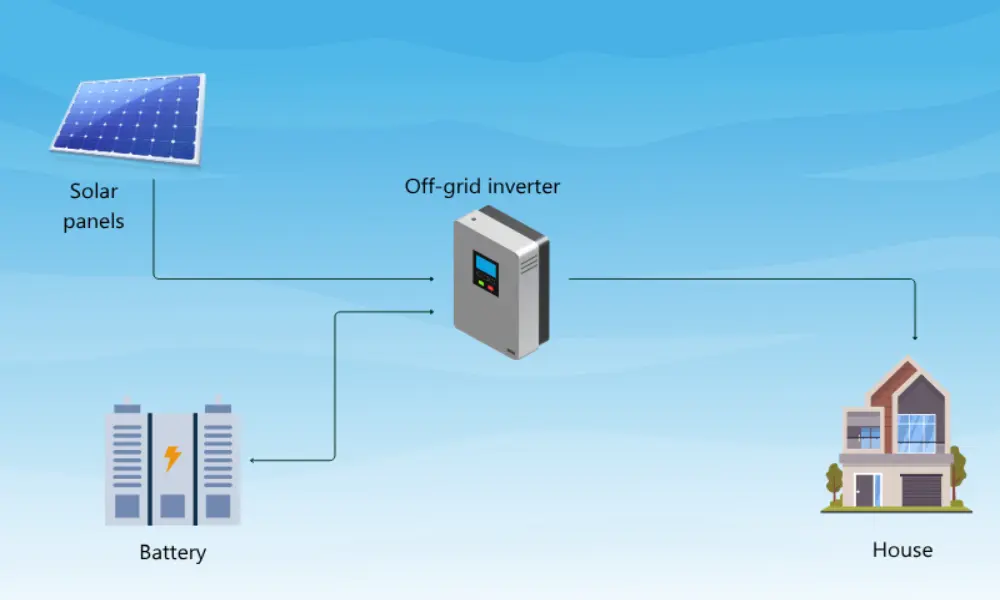
Off-grid solar power system
1.1 What is off-grid?
"Off-grid" is a general term for buildings or lifestyles designed to be independent of one or more public infrastructure services — most commonly, the national power grid. For a solar power system, going off-grid means the house or facility generates all its own electricity using its own solar panels and batteries: the system produces electricity with solar panels, charges the batteries through a charge controller, and then an inverter converts that power to supply the appliances in the home or a larger facility.
Off-grid used to be seen mainly as an option for small, remote cabins. But thanks to rapid advances in lithium-ion battery technology and solar panel efficiency in recent years, living off the grid has become a far more viable, reliable, and sustainable choice — not just for small households, but for any facility that wants true energy independence.
In exchange for that complete independence, off-grid system owners also take on responsibility for three important things:
- Generating enough electricity to meet daily consumption needs
- Storing enough backup power in the batteries to get through the night and through several consecutive cloudy or low-sun days
- Actively managing their consumption habits and performing routine maintenance to keep the power supply from being interrupted
1.2 Distinguishing between off-grid, on-grid, and hybrid systems
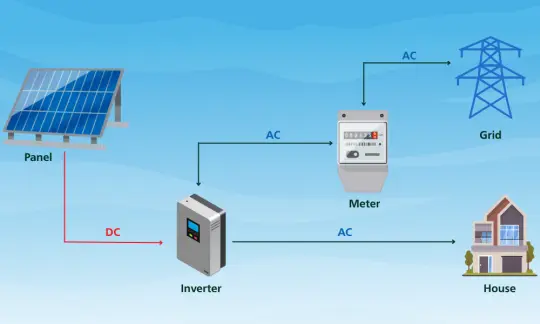
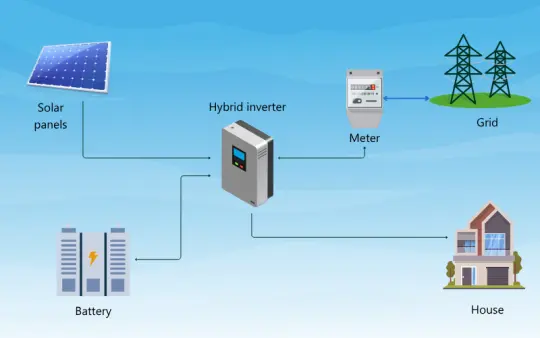
The three most common types of solar power systems today differ mainly in whether they connect to the grid and whether they include energy storage:
| Criteria | Off-grid | On-grid | Hybrid |
| Connected to the grid | No | Yes | Yes |
| Has a battery/storage bank | Yes (required) | No | Yes |
| Can supply power when the grid is down / at night | Yes (thanks to battery storage) | No | Yes |
| Best suited for | Areas without grid access that need full independence | Areas with a stable grid, mainly to lower electricity bills | Areas with grid access that also want backup during outages |
The key technical difference comes down to the inverter: a grid-tied inverter has to synchronize with the utility grid and automatically shuts down when the grid goes down, for safety reasons (to prevent "islanding"). An off-grid inverter, on the other hand, operates completely independently and doesn't need anti-islanding protection, since it's never connected to the grid in the first place.
2. Components of an off-grid solar system
A complete off-grid system typically consists of the following four main components:
2.1 Solar panels
Solar panels absorb sunlight and convert it into direct current (DC) electricity. This is the system's only source of power, so the capacity and number of panels need to be sized based on your total daily electricity needs.
2.2 Charge controller
The charge controller regulates the current flowing from the solar panels into the battery bank, preventing overcharging, overvoltage, or deep discharge — the main causes of reduced battery lifespan. There are two common types:
- PWM (Pulse Width Modulation): Uses pulse width modulation to repeatedly switch the current from the panels to the battery bank on and off. With PWM, the panel's rated voltage has to match the battery bank's rated voltage. However, PWM offers limited control over the current coming from the panels, so it captures less of the available power compared to MPPT.
- MPPT (Maximum Power Point Tracking): MPPT is more efficient because it can track the exact maximum power point the panels are producing at any given moment and deliver that power to the battery: the controller takes in higher voltage/lower current and converts it to lower voltage/higher current at the output, for the same amount of power. This lets MPPT control very precisely how much power goes into the battery — which matters most when the battery is nearly full but the system still needs to meet the connected load.
2.2 Off-grid inverter
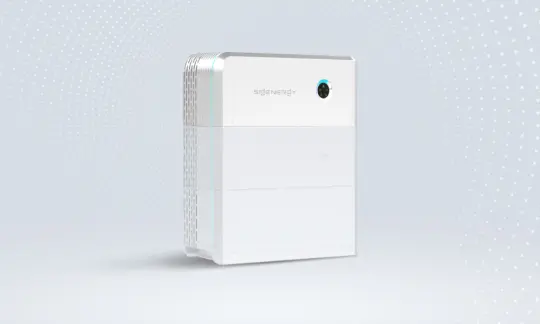
An off-grid inverter takes the direct current (DC) stored in the batteries and converts it into alternating current (AC) to power household appliances. Off-grid inverters come in a range of capacities, and when choosing one, two things matter most:
- Enough capacity for the total simultaneous load: add up the power draw of every appliance that could be running at the same time — that total is the minimum capacity the inverter needs to handle, not just the rating of any single appliance.
- Matching voltage with the battery bank: unlike an MPPT charge controller (which is more flexible about input voltage), an inverter's voltage is fixed and must match the battery bank's voltage exactly — for example, a 12V inverter only works with a 12V battery bank, not a 24V one. Since this can't be changed after installation, it's a decision worth thinking through carefully from the start, especially if you're planning to expand the system later.
In most off-grid systems, the inverter chosen is usually an inverter-charger — it works like a regular inverter (converting DC to AC to power your loads) but also has an input for charging the batteries. That input lets the system draw on a secondary power source (such as a petrol or diesel generator) to supply the load directly when needed, while using any surplus power from that source to recharge the batteries. This is an important backup layer for stretches of several consecutive low-sun days, when the solar array can't fully recharge the batteries on its own.
2.4 Energy storage — Battery bank / Lithium battery
This is the component that determines whether a system is truly "off-grid": surplus electricity generated during the day is stored in the batteries for use at night or whenever there's no sun. Storing power in batteries solves the intermittency problem inherent to renewable generation. Batteries can be traditional lead-acid or lithium (LiFePO4) — the latter lasts longer and performs better, but also costs more upfront.
3. How off-grid solar systems work
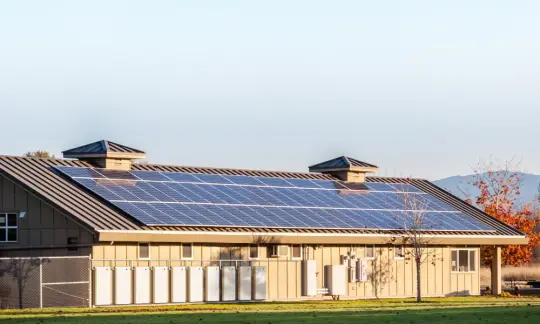
Electricity in the system flows in this sequence: solar panels → charge controller → battery bank → off-grid inverter → connected appliances. In a well-designed off-grid solar power system, on a sunny day, the energy typically flows through these steps:
- Sunlight hits the panels, generating DC current.
- The MPPT charge controller (or an inverter with built-in MPPT) optimizes the amount of power drawn from the panels.
- If the batteries aren't full, power is sent to charge the battery bank first.
- Once the batteries reach the required charge level, the inverter supplies AC power directly from the solar array to the connected appliances.
- At night or on cloudy days, the inverter draws power from the batteries to supply the load.
- If the battery charge drops below a certain threshold (typically around 20% for LiFePO4 batteries), the system either signals a low-battery warning or automatically starts a backup generator, if one is installed.
4. Advantages and disadvantages of off-grid solar power
4.1 Advantages of an off-grid system
- Complete control over your power supply: you're not dependent on the grid or the local utility, so you're unaffected by grid instability or outages.
- Brings electricity to places the grid can't easily reach: well suited to mountainous areas, farms, islands, and remote or mobile facilities, where extending the grid would be expensive or take too long.
- Keeps working when the grid goes down: unlike an on-grid system, which shuts off when the grid fails, an off-grid system keeps running on stored battery power, and can even take over much of the role a backup generator would otherwise play.
- Environmentally friendly: runs on 100% renewable solar energy, cutting emissions and noise compared with running a petrol or diesel generator.
4.2 Disadvantages of off-grid solar power
- Higher upfront cost than an equivalent on-grid system, mainly because of the battery bank — the longer you want to be able to run without sun, the more batteries you need, and the higher the cost.
- Batteries have a limited lifespan and need upkeep: unlike solar panels (which last 25+ years with little maintenance), lead-acid batteries typically last only 3–5 years, while lithium batteries last longer (10+ years) but will still need replacing eventually, and both need regular checks on charge level, connections, and ventilation.
- The whole burden of supplying power falls on the system: if the inverter, charge controller, or any other component fails, you could be without power until it's fixed — unlike an on-grid system, which can simply fall back on the grid if the solar side has a problem. This means more frequent maintenance and monitoring, and sometimes a backup generator for extended stretches of bad weather.
- More complex to design, requiring specialized expertise: you need a careful survey of your power needs, actual local sun hours, correctly sized battery capacity, and the right charge controller and inverter — undersizing leaves you short of power, while oversizing wastes money on capacity you'll never use.
5. When should you install an off-grid solar power system?
Off-grid systems deliver the most value in situations where energy independence isn't just a nice-to-have — it's practically a necessity. Some typical applications:
- Homes, farms, and rural areas without grid access: where extending the national grid would be too costly or technically impractical, solar power paired with batteries is usually the fastest, most cost-effective way to get electricity.
- Telecom and monitoring equipment in remote locations: cell towers, signal repeaters, weather stations, environmental sensors, and similar equipment are often installed in high, remote places with no grid access. A small, low-maintenance off-grid system is well suited to keeping this kind of equipment running continuously.
- Emergency backup and essential services: field hospitals, temporary shelters, disaster-relief facilities, or areas with an unreliable grid can all rely on an off-grid (or hybrid) system to keep critical equipment powered.
- Mobile applications — boats and vehicles: caravans, trailers, mid-sized boats, and remote campsites often use off-grid systems to power lights, mini-fridges, 12V appliances, and so on, giving you power on the go and cutting your reliance on noisy generators.
In urban areas that already have a stable grid connection, a purely off-grid system is less common, since on-grid or hybrid systems usually offer better value for money. For most grid-connected users, a hybrid setup — using solar and battery power day to day while keeping a grid connection for backup — tends to be the more balanced choice.
6. The role of DC cables in an off-grid solar power system
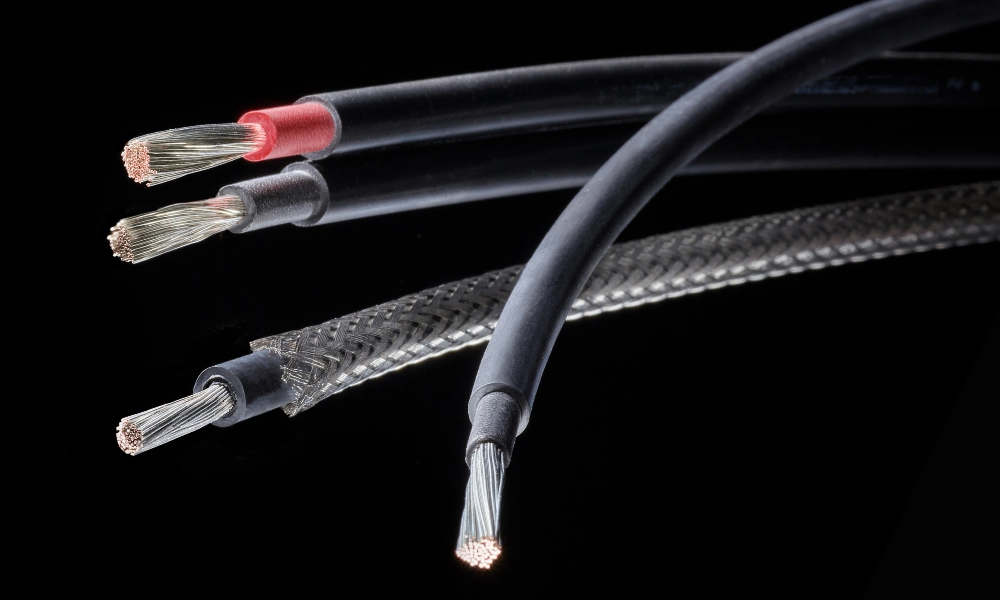
HELU DC cables
6.1 Why DC cables directly affect off-grid system efficiency
In an off-grid solar power system, all electricity—from the solar panels to the battery—is transmitted as direct current (DC) before the inverter converts it to AC at the final step. Whenever current flows through a wire, that wire has some resistance, which causes "voltage drop" — the voltage gradually diminishes along the way, much like water pressure dropping as it travels through a narrow or long pipe. That lost voltage means less power actually reaches the battery and the connected loads.
This is exactly why choosing the right DC cable matters far more than it does for an ordinary AC cable in the same system.
6.2 Key criteria for choosing DC cable in an off-grid system
DC cables used in off-grid solar power systems must meet three key criteria:
- High-quality conductor material: a pure copper core has low resistance, so less current is lost as heat, meaning more of the power actually reaches the battery and inverter instead of being wasted along the wire.
- Adequate cable gauge for the current and distance: a thicker cable lets more current flow through with less voltage drop, similar to how a wider pipe lets water flow more easily with less resistance. Using a cable that's too thin for the current or distance involved causes significant power loss, and can even generate heat and pose a safety risk if it's overloaded for extended periods.
- Insulation that can handle outdoor conditions: off-grid systems are usually installed outdoors for long periods, so the cable needs to resist UV exposure and withstand wide temperature swings and moisture. If the insulation degrades, the conductor inside can corrode, increasing resistance and power loss over time — affecting both the system's lifespan and its safety.
Beyond these three criteria, it's worth prioritizing cable with widely recognized safety and performance certifications such as UL or TÜV.
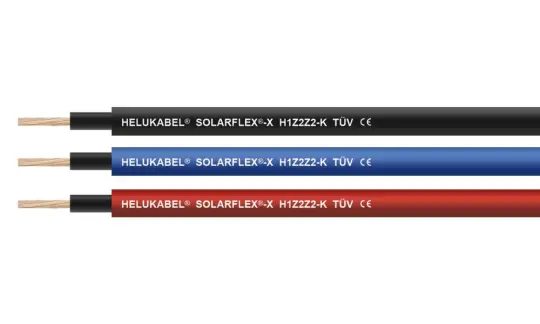
To meet all of these criteria, HELU offers the SOLARFLEX®-X H1Z2Z2-K line of DC cables specifically designed for solar power—featuring copper conductors, compliant with EN 50618/IEC 62930, rated for voltages up to 1,500 V DC (the UL-certified version is rated for up to 2,000 V DC per UL 4703), halogen-free insulation, flame-retardant properties, and the ability to withstand outdoor conditions throughout the system’s lifespan. For installations in areas at risk of rodent or insect damage to the cables, the rodent-resistant version, SOLARFLEX®-X H1Z2Z2-K NTS , can be used.
7. Why choose HELU for electrical connections in off-grid, on-grid, and hybrid solar systems
Whether you go with an off-grid, on-grid, or hybrid system, the part that carries electricity through the entire setup — from the panels, through the charge controller/inverter, to the batteries (if any) and the connected loads — is always the cables, connectors, and related accessories.
Rather than sourcing different cables and connectors from multiple suppliers, HELU provides a complete, consistent set of electrical connection components for every type of solar power system:
- DC cable for the solar panel: the SOLARFLEX®-X H1Z2Z2-K line (along with the rodent-resistant NTS version and a water-resistant version for floating solar) — used across all three system types, since the run from the panels to the charge controller/inverter is always DC, regardless of whether the system is off-grid, on-grid, or hybrid.
- MC4 connectors: for a watertight, electrically stable connection between panels and the wiring run outdoors.
- Low-voltage AC cable: for the run from the inverter to the load or to the grid connection point.
- Battery energy storage system (BESS) cable: the HELUPOWER HIGH AMP X line, suited to hybrid systems or off-grid systems with large-capacity battery storage.
- UV-resistant cable conduit (HELUCOND): protects cables from the elements during long-term outdoor installation.
In other words, whether you're building an off-grid, on-grid, or hybrid system, HELU is where you go to make sure the electrical connections — the part that determines the system's long-term safety and performance — are done right
Contact HELU Vietnam today for consultation and a product quote
8. FAQs
"Off-grid" is a general term for structures or lifestyles designed to be independent of one or more public infrastructure services, most commonly the national power grid. In the context of solar power, "off-grid" means that a home or structure generates all of its own electricity using its own solar panels and batteries, without being connected to the power grid.
A complete off-grid system typically consists of four main components: solar panels, a charge controller, a storage battery, and an off-grid inverter. Without any one of these components, the system cannot function in a truly “off-grid” manner—for example, without a battery, electricity cannot be used at night or when there is no sunlight.
Yes. An off-grid inverter is a required component for converting DC power from the battery into AC power to supply household appliances—it cannot be replaced by a standard grid-tied inverter due to differences in operation and safety requirements.
Yes. This is the biggest difference compared to a pure grid-tied system: excess electricity generated during the day is stored in the battery, and then the inverter draws power from the battery to supply devices at night or on days with little sunlight.
Most suitable for projects that are not connected to the power grid or that require complete autonomy in power supply (telecommunications stations, mobile projects, emergency backup systems, etc.). If a project is already connected to a stable power grid and the primary goal is to reduce electricity costs, grid-tied or hybrid systems are typically more cost-effective, as they do not require a large-capacity battery bank.
Regulations may vary depending on the system’s size, intended use, and the location of installation. Since this is a legal matter that may change over time and by region, you should contact a consulting or installation firm or your local electric utility for specific guidance before installation.
Costs depend on power output, battery capacity, the type of inverter/charge controller, and the actual installation conditions of each project; therefore, there is no standard price that applies to all cases. The most accurate approach is to have a consulting firm assess your specific electricity usage needs and then provide a quote based on the exact configuration.