Shielded fire-resistant cables: Why do you need both features?
When choosing cable for a fire alarm system, many people ask: if the cable is already fire-resistant, why does it also need a shield? Or the other way round? The answer is that the two features protect the circuit at two different times. Without one of them, the fire protection system can still fail, just at a different moment. This article looks at each scenario, then explains the construction of shielded fire-resistant cable and how to choose it.

Article content:
-
1What are shielded fire-resistant cables
-
2Differences from other types of cables
-
3Why are both features needed on a single cable?
-
4If the cable is only fire-resistant and not shielded
-
5If the cable is only shielded, not fire-resistant
-
6Applications of shielded fire-resistant cables
-
7Construction of shielded fire-resistant cables
Short answer: Shielded fire-resistant cable needs both features because it serves circuits that carry weak signals and must keep working during a fire. The shield keeps the signal correct during normal operation, so there are no false alarms or lost signals. Fire resistance keeps the circuit intact for 15 minutes to 2 hours during a fire, depending on the cable class. For these circuits, a cable with only one feature will fail at the other moment.
1. What are shielded fire-resistant cables
Shielded fire-resistant cables are a reliable solution for fire alarm systems
Shielded fire-resistant cables are designed with two features:
- Fire resistance: the cable continues to carry power and signals for a defined period while exposed directly to flame.
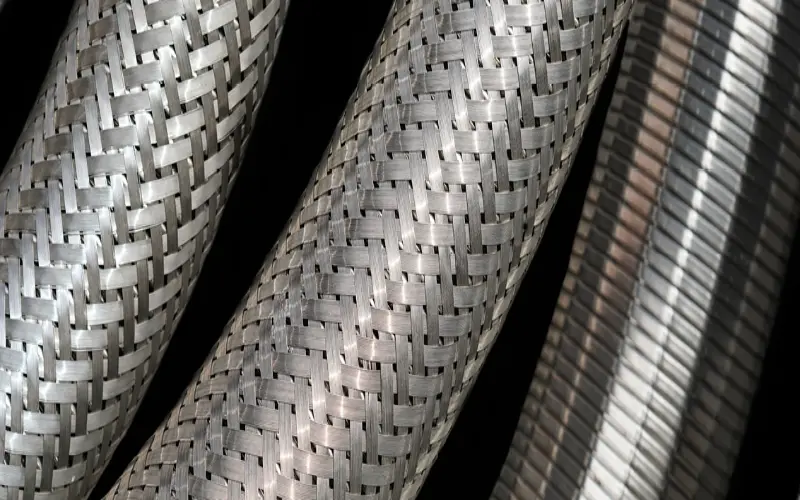
- Shielding: the cable has a metallic screen that reduces electromagnetic interference.
This type of cable is usually a multi-core control or signal cable with small cross-sections. It is used in fire protection systems and other safety circuits in buildings and industrial plants.
1.1 Is " shielded fire-resistant cable" a cable type or just a set of properties?
It describes properties, not a separate type of cable. "Fire-resistant" and "shielded" are two features a cable can have. What the cable is used for depends on the function of the circuit.
On the Vietnamese market, most products sold as " shielded fire-resistant cable" are fire alarm signal cables, usually with 2 cores of 1.0 or 1.5 mm². This is because fire alarm circuits are the most common application that needs both features at the same time. As a result, many people use the two names as if they meant the same thing.
| Name | Based on | Meaning |
| Fire alarm cable | Application | Cable for fire alarm system circuits |
| Fire-resistant cable | Property | Cable that keeps the circuit working when exposed to fire |
| Shielded cable | Property | Cable with a screen that reduces electromagnetic interference |
| Shielded fire-resistant cable | Properties | Cable with both properties. Often used for fire alarm circuits, but not only for them |

J-Y(St)Y Lg fire alarm cable
Keeping this distinction clear helps avoid two common misunderstandings when buying cable:
- Fire alarm cable is not always fire-resistant and shielded: Some types have no screen, and some are only flame-retardant. For example, in HELU's fire alarm cable range, J-Y(St)Y Lg has a screen, but its code has no FE/E fire resistance rating.
- Shielded fire-resistant cable is not only for fire alarms: Both features are also needed for control cables for smoke extraction fans, fire dampers and fire pumps, and for signal cables in voice evacuation systems.
So when buying, describe the cable by its function plus its properties and standards. For example: "fire alarm signal cable, 2 x 1.5 mm², fire-resistant to BS EN 50200 PH120, shielded, LSZH sheath". This is much clearer than just asking for "fire-resistant shielded cable". See also: fire alarm signal cable.
1.2 Fire-resistant vs. flame-retardant cables
The two terms are often used as if they mean the same thing, but they are very different.
| Flame-retardant cable | Fire-resistant cable | |
| Purpose | Limits the spread of flame along the cable | Keeps the circuit working while exposed to fire |
| In a fire | The cable is damaged and the circuit fails | The circuit keeps working for the specified time |
| Typical test standard | IEC 60332 | IEC 60331, BS 6387 |
Fire-resistant cables are usually also flame-retardant. The reverse is not true. Learn more about what fire-resistant cables are and the standards for fire-resistant cables .
2. Shielding and fire resistance: Why does one cable need both features?
Fire resistance and shielding cannot replace each other. Each one deals with a different threat that happens at a different time
| Shielding | Fire resistance | |
| Protects against | Electromagnetic interference from VFDs and motors | Flame burning the insulation, causing short circuits or open circuits |
| When it works | Throughout the cable's life, including during a fire on cable sections not yet reached by the flame | During a fire, for 15 minutes to 2 hours depending on the cable class |
| If missing | False alarms, communication faults, wrong control commands | Lost signals; smoke extraction fans, evacuation speakers and pumps are not activated |
| Provided by | Metallic screen, twisted pairs | Mica tape or ceramifiable silicone insulation |
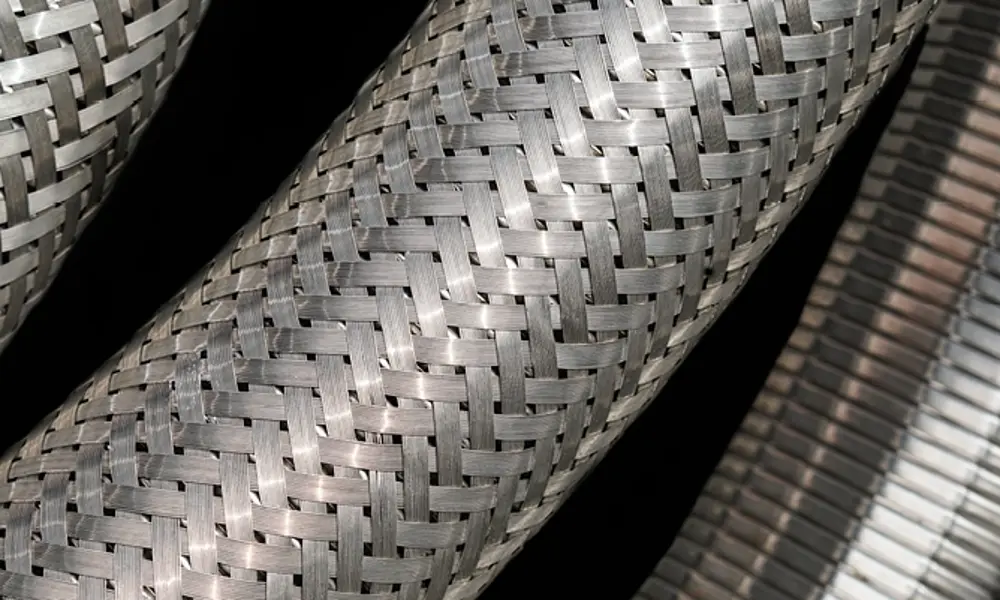
If the cable is only fire-resistant and not shielded, it will experience communication errors and control commands will be distorted.
2.1 Risks of a cable that is fire-resistant but not shielded
Fire-resistant cables are installed in buildings, fire alarm systems and industrial sites with many machines. In these places, they often run close to many other power cables, so electromagnetic interference is common. An unshielded fire-resistant cable faces two typical problems in these environments:
- The system may be switched off before a fire even starts: Interference causes false alarms or communication faults between systems. After a few times, operators tend to isolate the faulty zone or ignore the warnings. At that point, even the best fire resistance is useless, because the circuit is no longer monitored.
- Interference rises exactly when the system needs accurate signals the most: When a fire alarm is triggered, many large loads start almost at the same time: fire pumps, smoke extraction fans and stair pressurization fans. Some of them run on VFDs or soft starters. This is also when the fire alarm panel sends control commands and receives signals from other detectors.
2.2 Risks of a cable that is shielded but not fire-resistant
The insulation of an ordinary shielded cable softens and burns at temperatures far below those of a fire. Once the insulation is gone, the cores touch each other or touch the screen, causing a short circuit.
The screen does not help either. Aluminium melts at about 660°C, lower than the temperatures used in fire resistance tests (830 - 950°C). So the cable section inside the fire zone loses both its insulation and its screen.
A fire protection cable route usually passes through several areas. If the route short-circuits where the fire is, devices in other areas on the same route may stop receiving commands. Evacuation speakers may go silent, smoke extraction fans may not start and fire dampers may not close, just when people in the building need them most.
2.3 When do you need only one of the two features?
Not every application needs shielded fire-resistant cable. In some cases, having both features is unnecessary. Also, the more features a cable has, the more it usually costs.
Ask two questions: does the circuit have to work during a fire, and does it carry signals that are sensitive to interference or run close to sources of interference?
| Near interference source | Low interference environments | |
| Must work during a fire | Shielded fire-resistant cable. Example: control signals for smoke extraction fans and fire dampers | Fire-resistant cable. Example: power supply for emergency lighting, power cable for direct-on-line fire pumps |
| Does not need to work during a fire | Shielded Flame-retardant cable. Example: sensors and machine control not related to safety | Standard flame-retardant control cable |
Shielded fire-resistant cable is for circuits that must survive a fire and also transmit accurate signals. These are also the most important circuits in a fire protection system. Which circuits must use fire-resistant cable is defined by the fire protection design and the equipment manufacturer.

Shielded fire-resistant signal cables are commonly used in fire protection systems within building management systems (BMS).
2.4 Applications of shielded fire-resistant cable
Shielded fire-resistant cable is used for circuits that must keep working during a fire for alarm, evacuation and fire-fighting:
- Fire alarm systems: connecting smoke detectors, heat detectors and manual call points to the fire alarm panel. See also: fire alarm signal cable
- Voice evacuation and alarm devices: speakers, sounders and visual alarm beacons
- Smoke control systems: smoke extraction fans, stair pressurization fans and fire dampers
- Fire pump and firefighters' lift control
- Emergency lighting and exit signs
- Building management systems (BMS) and emergency stop circuits in factories, tunnels and data centres
3. Construction of shielded fire-resistant cable
Shielded fire-resistant cable is not simply a fire-resistant cable with a screen wrapped around it. The layers must be arranged so that one feature does not weaken the other. From the inside out, the cable has the following layers:
| Layer | Common materials | Function |
| Conductor | Copper, solid or stranded | Carries power and signals |
| Fire barrier | Mica tape wrapped around each conductor, or ceramifiable silicone insulation that forms a ceramic layer in a fire | Keeps the cores insulated from each other after the plastic has burned away |
| Insulation | XLPE, halogen-free compound, silicone | Insulates the cores in normal operation |
| Screen | Aluminium/polyester foil with a drain wire, or copper braid | Blocks electromagnetic interference |
| Outer sheath | Low smoke zero halogen (LSZH) compound, or flame-retardant PVC | Mechanical protection; limits toxic smoke in a fire |
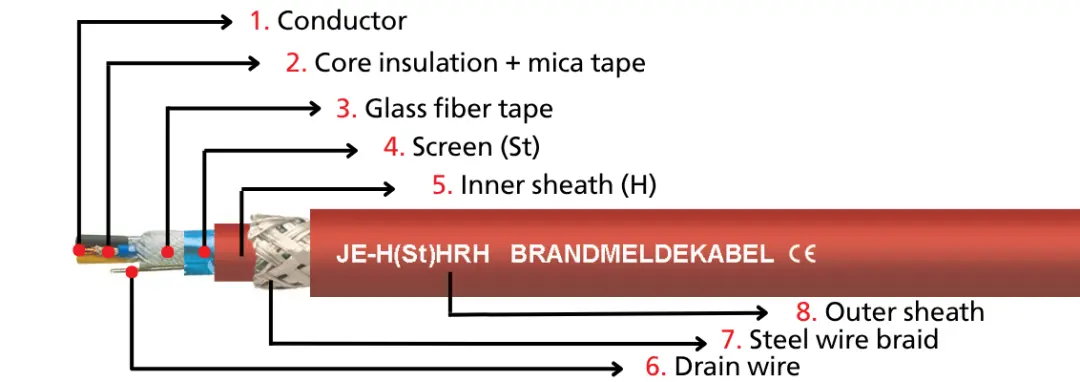
Which screen should you choose for a fire-resistant cable?
The shielding layer affects more than interference protection. It also changes the size, stiffness and termination of the fire-resistant cable.
| Type | Interference protection | Effects on fire-resistant cables | Suitable for |
| Aluminium foil with drain wire | Almost full coverage; effective against high-frequency interference | Thin; keeps the cable compact and easy to bend | Most fire alarm and control signal circuits |
| Copper braid | Effective at low and medium frequencies; easy 360° earthing | Larger, heavier and stiffer cable | Near VFDs and large motors |
| Foil plus braid | Best across a wide frequency range | Largest and stiffest; highest cost | Environments with heavy interference |
Whatever type you choose, the screen only works when it is earthed. Earthing at one end avoids circulating currents through earth (ground loops) and suits low-frequency interference (below about 1 MHz). Earthing at both ends with 360° contact blocks high-frequency interference better, but needs a good equipotential earthing system. For fire protection circuits, follow the instructions of the fire alarm panel manufacturer.
4. Standards for shielded fire-resistant cable
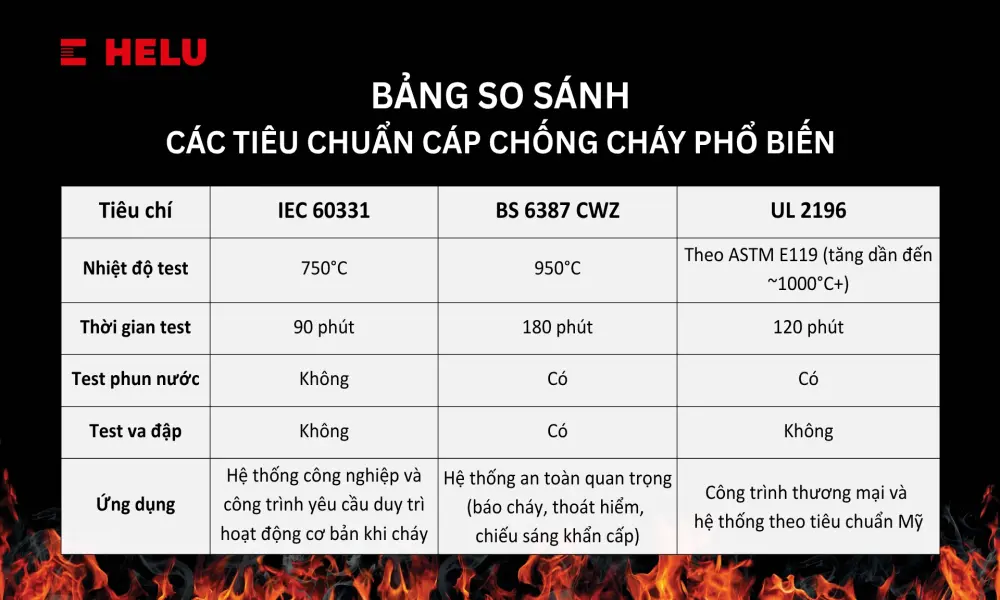
Comparison table of common fire-resistant cable standards
Fire resistance is proven by tests with a clear pass or fail result. Interference protection has no equivalent test. Instead, it is shown by the parameters in the datasheet.
4.1 Fire resistance standards
- Cables up to 20 mm in diameter, which includes most control and signal cables, are tested to IEC 60331-2 or BS EN 50200. Cables larger than 20 mm are tested to IEC 60331-1. Both tests combine flame with mechanical shock at a temperature of at least 830°C.
- BS EN 50200 classifies cables by how many minutes they keep the circuit working: PH15, PH30, PH60, PH90 and PH120. For fire alarm circuits, BS 5839-1 requires PH30 for standard fire-resistant cable, and PH120 plus BS 8434-2 for enhanced fire-resistant cable.
- BS 6387 CWZ is still widely specified in project documents in Vietnam.
- In crowded areas, choose cables that also meet IEC 61034 (smoke density) and IEC 60754 (halogen acid gas).
For details on IEC, BS, and UL standards, see the article on fire-resistant cables .
4.2 Interference protection parameters
There is no pass/fail test for interference protection like IEC 60331. To assess a cable's interference protection, check these parameters in the datasheet:
- Screen type: foil, braid or both; an overall screen or individually screened pairs.
- Braid coverage (%): typically about 60–95%.
- Twisted pairs: whether the cores are twisted in pairs.
- Capacitance (pF/m): a screen increases capacitance, and addressable fire alarm panels have a capacitance limit per loop.
5. How to read shielded fire-resistant cable markings
5.1 Common markings
Cable markings indicate the structure from the inside out. Some common markings found in the Vietnamese market:
| Symbol | Meaning |
| Cu | Copper conductor |
| Mica | Mica fire barrier tape |
| XLPE / X | Cross-linked polyethylene insulation |
| PVC / V | PVC insulation or sheath |
| LSZH (or LSHF, LS0H) | Low smoke, halogen-free sheath |
| S (e.g., -S, /S) | Has a screen against interference |
| DSTA | Double steel tape armour |
Example: Cu/Mica/XLPE/S/LSZH is a cable with a copper conductor, mica fire barrier tape, XLPE insulation, a screen and a low smoke, halogen-free sheath.
Be careful with "FR": "FR-PVC" usually means flame-retardant PVC, not fire-resistant. However, some manufacturers use "Fr" to mean fire-resistant. So do not rely on the letters "FR" on the sheath. Check which standard the datasheet lists: IEC 60331 or BS 6387 means fire-resistant, while IEC 60332 alone means flame-retardant only.
5.2 Shielded fire-resistant control cable to German standards
Cables made to German standards use their own coding system. A typical example is the fire alarm cable JE-H(St)H Bd FE180/E30:
| Code | Meaning |
| J | Installation cable for fixed installation |
| E | For signal and electronic circuits |
| H (first) | Halogen-free insulation |
| (St) | Static screen made of metal foil |
| H (second) | Halogen-free outer sheath |
| Bd | Cores stranded in bundles |
| FE180 | Insulation integrity for 180 minutes when exposed to fire |
| E30 / E90 | Functional integrity of the whole cable system (cable and supports) for 30 or 90 minutes, to DIN 4102-12 |
The two ratings mean different things:
- FE180 describes the cable itself.
- E30/E90 describes the whole system after installation, including trays, clamps and anchors.
A cable rated FE180 can still fail if it is installed on ordinary supports, because the supports may collapse before the cable fails.
6. How to choose shielded fire-resistant cable
When choosing shielded fire-resistant cable, check these six points:
- True fire resistance or just flame retardancy: The datasheet must state a circuit integrity standard, such as IEC 60331 or BS 6387. If it lists only IEC 60332, the cable is only flame-retardant.
- Circuit integrity time: Choose according to the fire protection design. If the design requires the whole system to meet E30 or E90, choose a cable and support system that have been tested together.
- Shielding type:
Aluminium foil with drain wire: compact and easy to terminate; enough for most fire alarm and signal circuits.
Copper braid: better interference protection and stronger mechanically. Use it when the cable runs near VFDs or large motors.
Twisted pairs: recommended for analogue signals and communication signals. - Number of conductors and cross-sectional area: Choose according to the load current and route length. For fire alarm circuits, follow the panel manufacturer's recommendations on cross-section and maximum loop length.
- Sheath material: In crowded areas, enclosed spaces and tunnels, use an LSZH sheath to reduce smoke and toxic gases in a fire.
- Certifications and datasheets: Choose cables with test reports or certificates from an independent body. The datasheet must show the full construction and the standards met.
7. Shielded fire-resistant cable solutions from HELU
HELU offers two types of cables for fire protection systems , manufactured in accordance with German standard designations. The first group is shielded fire alarm cable for signal circuits. The second group is 0.6/1 kV safety cable for power circuits that must keep working during a fire.
7.1 Shielded fire alarm cables
All products in this group carry the code (St), which means they have a metal foil screen. They differ in sheath material and in their circuit integrity rating.
| Products | Fire resistance (as indicated) | Suitable for |
| JE-H(St)H Bd FE 180/E30 | FE 180, E30 system | Fire alarm circuits that require 30 minutes of functional integrity |
| JE-H(St)H Bd FE 180/E90 | FE 180, E90 system | Circuits that require 90 minutes, such as smoke control |
| JE-H(St)H Bd FE 180/E30-E90 | FE 180, E30 to E90 system | Projects with both requirement levels |
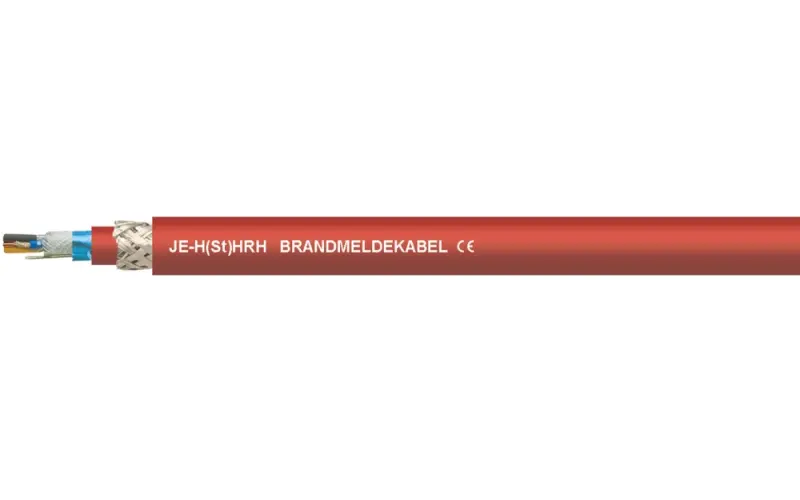
| JE-H(ST)HRH | Part of the functional integrity range | See the datasheet for the exact rating |
| J-H(St)H Bd | No FE/E rating in the code | Fire alarm circuits without a circuit integrity requirement that need a halogen-free sheath |
| J-Y(St)Y Lg | No FE/E rating in the code | Standard fire alarm circuits, PVC sheath (Y) |
The J-H and JE-H series feature halogen-free housings, making them suitable for crowded areas. Check out our entire product catalog!


7.2 0.6/1 kV safety cables with functional integrity
This group is for power circuits that must keep working during a fire, such as fire pumps, smoke extraction fans and emergency lighting. They belong in the "fire-resistant only" box of the table above, unless the circuit runs near interference sources.
| Products | Fire resistance (as indicated) | Notes |
| (N)HXH-FE 180/E 30 | FE 180, E30 system | No screen |
| (N)HXH-FE 180/E 90 | FE 180, E90 system | No screen |
| (N)HXCH-FE 180/E 30 | FE 180, E30 system | Has a concentric conductor (C) |
| (N)HXCH-FE 180/E 90 | FE 180, E90 system | Has a concentric conductor (C) |
View the entire catalog at Safety Cable With Functional Integrity – 0.6/1 kV.
If you're still not sure which type of cable is right for you?
Please provide HELU Vietnam’s Technical Department with information regarding the circuit’s function, the required backup time specified in the fire safety documentation, the line length, and any sources of interference along the line to receive recommendations on specific cable types.
Contact HELU Vietnam today for consultation and a product quote
8. Frequently Asked Questions
It depends on the standard the cable meets. Cables tested to BS EN 50200 are classified from PH15 to PH120, which means 15 to 120 minutes of circuit integrity. Cables meeting BS 6387 category C are tested for 3 hours at 950°C. Cables marked FE180 maintain insulation integrity for 180 minutes. Check the datasheet for the exact rating.
Not always. However, for addressable fire alarm systems that transmit digital signals, or when the cable runs close to power cables, a shielded cable helps reduce false alarms and communication faults. Check the cable requirements of the fire alarm panel manufacturer.
Not for fire protection circuits. Ordinary shielded cable has no fire barrier. In a fire, its insulation burns and causes a short circuit, exactly when the system needs to work most.
It depends on the current drawn by the devices on the loop and on the route length. Long loops, or loops with many devices, usually need a larger cross-section to limit voltage drop. Use the maximum cable length table provided by the fire alarm panel manufacturer.
Conclusion:
Shielded fire-resistant cable must meet two requirements at the same time: the circuit must not fail in a fire, and the signal must stay correct in normal operation. When choosing cable, check the standards listed in the datasheet instead of relying on the letters "FR" on the sheath.