What are Cat5e cables? Speed, Specifications and Comparison with Cat6
A Cat5e cable is a twisted-pair cable with a bandwidth of 100 MHz. It supports data speeds of up to 1 Gigabit per second (1 Gbps) over cable runs of up to 100 m. With equipment that supports the IEEE 802.3bz standard, speeds can reach 2.5 Gbps and 5 Gbps. Although higher cable categories such as Cat6, Cat6a, Cat7 and Cat8 are available, Cat5e remains a cost-effective choice that meets the needs of most 1 Gbps networks today. This article explains the structure and specifications of Cat5e, how it differs from Cat6, when to choose Cat5e, and the Cat5e cable ranges available for offices, outdoor use and factories.

Article content
1. What are Cat5e cables?

HELUKAT 200 IND Cat5e network cable
Cat5e (Category 5e) cable is an improved version of the Cat5 twisted-pair cable. It is rated for transmission performance up to 100 MHz and is used for Ethernet standards from 10 Mbps up to 5 Gbps. Since 2001, Cat5e has been the version in common use, replacing Cat5.
What does the “e” in Cat5e mean?
The “e” stands for enhanced. Compared with Cat5, the Cat5e standard sets stricter requirements for crosstalk , attenuation (signal loss) and return loss (signal reflected back along the cable).
The most noticeable difference between Cat5 and Cat5e is speed. Cat5 cable carries data at 10 Mbps or 100 Mbps, often labelled “10/100 Ethernet”. Cat5e adds support for 1,000 Mbps (1 Gbps), often labelled “10/100/1000 Ethernet”. This means any network that needs more than 100 Mbps must use Cat5e or higher. Cat5e is also backward compatible with all devices and network ports designed for Cat5.
Which standards define Cat5e ethernet cable?
Category 5 cable is currently defined in ISO/IEC 11801, IEC 61156 and EN 50173. It was originally specified in ANSI/TIA/EIA-568-A. When buying cable, check that the datasheet clearly states which standards the cable meets, rather than relying only on “Cat5e” printed on the jacket.
2. Structure of a Cat5e cable
A typical Cat5e cable has four twisted pairs of copper wire (eight conductors in total), surrounded by a protective outer sheath. The standard does not limit the cable to four pairs, but Gigabit Ethernet and faster networks need all four.
- Conductors: there are two types, solid and stranded. Solid-conductor cable uses 22 to 24 AWG wire, or 26 AWG for short runs; 24 AWG is the most common.
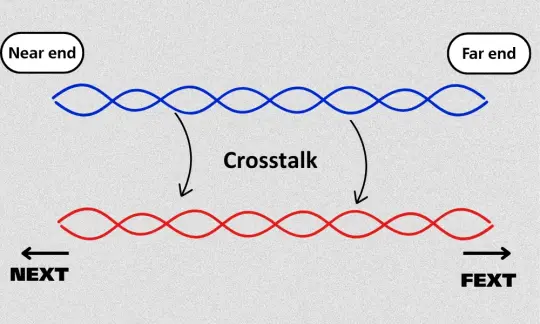
- Twisted pairs: each pair is twisted at a different rate to reduce crosstalk between pairs. Because the two wires in a pair are twisted together, they sit, on average, at the same distance from any source of interference. Both wires therefore pick up almost the same noise, which is then cancelled out.
- Sheath: usually PVC, or LSZH (low smoke, zero halogen) for buildings with strict fire-safety requirements.
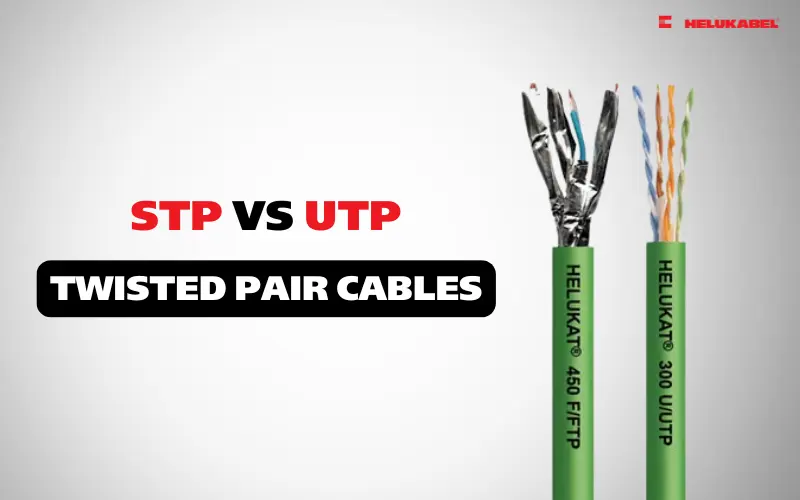
- Shielding: most Cat5e cables are U/UTP, meaning they have no shielding. Some types have a foil layer or a braided shield.
When choosing Cat5e ethernet cable, there are two things to consider: the conductor type and the shielding.
2.1 Solid or stranded Cat5e cable?
Cat5e cable comes with two types of conductor: solid and stranded.
- Solid: each conductor is a single, continuous copper wire. This type is normally used for permanent installation inside walls or ceilings, for example from the server room to a wall outlet.
- Stranded: each conductor is made of many fine copper strands twisted together, which makes it more flexible. It is used for short patch cords connecting computers, switches and routers, where cables are often plugged, unplugged or moved.
| Solid | Stranded | |
| Used for | Long runs, permanent installation, in-wall cabling | Short runs, patch cords, connections that change often |
| Flexibility | Relatively stiff | More flexible |
| Example | Horizontal cabling in an office building | Cable from a computer to a router |
It is very hard to tell the two types apart from the outside. The quickest way is to bend the cable: stranded cable is noticeably more flexible. In factories, cables installed in moving positions also use stranded conductors, for example HELUKAT® PROFInet B.
2.2 Types of Cat5e cable by shielding
Most Cat5e cables are unshielded. Shielded types (FTP, STP) are useful when the cable runs near equipment that emits radio frequency (RF) signals. Under ISO/IEC 11801, shielding is named in the format X/YTP:
- The first letter shows the shielding around the whole cable.
- The second letter shows the shielding around each individual pair.
U means unshielded, F means foil, and S means braided shield.
| Symbol | Overall shield | Individual pair shield |
| U/UTP | None | None |
| F/UTP | Foil | None |
| SF/UTP | Braid + foil | None |
3. Cat5e cable specifications
| Specifications | Value |
| Bandwidth | Up to 100 MHz |
| Supported Ethernet standards | 10BASE-T, 100BASE-TX, 1000BASE-T, 2.5GBASE-T, 5GBASE-T |
| Maximum length per segment | 100 m |
| Number of pairs | Usually 4 pairs (8 conductors) |
| Common wire gauge | 24 AWG |
| Characteristic impedance | 100 Ω |
| Connector | RJ45 |
| Power over Ethernet (PoE) support | Yes |
3.1 Cat5e cable speed
Cat5e runs reliably at 1 Gbps (Gigabit Ethernet) over a 100 m cable run. The IEEE 802.3bz standard, published in 2016, also allows 2.5 Gbps and 5 Gbps over Cat5e or better cable, again at lengths of up to 100 m. However, the switch and network card must both support this standard. If you need 10 Gbps, use Cat6 for short runs or Cat6a.
3.2 How long can a Cat5e cable be before the signal weakens?
The limit is 100 m for the whole link. Under ANSI/TIA-568, the permanently installed cable can be up to 90 m, the total length including patch cords must not exceed 100 m, and each patch cord should be no longer than 5 m. Beyond this, signal performance is no longer guaranteed. For longer distances, split the link with a switch or use fiber optic cable .
4. Cat5e vs Cat6 (and Cat6a)
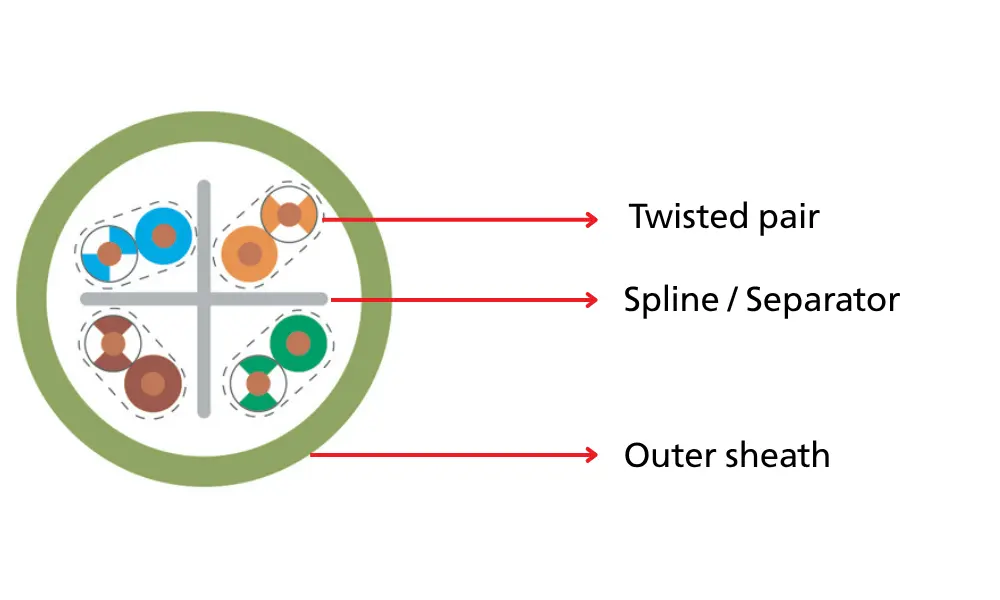
The spline is the most distinctive feature of Cat6. This cross-shaped plastic bar divides the interior of the cable into four separate compartments, preventing the four wire pairs from coming into contact with one another.
The main differences are bandwidth and the ability to carry 10 Gbps. Cat6 has a bandwidth of 250 MHz and meets stricter crosstalk requirements than Cat5e ethernet cables, but it can carry 10 Gbps only over runs of up to 55 m. Cat6a increases bandwidth to 500 MHz and supports 10 Gbps over the full 100 m.
In terms of construction, Cat6 cable often has a plastic separator (spline) that keeps the four pairs apart to reduce crosstalk. This makes the cable thicker and stiffer than Cat5e.
Cat6 cables are backward compatible with Cat5e cables, so they can be used together in the same system. Learn more about Cat6 network cables and the differences between Cat5, Cat6, and Cat7 .
| Criteria | Cat5e | Cat6 | Cat6a |
| Bandwidth (MHz) | 100 | 250 | 500 |
| Highest Ethernet standard | 5GBASE-T (5 Gbps) | 10GBASE-T (10 Gbps) | 10GBASE-T (10 Gbps) |
| Max length at 10 Gbps (m) | Up to 55 | 100 | |
| Max length up to 1 Gbps (m) | 100 | 100 | 100 |
| Wire gauge (AWG) | 22–26 (24 most common) | 22–26 |
4.2 When should you choose Cat5e cable?
Choose Cat5e when your network runs at up to 1 Gbps (or 2.5–5 Gbps if your equipment supports IEEE 802.3bz) and you have no plans to upgrade to 10 Gbps. There are two cases:
Cat5e is a reasonable choice when:
- Your LAN runs at Gigabit speed with cable runs of no more than 100 m
- Your devices need power over PoE
- You are running an industrial network at 100 Mbps, such as PROFINET, which uses only two pairs
Choose Cat6 or Cat6a when:
- You need 10 Gbps: Cat6 for runs up to 55 m, Cat6a for runs up to 100 m
- The cable passes through areas with high electrical interference and needs a larger safety margin for crosstalk
5. HELU Cat5e cable range
HELU offers HELUKAT® Cat5e cables for all three environments: indoor, outdoor, and industrial.
5.1 Cat5e network cables for indoor use in homes and offices
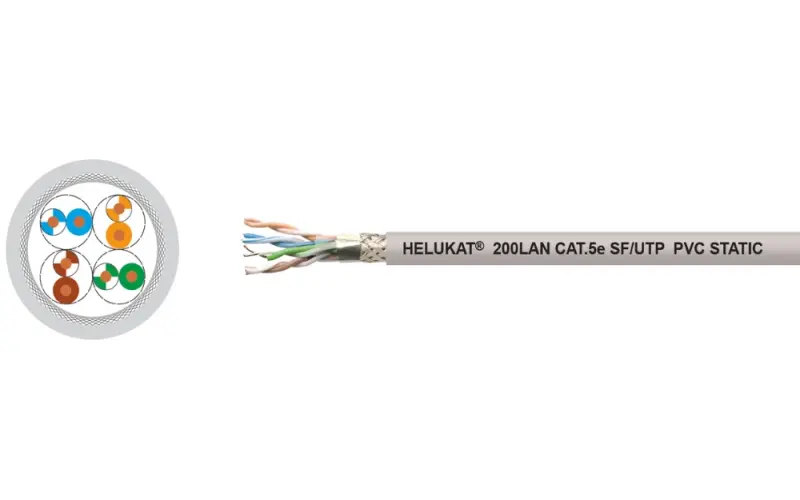
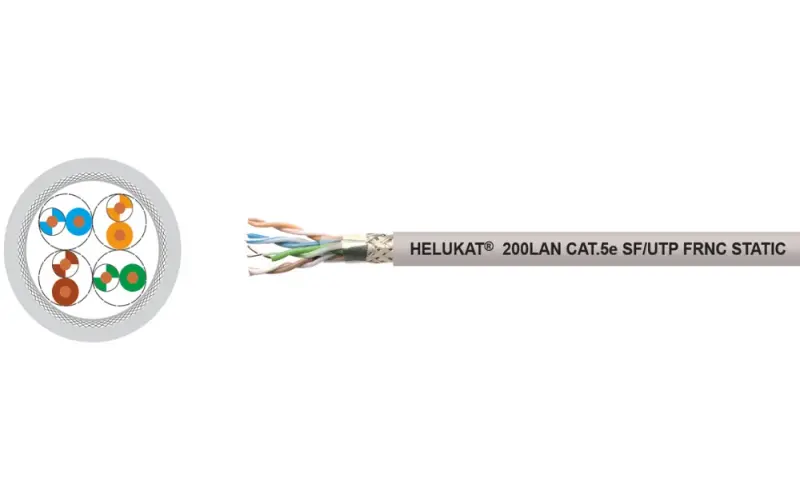
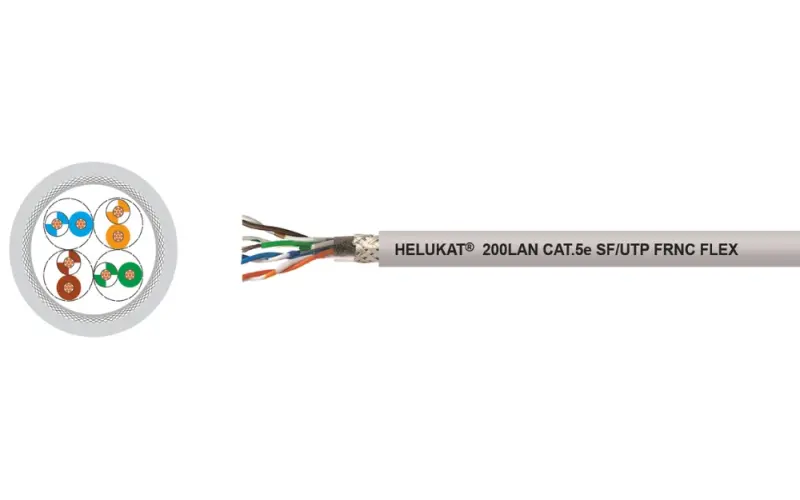
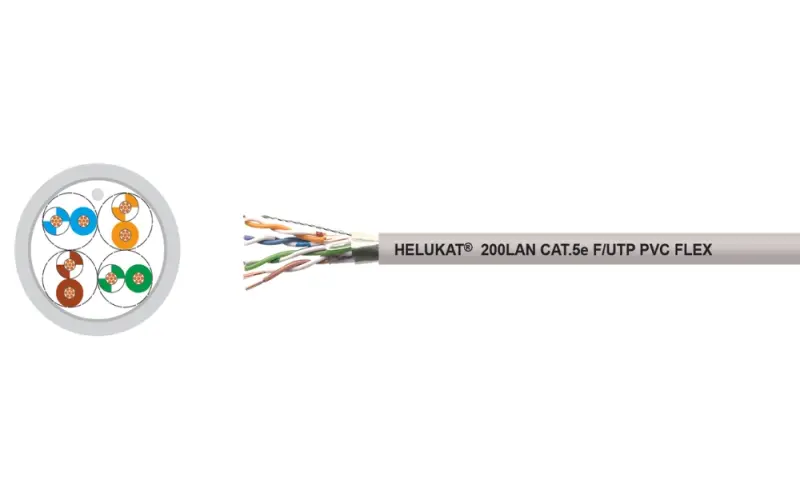
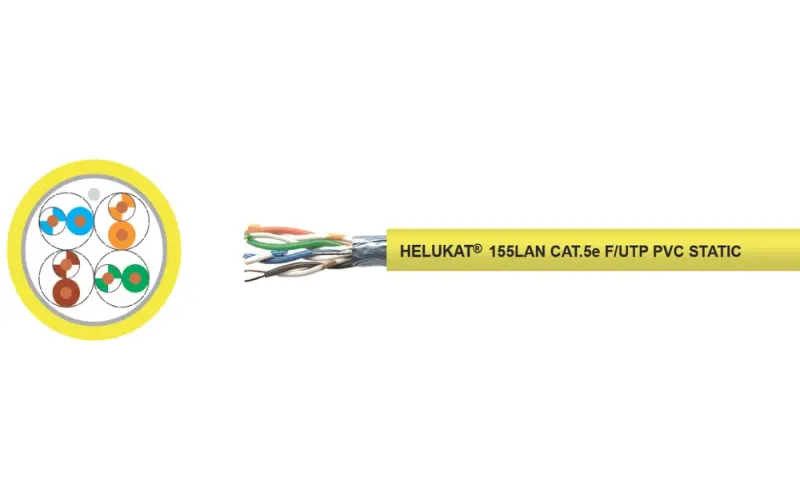
In building systems, most network cables do not require shielding, so HELUKAT® 155 U/UTP is suitable for standard office networks. The F/UTP and SF/UTP series are designed for areas with high levels of electromagnetic interference. The FRNC jacket series is halogen-free and suitable for projects requiring low levels of toxic smoke in the event of a fire.
| Products | Shielding | Sheath | Conductor |
| HELUKAT® 155 CAT.5e U/UTP PVC STATIC | None (U/UTP) | PVC | Solid, 24 AWG |
| HELUKAT® 155 CAT.5e F/UTP PVC STATIC | Foil (F/UTP) | PVC | Solid, 24 AWG |
| HELUKAT® 200 CAT.5e SF/UTP PVC STATIC | Braid + foil (SF/UTP) | PVC | Solid, 24 AWG |
| HELUKAT® 200 CAT.5e SF/UTP FRNC STATIC | Braid + foil (SF/UTP) | FRNC, halogen -free | Solid, 24 AWG |
| HELUKAT® 200 CAT.5e F/UTP PVC FLEX | Foil (F/UTP) | PVC | Stranded, 26 AWG |
| HELUKAT® 200 CAT.5e SF/UTP FRNC FLEX | Braid + foil (SF/UTP) | FRNC, halogen-free | Stranded, 26 AWG |

5.2 Outdoor Cat5e cable
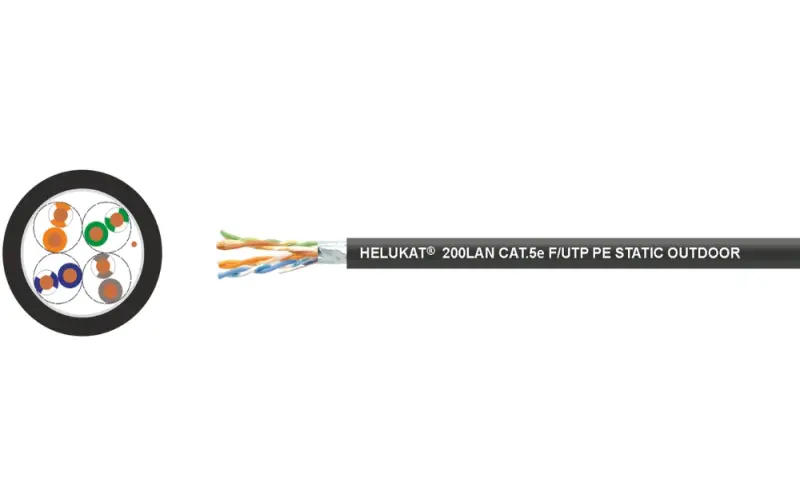
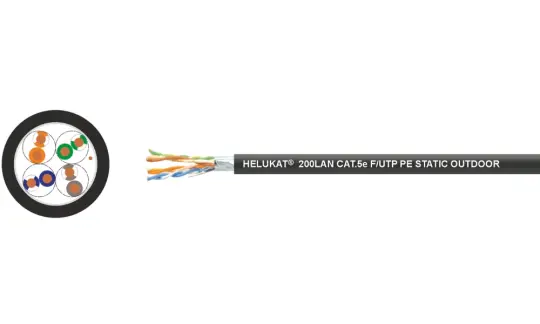
Outdoor network cable is designed to withstand the weather. HELUKAT® 200A has a UV-resistant, halogen-free PE sheath and a foil shield.
| Product | Shielding | Sheath | Conductor |
| HELUKAT® 200A CAT.5e F/UTP PE STATIC (805572) | Metal Foil (F/UTP) | PE, UV-resistant, halogen-free | Solid, 24 AWG |
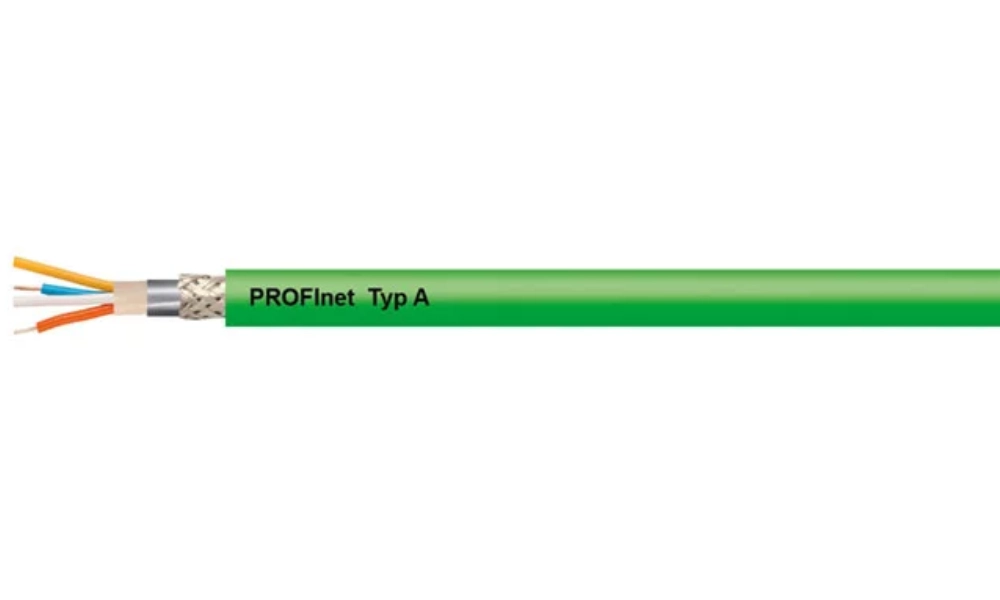
HELUKAT® Cat5e PROFInet FastConnect cable
5.3 Industrial and PROFINET Cat5e cable
In industrial applications, ethernet cable is usually shielded. All HELU industrial Cat5e cables use a braided shield and are available in versions for different installation types, from fixed installation to continuous motion in drag chains and robots.
Industrial Ethernet cable is selected according to installation conditions. It differs from office network cable in three ways:
- Shielding: a shielded cable helps keep a PROFINET network stable. All HELU PROFINET cables use an SF/UTP construction.
- Sheath suited to the environment: PVC for fixed indoor installation, FRNC (flame-retardant, low smoke) for mobile applications, and PUR for continuous motion.
- Flex resistance: cables for robots or drag chains must be specially designed for continuous movement.
Some Cat5e cable types are also compatible with FastConnect technology , which allows RJ45 or Sub-D connectors to be fitted on site without a crimping tool.
| Products | Features | Sheath | FastConnect (SK) |
| HELUKAT® 100T CAT.5e S/UTP PUR TORSION (802186) | Torsional movement | PUR, UV resistant | |
| HELUKAT® PROFInet A CAT.5e SF/UTP PVC STATIC (800653) | Fixed installation, indoor | PVC | Yes |
| HELUKAT® PROFInet B CAT.5e HYBRID SF/UTP FRNC FLEX (801651) | Mobile, flexible | FRNC | |
| HELUKAT® PROFInet C CAT.5e SF/UTP PUR CHAIN (800655) | Continuous motion, drag chain | PUR | Yes |
| PROFInet R+ CAT.5e SF/UTP PUR ROBOTIC (11007800) | Continuous motion with torsion, robots | PUR | |
| HELUKAT® 100IND CAT.5e SF/UTP FRNC FLEX (805701) | Flame-retardant, low smoke | FRNC |
View the full product lineup of HELU's Cat5, Cat6, and Cat7 network cables .
5.4 Pre-assembled Cat5e patch cables
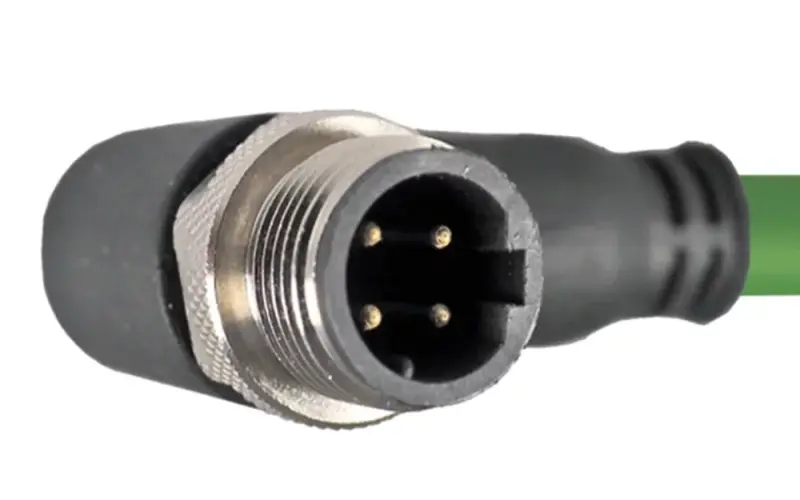
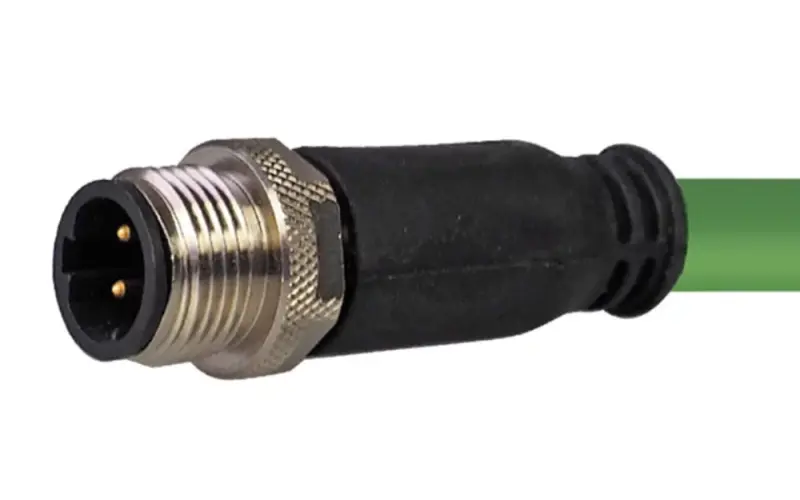
In addition to cable, HELU offers Cat5e pre-assembled cables with connectors at the factory, in lengths from 0.5 m to 25 m. These cables use a PUR jacket and are available with RJ45 connectors (IP20) for control cabinets and M12 D-coded connectors (IP67) for field devices.
| Products | Structure | Connector type | Length (m) |
| HELUKAT® 100 SF/UTP Cat. 5e | 4x2xAWG26/19, PUR jacket, suitable for use in chain troughs, UL AWM | RJ45 – RJ45 (IP20); M12 – M12 straight (IP67); M12 – M12 90° angle (IP67); RJ45 – M12 | 0.5–25 |
| HELUKAT® 200 IND SF/UTP Cat. 5e | 4x2xAWG26/7, PUR jacket, for flexible applications, AWM 21576 | RJ45 – RJ45 (IP20); M12 – M12 straight (IP67) | 0.5–15 |

If you still have questions about Cat5e network cables, as well as Cat6 and Cat7 network cables, please contact HELU Vietnam immediately for answers to your questions, advice, and a product quote.
6. Frequently Asked Questions about Cat5e network cables
Cat5e cable carries data at up to 1 Gbps over a 100 m cable run. With equipment that supports IEEE 802.3bz, Cat5e can also run at 2.5 Gbps and 5 Gbps over the same distance.
Cat6 has a bandwidth of 250 MHz compared with 100 MHz for Cat5e, has stricter crosstalk requirements, and can carry 10 Gbps over runs of up to 55 m. For 1 Gbps networks, both types reach 100 m.
Yes. PoE standards require Category 5 cable or better for higher power levels. Use pure copper cable, and watch the temperature when many PoE cables run together in one bundle.
Yes, if you choose a cable designed for outdoor use. For example, HELUKAT® 200A CAT.5e F/UTP PE STATIC has a UV-resistant, halogen-free PE jacket and a foil shield. Standard PVC-jacketed cable is intended for indoor installation.
Yes, as long as it suits your needs and you choose standard-compliant copper cable. Cat5e handles Gigabit networks well over 100 m, but it is not the right choice for new infrastructure that needs 10 Gbps.