Aluminum cables for outdoor uses: Characteristics, classification, and applications
If you're researching aluminum wire for outdoor power transmission systems, you've probably come across a range of overlapping terms: single-core aluminum cables, twisted aluminum cables, 7-strand aluminum cables, ABC cables... This article explains what outdoor aluminum cable actually is, how to classify it correctly by core count and strand count, which standards apply, real-world applications, and directly answers a question many people still worry about: is aluminum wire really less safe than copper, as often rumored?
Article content:
1. What are outdoor aluminum cables?
Aluminum cable
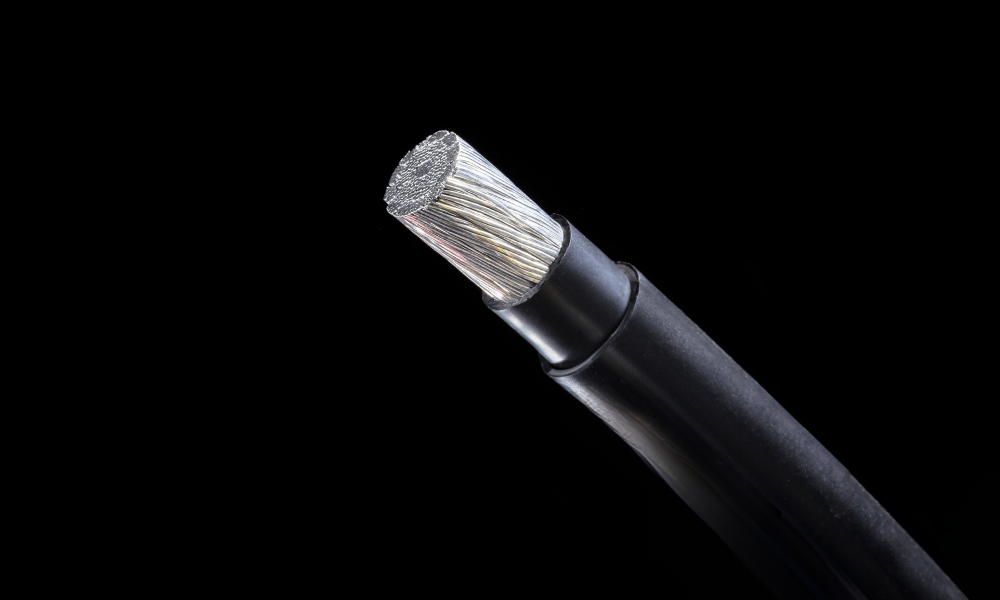
"Outdoor aluminum cable" is a common term used in Vietnamese to describe cables with aluminum (or aluminum alloy) conductors suited for outdoor installation — able to withstand UV exposure, rain, sun, humidity, wind, and temperature fluctuations over long periods. This term describes the application (outdoor use) rather than an official technical classification within the electrical industry. In other words, "outdoor" here refers to the usage context, while the actual technical nature of the cable is defined by its conductor structure, strand count, insulation (if any), and the applicable standard.
In terms of its role in the power system, most outdoor aluminum cables fall under the transmission and distribution cable category: electricity from a power plant or substation is fed into high-voltage transmission lines to minimize losses over long distances, then stepped down and carried through distribution lines before reaching consumers via a service drop cable connected to the building. To meet these requirements, such cables are typically built from multiple aluminum strands twisted together (reducing resistance and improving flexibility during installation); insulated types are usually covered in XLPE or PVC to limit current leakage and reduce safety hazards.
Explore the structural characteristics and applications of aluminum electrical wire
In English, there is no single fixed term that maps exactly onto "outdoor aluminum wire/cable" — the closest equivalents are generally based on installation method: overhead aluminum cable, aerial bundled cable (ABC — insulated conductors twisted together), and underground aluminum cable.
For this reason, when consulting technical documentation or placing an order, it's best to use the English term that matches the specific installation method (overhead or underground) rather than translating literally as "outdoor aluminum wire/cable" — that phrase is a general, marketing-style description, not a standardized industry term.
2. Key features of outdoor aluminum cables
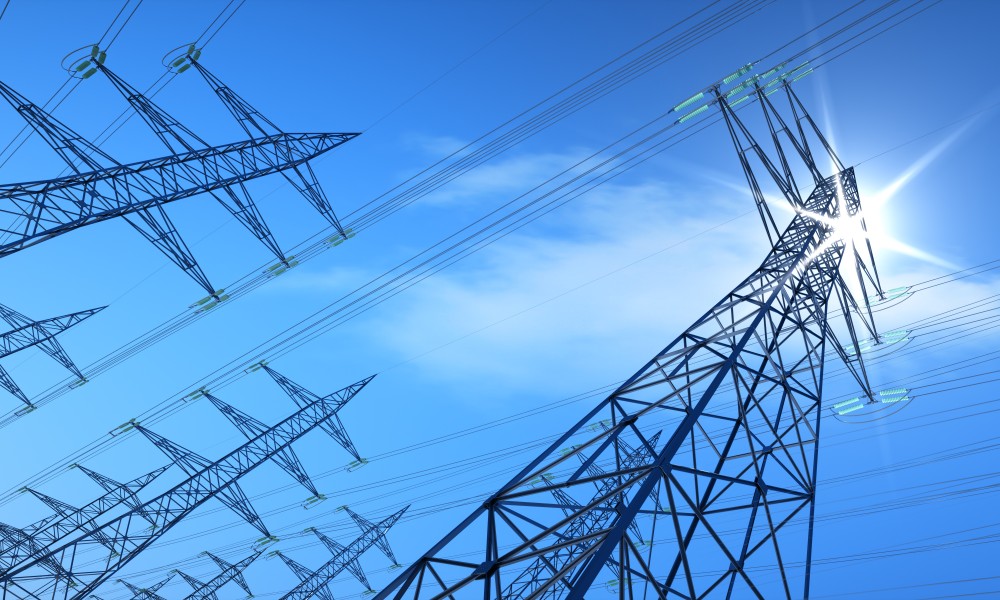
Aluminum cables can withstand temperature fluctuations, wind, and mechanical loads well over the long term
2.1 Good conductivity at a reasonable cost
Among conductive metals, silver conducts electricity best, followed by copper, then aluminum — but since silver is too expensive for widespread use, aluminum is generally considered the second-best practical choice after copper for cables used at industrial scale. Aluminum's conductivity is about 61–65% of copper's on the IACS scale — lower than copper, but still efficient enough for power transmission when the cross-section is sized correctly, while its raw material cost is significantly lower than copper's.
2.2 Withstands harsh weather and mechanical loads
When designed correctly for a given application, aluminum cables can withstand temperature swings, wind, and mechanical stress over long periods — which is why the power industry has relied on aluminum for overhead lines for more than a century. For long spans that require higher tensile strength than pure aluminum can provide, the industry developed designs that pair aluminum with a reinforcing steel core (ACSR), or a steel core with fully annealed aluminum for higher operating temperatures (ACSS, capable of running above 200°C).
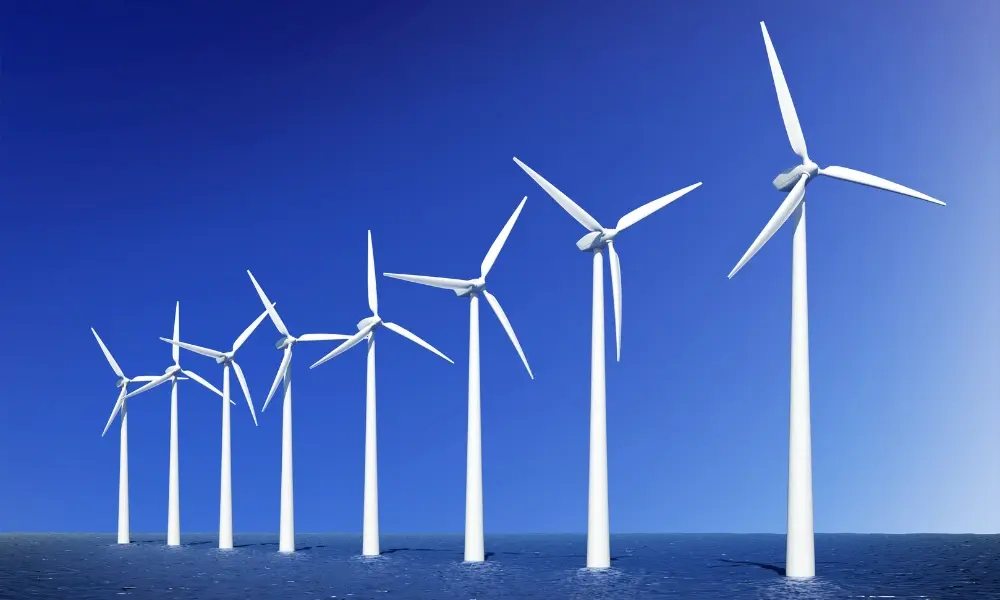
Single-core aluminum electrical cables are lightweight yet durable and are commonly used in wind turbines
2.3 Lightweight and easy to install
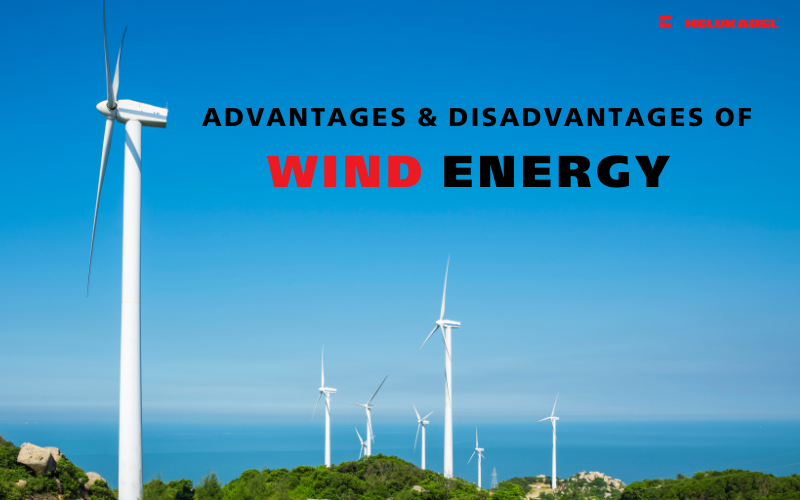
Because aluminum's density is only about 30% of copper's, aluminum wire is significantly lighter than a copper cable with equivalent conductivity. This lighter weight reduces the load on poles, supports, and foundations, simplifies installation and transport, and is especially valuable in hard-to-reach locations or applications with strict weight limits, such as power cables for wind turbines .
2.4 Corrosion resistance of outdoor aluminum cables
Aluminum naturally forms a thin, hard, transparent oxide layer when exposed to air, which protects the metal underneath from further corrosion — this is why aluminum cable holds up well against moisture, rain, and sun under normal atmospheric conditions. This oxide layer is only a few nanometers thick, so it doesn't meaningfully hinder conductivity under normal operating conditions.
2.5 Safety when properly installed and operated
Aluminum metal itself does not burn and does not release toxic gases under normal operating conditions, making it suitable for both residential and industrial use. That said, the actual safety of the overall system depends heavily on correct installation practices — particularly at connection points.
2.6 A mature connector ecosystem
The market offers a full range of connectors and lugs designed specifically for aluminum (bimetallic Al/Cu lugs, crimp connectors...), which makes field replacement or repair of aluminum cable fairly convenient. However, this doesn't mean aluminum is "compatible with any connector," aluminum must always be paired with connectors specifically designed and rated for it.
3. Classification of outdoor aluminum cable
There are three classification approaches that are often confused with one another. Understanding all three will help you communicate more precisely with suppliers.
3.1 Single core vs. single strand aluminum cable
Single core aluminum cable and single strand aluminum cables are actually two different things, though they're frequently mixed up:
- Core count is the number of independent conductors inside one cable — for example, single core aluminum cable has only one conductor, while twisted aluminum cable can have 2, 3, or 4 cores bundled together (typically for single-phase or three-phase-plus-neutral systems).
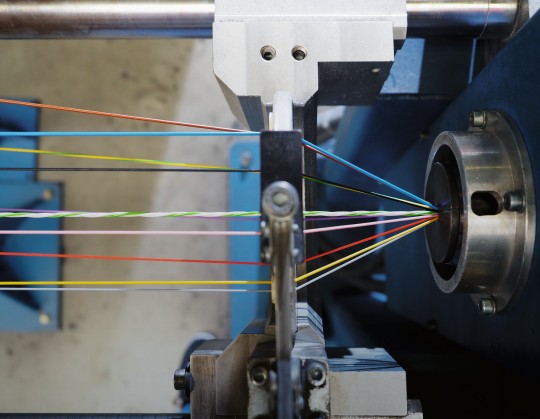
- Strand count is the number of small aluminum wires twisted together to form a single conductor. A core may be a single solid strand, or made up of multiple smaller strands (commonly 7, 19, 37, or 61, depending on cross-section), which makes the cable more flexible and easier to install than a solid core.
| Classification | Common types | Meaning / Application |
| By core count | 1 core (single) | Used for simple connections, low-voltage lines, powering outdoor equipment |
| 2 cores (duplex) | Used for single-phase circuits | |
| 3–4 cores (triplex/quadruplex) | Used for three-phase + neutral circuits, common on low-voltage overhead lines | |
| By strand count per core | 1 strand (solid) | Solid core, stiffer, less suited to applications requiring frequent bending |
| 7, 19, 37, 61 strands (stranded) | Stranded core, flexible and easy to install; larger cross-sections generally use more strands for better flexibility |
Under TCVN 6612:2007 (equivalent to IEC 60228:2004) — the standard governing conductors of insulated cables — a 7-strand aluminum conductor should have a minimum cross-section of 10 mm² for safe use; smaller cross-sections exist on the market under special designs but are not recommended for general use. HELU has a separate article explaining conductor classes under IEC 60228 in more detail, if you'd like to dig deeper into this concept.
3.2 Classification by conductor metal structure
This classification is rarely explained in Vietnamese-language articles, yet it's very important for aluminum cables used on long overhead spans (transmission and medium/high-voltage distribution). On lines stretching a long distance between poles, the cable must withstand significant mechanical tension from its own weight, wind, and ice loading — while pure aluminum has relatively low tensile strength. The power industry solved this by combining aluminum (good conductivity) with a load-bearing core:
| Type | Full name | Structure | Features |
| AAC | All-Aluminum Conductor | Entire core made of stranded pure aluminum wires, no reinforcing core | Lightweight, good conductivity, low cost; lower tensile strength, so typically used for shorter spans |
| AAAC | All-Aluminum-Alloy Conductor | Entire core made of aluminum alloy instead of pure aluminum | Stronger mechanically than AAC; often used as a substitute for ACSR in some applications |
| ACSR | Aluminum Conductor Steel-Reinforced | Strands of pure aluminum wound around a central galvanized steel core that carries the load | Highest tensile strength in the group; higher tension means less sag between poles — suited to long spans; continuous operating temperature limited to about 75°C, the point at which aluminum begins to anneal if sustained over time |
| ACSS | Aluminum Conductor Steel-Supported | Similar to ACSR, but the aluminum strands are fully annealed from the start | Can operate above 200°C without losing strength, since the steel core bears most of the tension |
Choosing the right type of aluminum wire (AAC, AAAC, or ACSR) depends on span length, environmental conditions (coastal areas, for instance, should prioritize types with better corrosion resistance), and the specific mechanical load requirements of each project — this should be calculated by a design engineer rather than applying one fixed type to every project.
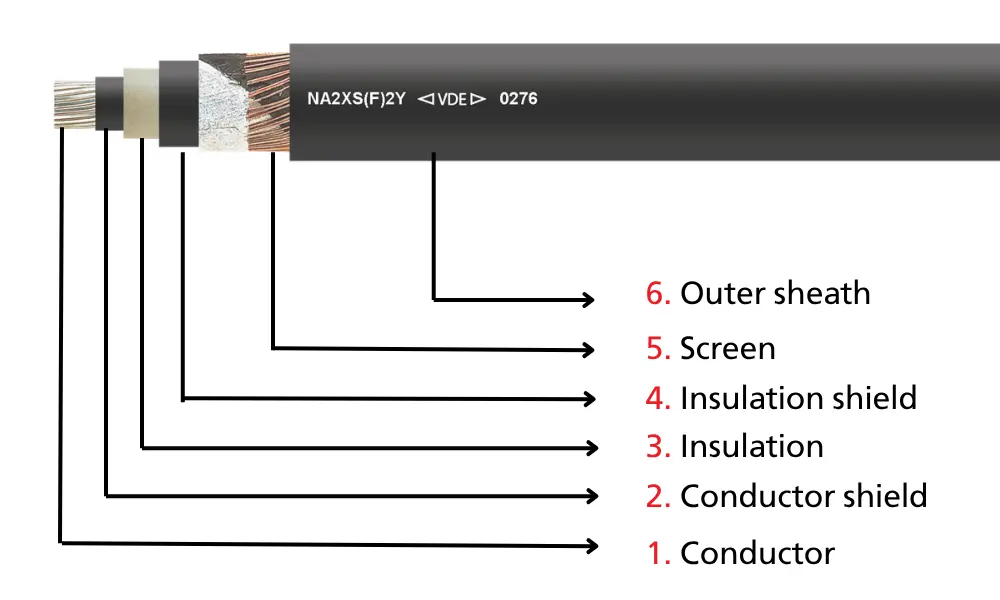
Components of underground outdoor aluminum cables
3.3 Classification by installation method
Beyond the two classifications above, outdoor aluminum cable is also grouped by installation method:
Overhead aluminum cable — commonly used in transmission and distribution systems for its ability to carry high voltage over long distances. This group splits further into two types, depending on whether insulation is present:
- Bare overhead conductor — has no insulation; phases are separated by air gaps, and sometimes coated with a thin layer to reduce the risk of flashover or fire when in contact with trees or other obstacles — common on high-voltage transmission lines.
- Insulated twisted (bundled) cable — commonly known as ABC (Aerial Bundled Cable) — multiple individually insulated conductors twisted together, common on low-voltage urban and rural distribution grids for safety reasons.
Underground aluminum cable — installed in conduit or by direct burial. Because it's constantly exposed to damp soil — a far harsher condition than overhead installation — this type always includes insulation to prevent short circuits, along with a protective outer jacket resistant to moisture and soil corrosion. This is also why underground cable never uses bare conductors the way some overhead cables do.
In the market, common designation codes for outdoor aluminum wire include: AV, AX, AXV (PVC or XLPE insulated — used for both insulated overhead and underground applications depending on jacket construction), DuAV (duplex cable), and LV-ABC (low-voltage twisted cable for overhead installation). Each code corresponds to a specific conductor structure, insulation type, and installation method, so when discussing your needs with a supplier, be specific — core count, cross-section, overhead or underground, conductor metal structure — rather than simply saying "outdoor aluminum wire."
4. Applications of outdoor aluminum cable
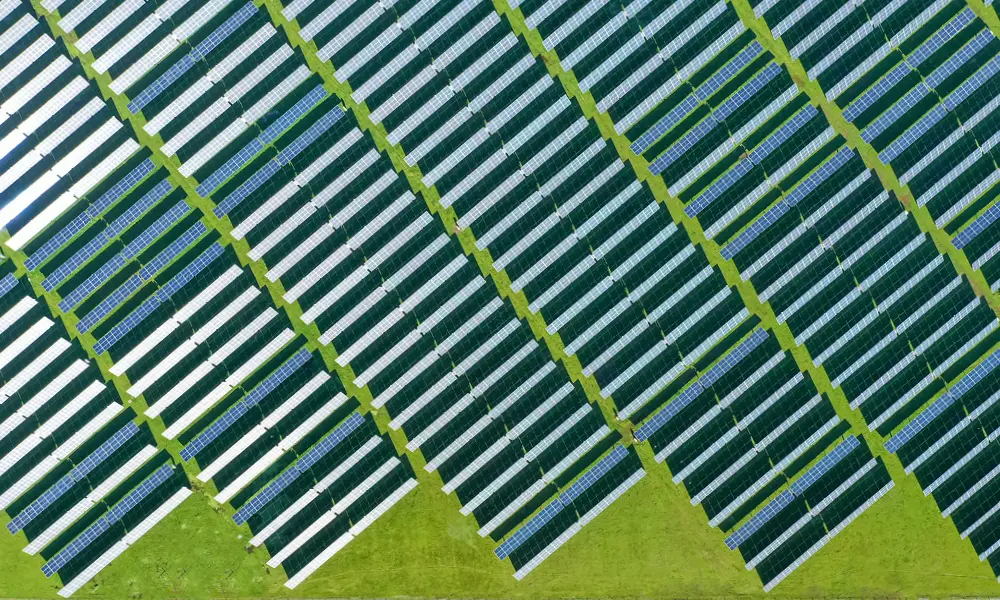
Outdoor aluminum cables are a crucial component of renewable energy projects (solar power, wind power)
Thanks to its light weight and cost-effectiveness, outdoor aluminum cable is widely used in:
- Low and medium voltage overhead transmission and distribution: especially suited to long lines (rural areas, new industrial zones), and for very long spans or river crossings.
- Coastal areas or highly corrosive environments: aluminum alloy types (AAAC) are often preferred for their better corrosion resistance compared with pure aluminum.
- Renewable energy systems: specialized aluminum cables (such as HELU's HELUWIND® WK POWERLINE ALU line, built with flexible fine-stranded aluminum technology) are used as power cables for wind turbines, where reducing mechanical load along the full height of the tower is critical.
- Construction and urban infrastructure: powering construction sites, substations, and public lighting systems.
- Large-scale solar power systems: connecting panel arrays to substations or the grid.
5. HELU's outdoor aluminum cable product range
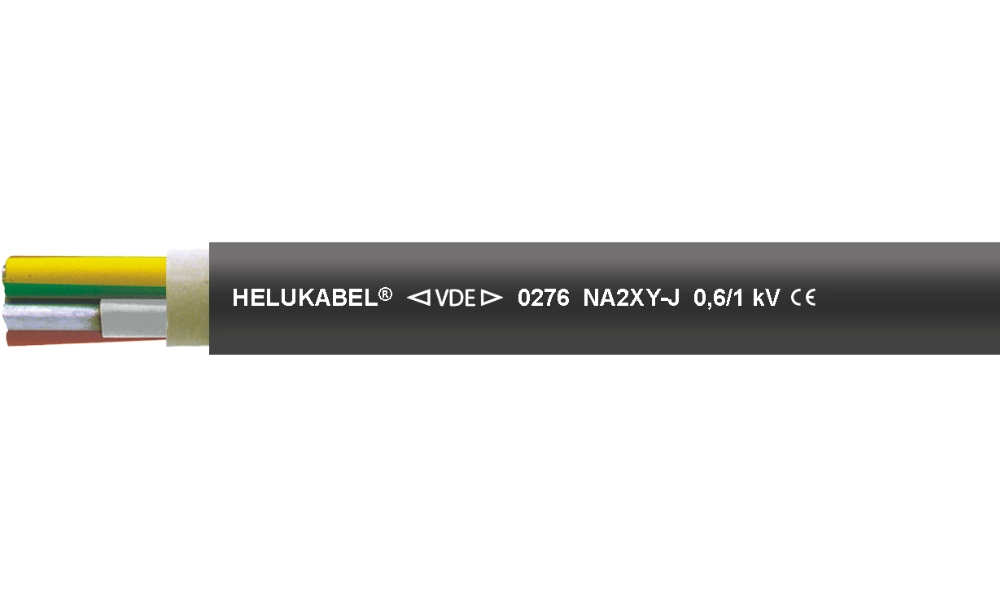
NA2XY aluminum conductor, XLPE-insulated cable
HELU offers a range of aluminum cable lines suited to different outdoor applications:
5.1 Low voltage aluminum cables
NAYY, NA2XY (RE/SE/SM types), 0.6/1kV — the designation codes refer to conductor structure: RE (round, solid), SE (sector-shaped, solid), SM (sector-shaped, stranded) — suited to common low-voltage systems.
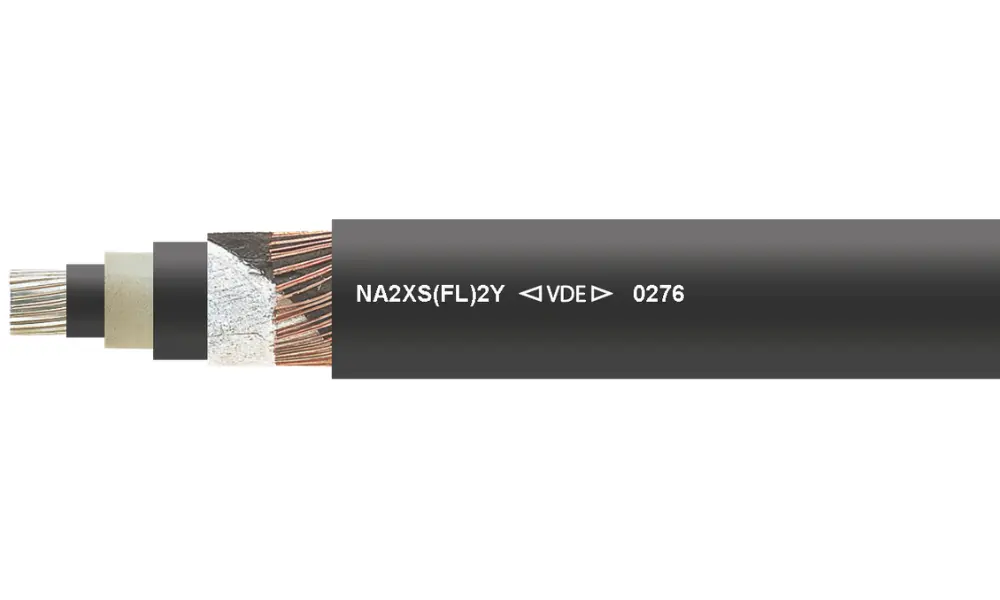
NA2XS(FL)2Y aluminum conductor, medium voltage cable
5.2 Medium voltage aluminum outdoor cables
NA2XSY, NA2XS2Y, NA2XS(F)2Y, NA2XS(FL)2Y, 6–30kV — XLPE-insulated medium-voltage aluminum cables for substations, indoor installation, protected outdoor installation, and direct burial underground or underwater, depending on jacket type.
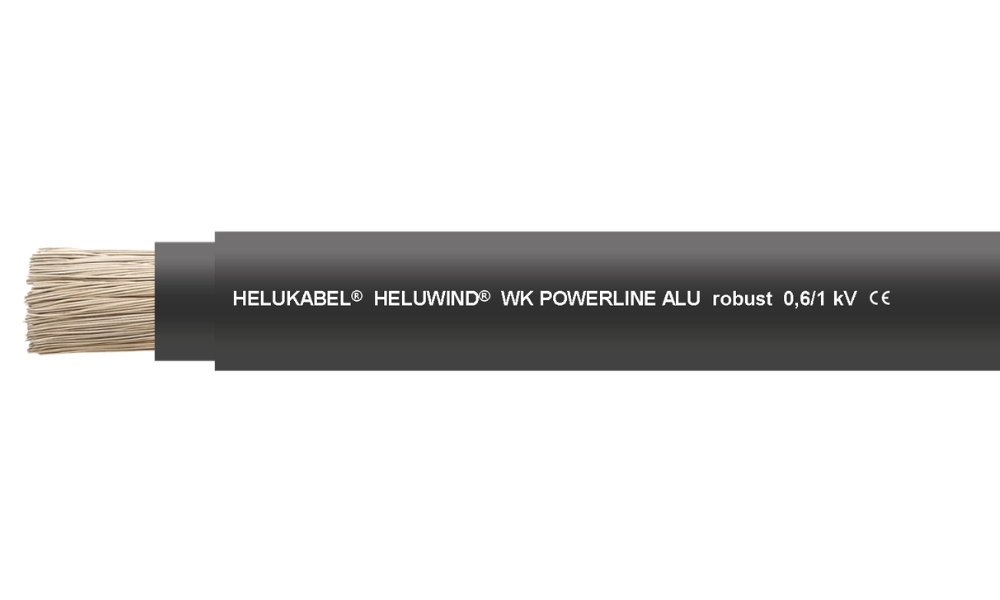
HELUWIND® WK POWERLINE ALU ROBUST 0.6/1 kV single core aluminum cable
5.3 Single core aluminum cables
HELUWIND® WK POWERLINE ALU — a line of flexible aluminum cables with a multi-strand structure, specifically designed for wind turbine power cable systems , allowing continuous installation along the full height of the tower without segmenting by level, which shortens installation time.
To select the right cable for a specific project (core count, cross-section, voltage class, installation conditions), please contact the HELU Vietnam engineering team directly for consultation and precise specifications.
| Version | Operating temperature range(Movement, Fixed Installation) | Minimum bending radius(Movement, Fixed Installation) | Shell Material | Cross-sectional area | Part No. |
| 0.6/1 kV | -20°C to +90°C, -40°C to +90°C | 10x outer diameter, 4x outer diameter | Special PVC | 70–400 mm² | 707062 |
| ROBUST 0.6/1 kV | -20°C to +90°C, -40°C to +90°C | 10x outer diameter, 4x outer diameter | Special PUR | 70–400 mm² | 707097 |
| 1.8/3 kV | -20°C to +90°C, -40°C to +90°C | 10x outer diameter, 4x outer diameter | Special PVC | 185–400 mm² | 707647 |
| ROBUST 1.8/3 kV | -20°C to +90°C, -40°C to +90°C | 10x outer diameter, 4x outer diameter | Special PUR | 185–400 mm² | 707692 |
| HALOGEN-FREE 1.8/3 kV | -20°C to +90°C, -40°C to +90°C | 10x outer diameter, 4x outer diameter | TPE-O is halogen-free | 185–400 mm² | 709143 |
| LS0H 0.6/1 kV | -40°C to +90°C | 4x Outer Diameter (fixed) | cross-linked polyolefin | 50–630 mm² | 17000626 |
| LS0H 1.8/3 kV | -40°C to +90°C | 4x Outer Diameter (fixed) | cross-linked polyolefin | 50–630 mm² | 17009846 |
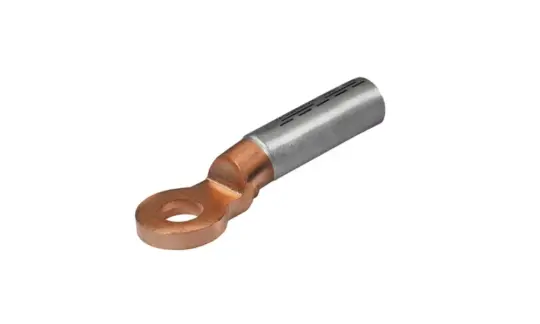
5.4 Cable lugs
Some of HELU's cable lug accessories include:
6. Current-carrying capacity tables for aluminum cables
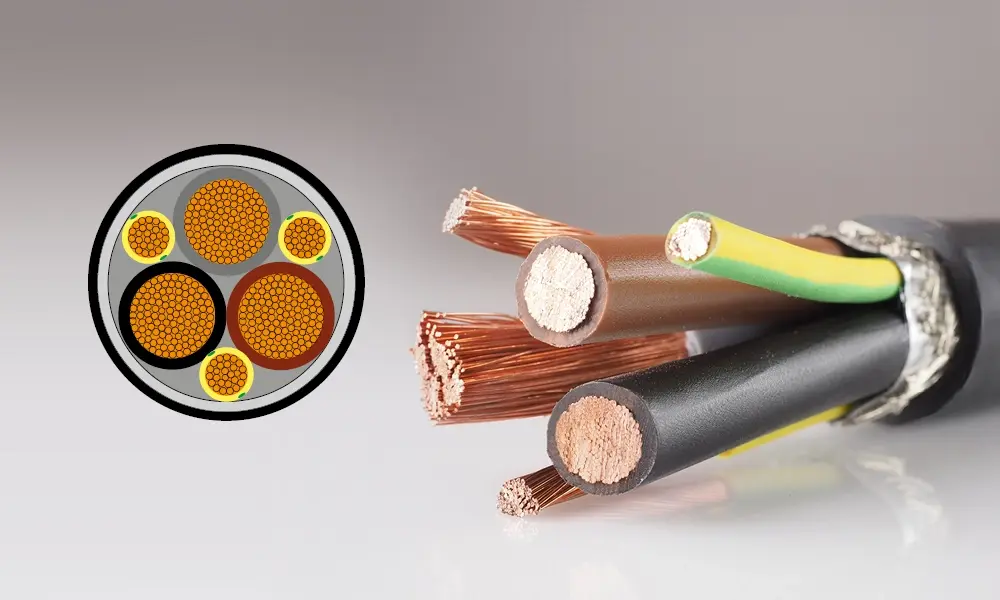
The current-carrying capacity of aluminum wire depends on many factors, such as the installation method, ambient temperature, and conductor cross-sectional area
6.1 What is current-carrying capacity?
Current-carrying capacity (ampacity) is the maximum current a cable can carry continuously over a sustained period without overheating. Exceeding this permitted current can damage the cable's insulation and, in the worst case, lead to fire.
The following factors determine the maximum current outdoor aluminum wire can safely carry:
- Conductor cross-section: a larger cross-section means lower resistance and better heat dissipation.
- Installation ambient temperature: rated current is usually published under standard conditions (commonly 20°C); higher real-world temperatures reduce current-carrying capacity.
- Installation method: overhead, in conduit, on cable trays, or direct burial each has a different heat-dissipation coefficient.
6.2 Current carrying capacity for NYY, NAYY, NYCY, NYCWY, NAYCWY 0.6/1 kV cables
Current carrying capacity in ampere (A), installation underground (20°C) acc. to DIN VDE 0276 part 603, cyclic load degree 0.72)
| Cable cross-sectional area (mm²) | NAYY | NAYCY | NAYCWY |
| 16 | - | - | - |
| 25 | 102 - 160 | 108 | 103 |
| 35 | 123–193 | 129 | 123 |
| 50 | 144 - 230 | 153 | 145 |
Current carrying capacity in ampere (A), installation in the open (30°C)
| Cable cross-sectional area (mm²) | NAYY | NAYCY | NAYCWY |
| 16 | - | - | - |
| 25 | 82–110 | 91 | 83 |
| 35 | 100 - 135 | 112 | 101 |
| 50 | 119 - 166 | 137 | 121 |
Conversion factors for multi-core cables (from 5 cores) The conversion factors are to be used when installing underground or in the open using values in the above tables.
| Number of loaded cores n | Installation underground f | Installation in the open f |
| 5 | 0.7 | 0.75 |
| 7 | 0.6 | 0.65 |
| 10 | 0.5 | 0.55 |
| 14 | 0.45 | 0.50 |
| 19 | 0.4 | 0.45 |
6.3 Current carrying capacity table for NA2XY cables
| Cross section (mm2) | Installation underground (20°C) | Installation in the open (30°C) |
| 16 | - | - |
| 25 | 112–177 | 102–136 |
| 35 | 135–212 | 126–166 |
| 50 | 158- 252 | 149 - 205 |
6.4 Current carrying capacity for XLPE-insulated, 6/10 kV, 12/20 kV, 18/30 kV aluminum cables
| Cable cross-sectional area (mm²) | Installation underground (20°C) | Installation in the open (30°C) | ||||
| 6/10 kV | 12/20 kV | 18/30 kV | 6/10 kV | 12/20 kV | 18/30 kV | |
| 25 | - | - | - | - | - | - |
| 35 | 145 - 165 | - | - | 153–182 | - | - |
| 50 | 171–194 | 172–195 | 174–195 | 183–219 | 185–219 | 187–219 |
| 70 | 208–236 | 210 - 237 | 213 - 238 | 228 - 273 | 231 - 273 | 232 - 273 |
7. Frequently Asked Questions (FAQs)
Because for the same current-carrying capacity, outdoor aluminum wire only needs a cross-section about 1.5 times larger than a copper cable, yet weighs roughly half as much — this is the core reason the power industry favors aluminum for overhead lines, where cable weight directly affects pole loading, sag, and support-structure costs.
Copper conducts electricity better: aluminum's conductivity is only about 61–65% of copper's (on the IACS scale). In exchange, aluminum is considerably lighter — its density is only about 30% of copper's, meaning it's nearly three times lighter at the same cross-section. As a result, aluminum is generally preferred for larger cross-sections and overhead distribution lines, while copper is preferred where a smaller cross-section or limited installation space is needed.
Single core aluminum wire is typically used for simple connections, low-voltage lines, or powering outdoor equipment. For indoor residential wiring, the choice between copper and aluminum should be based on specific technical advice, since it involves connector compatibility, safety standards, and local installation practices.
This is the ACSR (Aluminum Conductor Steel-Reinforced) design — used for long spans such as transmission lines and river crossings. The steel core bears most of the mechanical tension, while the outer aluminum strands carry the current; thanks to the skin effect, alternating current already concentrates near the outer layer, so a non-conductive steel core at the center doesn't cause significant waste.
If you're still unsure which type of outdoor aluminum wire best suits your project, feel free to contact the HELU Vietnam engineering team for detailed consultation.