What is a three-phase cable? How to size it by load power?
A three-phase cable carries the power for motors, compressors, pumps and most of the equipment on a factory floor. Pick a cable that is too small and it runs hot and causes voltage drop. Pick one that is too large and you pay more for no benefit. This article explains how a three-phase cable is built, the main types, and how to size it from the load power in three steps, with a worked example.

Article content:
1. What is a three-phase cable?
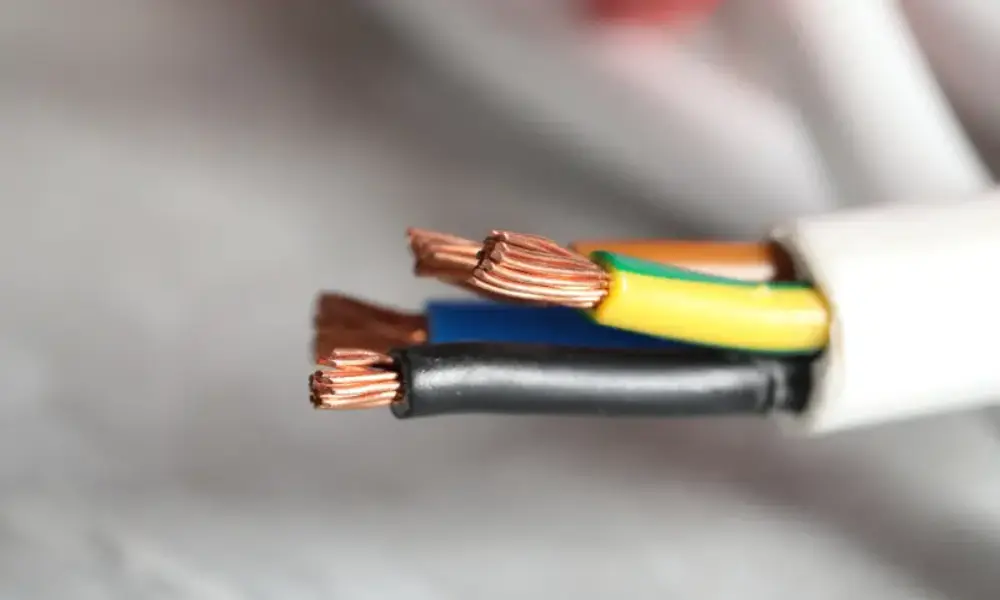
A three-phase cable has three phase wires (L1, L2, and L3) and may also have a neutral wire and/or a ground wire.
A three-phase cable is a wire or cable that carries power in a three-phase AC system. It has three phase conductors: L1, L2 and L3. Depending on the system, it may also have a neutral (N), a protective earth (PE), or both.
On Vietnam's low-voltage grid, the voltage between two phases is 380 V. The voltage between one phase and neutral is 220 V. The three currents are 120° apart, so the load gets a smoother power supply than it would from single-phase.
That is why a three-phase cable is used for large loads: motors, air compressors, HVAC systems, lifts and distribution boards. For the same power, a three-phase system draws less current per conductor than a single-phase one, so each core can be smaller.
Three-phase vs single-phase cables
For the same load, a three-phase cable carries about one third of the current that single-phase cable does. Each core can therefore be smaller, the cable is more compact and it uses less copper.
| Criteria | Single-phase cable | 3-phase cable |
| Conductors | 1 phase + 1 neutral | 3 phases (neutral optional) |
| Common core count | 2 or 3 cores | 3, 4 or 5 cores |
| Voltage (Vietnam) | 220 V | 380 V between phases |
| Cross-section needed | Large | Much smaller, because each conductor carries less current |
| Typical loads | Household appliances, lighting | Motors, industrial machines, distribution boards |
2. Construction of a 3-phase cable
A three-phase cable usually has four parts, from the inside out: the conductor, the insulation, a protective layer (if any) and the outer sheath.
2.1 Conductor
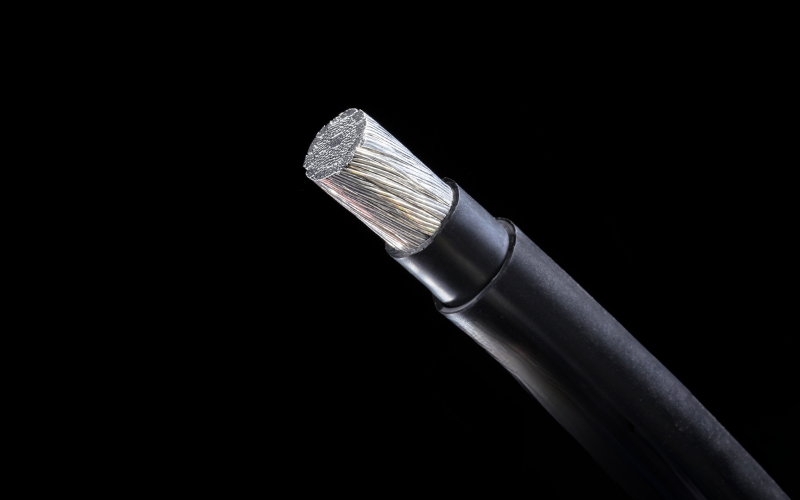
The conductor is made of copper or aluminium. Copper conducts better, so for the same current a copper conductor can be smaller. Aluminium is lighter and cheaper, and is often used for large cables on long runs.
According to the IEC 60228 standard , conductors are classified into several classes:
- Class 1: a single solid wire.
- Class 2: several stranded wires, common in fixed installations.
- Class 5 and 6: many fine wires. Used on equipment that vibrates or has to bend often.
2.2 Insulation
The two most common materials are PVC and XLPE. The advantage of PVC is that it can withstand a maximum conductor temperature of 70°C during continuous operation, while XLPE can withstand 90°C. As a result, XLPE-insulated cables can carry a higher current for the same cross-sectional area. Learn more about XLPE electrical cables.
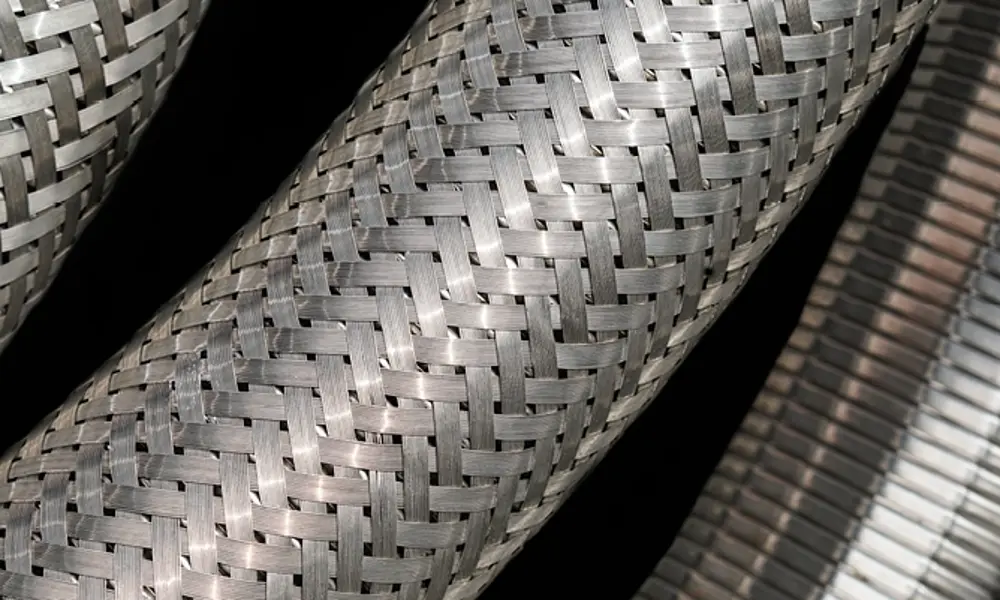
Some three-phase power cables may have an additional shielding layer to prevent the effects of electromagnetic interference.
2.3 Armour and screening
Depending on where it is installed, a three-phase cable may also have a screen, armour, or both.
- Steel armour (steel tape or steel wire): protects against impact. Used for buried cable. Armour is chosen for the installation conditions, not for the voltage rating.
- Screen (copper braid, aluminium foil): needed on the cable between a variable frequency drive (VFD) and its motor. It limits electromagnetic interference (EMC) with nearby equipment.
2.4 Outer sheath
The sheath keeps out moisture, oil, UV light and chemicals. Common materials are PVC, PE, PUR, or halogen-free compounds (LSZH) for public buildings.
3. Types of three-phase cables
A three-phase cable is not one single cable type but a whole family of cables used for three-phase power. The simplest way to classify it is by the number of cores, which depends on how the system is earthed and what loads it feeds.
| Cable type | Cores | Compatible system | Typical applications |
| 3-core | L1, L2, L3 | Three-phase, three-wire | Motors and balanced three-phase loads with no neutral |
| 4-core | L1, L2, L3 + N (or PEN) | Three-phase, four-wire, TN-C | Distribution boards that supply both three-phase and single-phase loads |
| 4-core | L1, L2, L3 + PE | Three-phase, three-wire with separate earth | Motors, machine tools |
| 5-core | L1, L2, L3 + N + PE | Three-phase, five-wire, TN-S | Factories with many VFDs and electronics, TN-S buildings, data centres |
3.1 3-core three-phase cables
A 3-core three-phase cable (often just called 3-core cable) has only the three phase conductors, L1, L2 and L3, and no neutral. It is used when the circuit feeds only balanced three-phase loads, such as large motors or industrial machines. A balanced load draws almost no current through the neutral, so the neutral is not needed.
3.2 4-core three-phase cables
A 4-core three-phase cable (often just called 4-core cable) has the three phase conductors L1, L2 and L3, plus a fourth core. The fourth core can be a neutral, or a PEN conductor (combined neutral and protective earth) in a TN-C system. With a neutral, the cable can supply both three-phase and single-phase loads from the same circuit. That makes it a common choice for commercial buildings and distribution boards that feed mixed loads.
3.3 5-core three-phase cables
A 5-core cable has three phase conductors, a neutral (N) and a protective earth (PE). The PE carries no working current, so it is always free to carry fault current to earth. Keeping the neutral and the protective earth separate makes the system safer. This is the standard configuration for TN-S systems, typically used in:
- Industrial sites with strict safety requirements
- Modern factories and automation systems with many VFDs and electronic devices
- Projects with strict equipment protection requirements, such as data centres and hospitals
3.4 Classification by installation environment
- Cables for fixed indoor installation, in cable trays or cable ladders: PVC- or XLPE-insulated cables, such as CVV and CXV cables. See also : What are CVV and CXV cables ?
- Underground cable: steel-armoured cable.
- Cables for mobile devices, vibration-resistant: flexible cables, Class 5 conductors, rubber or PUR jacket. See rubber cables and PVC cables .
- Public facilities and areas requiring power continuity during a fire: shielded fire-resistant cables ; halogen-free cables.
4. Three-phase cable color codes
4.1 IEC color coding
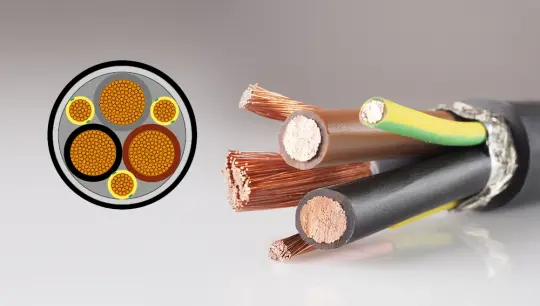
Under the international standard IEC 60445, three-phase cable color codings are: L1 brown, L2 black, L3 grey, neutral blue, protective earth green/yellow.
| Conductor | Marking | Colors according to IEC 60445 |
| Phase 1 | L1 | Brown |
| Phase 2 | L2 | Black |
| Phase 3 | L3 | Gray |
| Neutral | N | Blue |
| Grounding Protection | PE | Green with yellow stripes |
Green/yellow is reserved for protective earth. Never use a green/yellow core as a phase or a neutral.
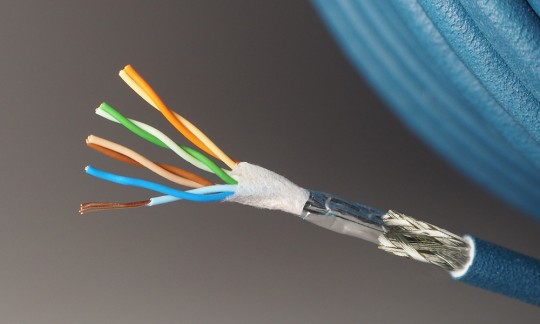
Two things to watch when wiring on site:
- Older installations may use a different color code: When you modify or extend one, test and re-mark each phase. Do not rely on the insulation color.
- Many industrial cables do not use color to tell phases apart: The cores are all black with printed numbers 1, 2, 3, plus one green/yellow core. In that case, the wiring diagram must show which numbered core goes to which phase.
4.2 -J and -O suffixes: does the cable have an earth core?
On cables made to German standards, the suffix -J means the cable has a green/yellow protective earth (PE) core. The suffix -O means it does not. DIN VDE 0293-308 sets the core colors as follows:
| Number of cores | With protective core (-J) | No protective core (-O) |
| 3 | Green/yellow, blue, brown | Brown, black, grey |
| 4 | Green/yellow, brown, black, grey | Blue, brown, black, grey |
| 5 | Green/yellow, blue, brown, black, grey | Blue, brown, black, grey, black |
| 6 or more | Green/yellow, other cores black with printed numbers | Black with printed numbers |
From the table you can quickly read a three-phase cable's configuration:
- 4-core -J: three phases (brown, black, grey) and PE. No neutral.
- 4-core -O: three phases and neutral (blue). No PE.
- 5-core -J: three phases, neutral and PE, for TN-S systems.
For example, a cable marked 5G6, or a 5-core 6 mm² cable with the -J suffix, is a 3P + N + PE cable. The "G" in the size marking and the "-J" suffix say the same thing: the cable has a green/yellow core.
5. How to size three-phase cable by load power
Sizing three-phase cable by load power takes three steps. Work out the current from the load power. Pick a cross-section with enough current-carrying capacity once you allow for the installation method, temperature and number of cables run together. Then check the voltage drop over the length of the run.
Step 1: Calculate the load current
The load current of a three-phase circuit is calculated using the following formula: I = P / (√3 × U × cosφ × η)
Here P is the power (W), U is the phase-to-phase voltage (380 V on Vietnam's low-voltage grid), and cosφ is the power factor shown on the nameplate. η is the efficiency, used only for motors, because the power on a motor nameplate is the mechanical output at the shaft. For other loads, take η = 1. If the motor nameplate gives a rated current, use that figure directly.
Example: a 15 kW motor, 380 V, cosφ = 0.85, η = 0.9. Load current I = 15,000 / (1.732 × 380 × 0.85 × 0.9) ≈ 29.8 A. Leave out the efficiency and you get only 26.8 A, about 10% below the real figure.
Step 2: Choose the cross-section by current-carrying capacity
The cable is correctly sized when: load current ≤ circuit breaker rating ≤ current-carrying capacity of the cable. Current-carrying capacity comes from tables. For a three-phase circuit, use the "3 loaded cores" column (the PE core does not count). The table below is for multi-core copper cable at an ambient temperature of 30°C:
| Cross-section | PVC, in conduit on the wall | PVC, in the wall | XLPE, in the wall |
| 4 mm² | 27 A | 32 A | 40 A |
| 6 mm² | 34 A | 41 A | 52 A |
| 10 mm² | 46 A | 57 A | 71 A |
The table values must be reduced in two cases:
- Ambient temperature above 30°C: at 40°C, multiply by 0.87 for PVC cable or 0.91 for XLPE cable.
- Several cables run close together: for example, three circuits bunched on a wall or in a tray, multiply by 0.70.
Back to the example: load current 29.8 A, a 32 A breaker, cable clipped direct to a wall.
| Conditions | Cable | Current-carrying capacity | Is it ≥ 32 A? |
| 30°C | 4 mm² PVC | 32 A | Dat |
| 40°C | 4 mm² PVC | 32 × 0.87 ≈ 27.8 A | Failed |
| 40°C | 6 mm² PVC | 41 × 0.87 ≈ 35.7 A | Dat |
| 40°C, 3 circuits sharing a common path | 6 mm² PVC | 41 × 0.87 × 0.70 ≈ 25.0 A | Failed |
In the last case, you need to go up to PVC 10 mm² (≈ 34.7 A) or switch to XLPE 6 mm² (52 × 0.91 × 0.70 ≈ 33.1 A). Same motor, but the cable size changes from 4 to 10 mm² just because of temperature and how the cable is run.
Step 3: Check for voltage drop
Even a cable rated for the load may not be suitable if the cable run is too long. For cables with a small cross-sectional area, an approximate calculation can be made (ignoring reactance): ΔU = (√3 × I × L × ρ × cosφ)/S
Here L is the length of the run (m), S is the cross-section (mm²), and ρ = 0.0225 Ω·mm²/m for copper.
Continuing the example with 6 mm² cable at 29.8 A: a 50 m run drops about 8.2 V (2.2%), and a 100 m run drops about 16.4 V (4.3%). IEC 60364-5-52 recommends no more than 5% voltage drop for power circuits supplied from the public low-voltage grid. The 100 m run still passes, but only just. When a motor starts direct-on-line, the current and voltage drop are several times higher. On long runs, consider going up to 10 mm² or using star-delta starting, a soft starter or a VFD.
Note:
The figures above show how the calculation works. For a real design, use the tables for the exact cable type and installation conditions, or ask a HELU engineer for advice.
6. Applications of three-phase cables
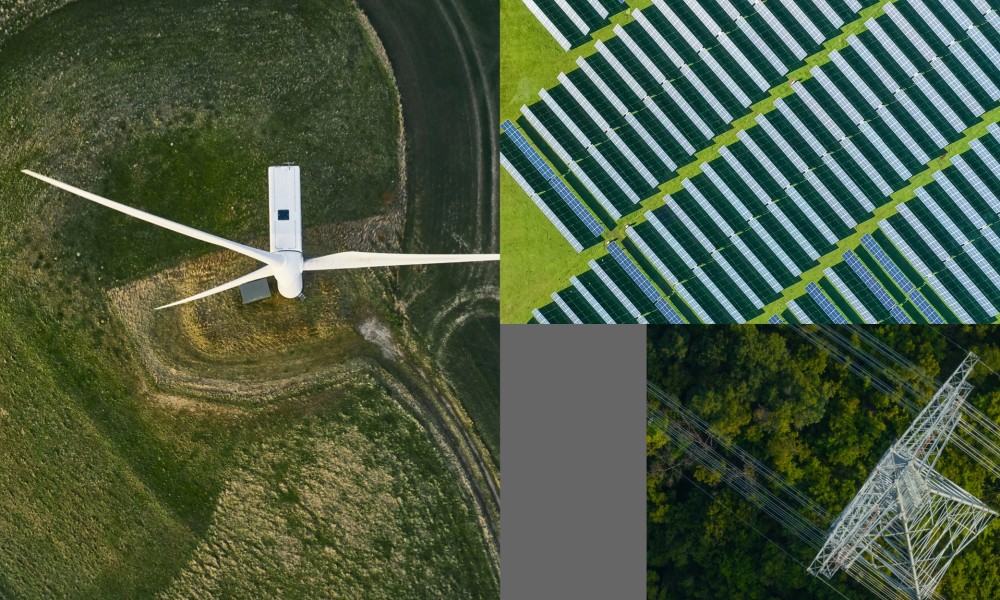
A three-phase cable is found in almost every high-power system:
- Industrial production: motors, CNC machines, pumps, fans, air compressors and automated lines. These are high-power machines that run for long hours, so they almost always use a three-phase supply.
- Buildings and infrastructure: HVAC systems, lifts and water pumps. Large buildings use a lot of power in one place and need a more stable supply than a normal home.
- Power distribution: cable from the main switchboard to sub-distribution boards, feeding each workshop, floor or zone of an industrial park.
- Renewable energy: the AC side of a solar system, from the solar inverter to the grid connection panel, and the grid connection of a battery energy storage system (BESS).
- EV charging: high-power AC chargers usually run on three-phase.
7. Things to consider when choosing three-phase cable for industrial sites
On a factory floor, the right size is not enough. The cable also has to suit the load and its surroundings.
| Scenario | Cable requirements |
| Voltage rating | Pick a cable with the right rated voltage. 380 V low-voltage circuits usually use 0.6/1 kV power cable. Medium-voltage networks need dedicated medium-voltage cable |
| Installation method (in conduit, on a wall, on a tray) | Directly affects current-carrying capacity; see Step 2 in the sizing section |
| Motor on a VFD | Screened cable, preferably symmetrical, with the screen earthed at both ends |
| Moving equipment, drag chains | Flexible cable rated for continuous bending |
| Outdoors | UV-resistant, moisture-resistant sheath |
| Buried, or at risk of crushing or impact | Steel-armoured cable with a waterproof sheath |
| Near furnaces or hot areas | Heat-resistant cable; recalculate current-carrying capacity for the actual temperature |
| Oil or chemicals | Oil-resistant sheath (PUR or a special compound) |
| Public buildings, tunnels, escape routes | Fire-resistant, low-smoke, halogen-free cable |
Besides, you should choose certified cable with a full datasheet (IEC, VDE, UL). Without a datasheet, you cannot look up the exact current-carrying capacity.
8. Three-phase cables from HELU
HELU supplies three-phase cables for a wide range of installations: power cable for fixed wiring, flexible cable for machinery, screened cable for VFDs and fire-resistant cable. Every product comes with a datasheet that sets out its construction, standards and technical data, so engineers can look up values and calculate accurately.
| Cable family | Key features | Typical applications | Example of the HELU cable line |
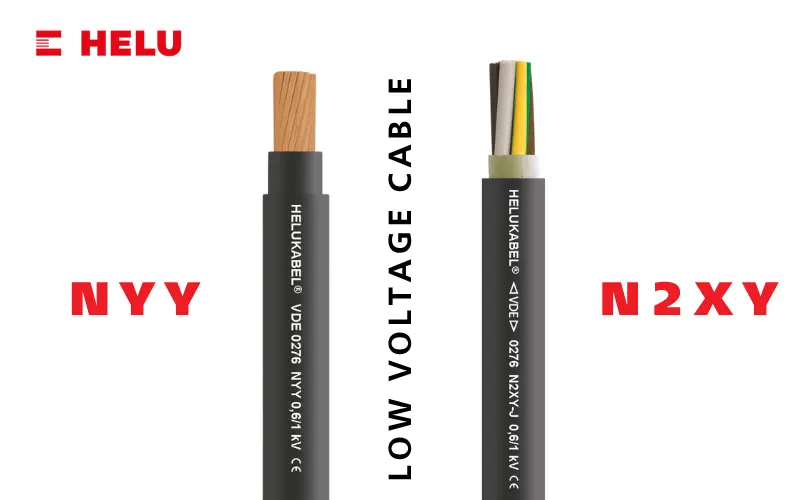
| PVC-insulated power cable, 0.6/1 kV | Common and low cost; max. conductor temperature 70°C | Fixed installation indoors, outdoors and underground | NYY-J / NYY-O; NAYY (aluminum core) |
| XLPE-insulated power cable, 0.6/1 kV | Rated 90°C; carries more current than PVC of the same size | Power distribution in factories and buildings | N2XY |
| Halogen-free cable | Low smoke, no halogen gases in a fire | Public buildings, hospitals, data centres | N2XH-J / N2XH-O |
| Cable with concentric conductor | Copper wires wound around the cores (code letter C) | Circuits that need an extra metallic protective layer | NYCY, NYCWY, N2XCH |
| Fire-resistant (circuit integrity) cable | Keeps insulation and function during a fire (FE 180, E30/E90) | Fire pumps, smoke extract fans, emergency lighting | (N)HXH-FE 180, (N)HXCH-FE 180 |
| VFD motor cable (EMC) | Copper braid screen; some ranges have a symmetrical design | VFD-to-motor connections for pumps, fans, conveyors | TOPFLEX®-EMV |
| Servo cable | Screened power cores for servo motors; many types suit cable chains | Robots, CNC machines, automated lines | TOPSERV® |
| Flexible rubber cable | Flexible, weather-resistant, 450/750 V | Mobile equipment, construction sites, temporary power | H07RN-F |
| Medium-voltage cable | Rated 6/10 kV to 18/30 kV, copper screen | MV networks, substations | N2XSY, NA2XS(F)2Y. See also medium-voltage power cables |
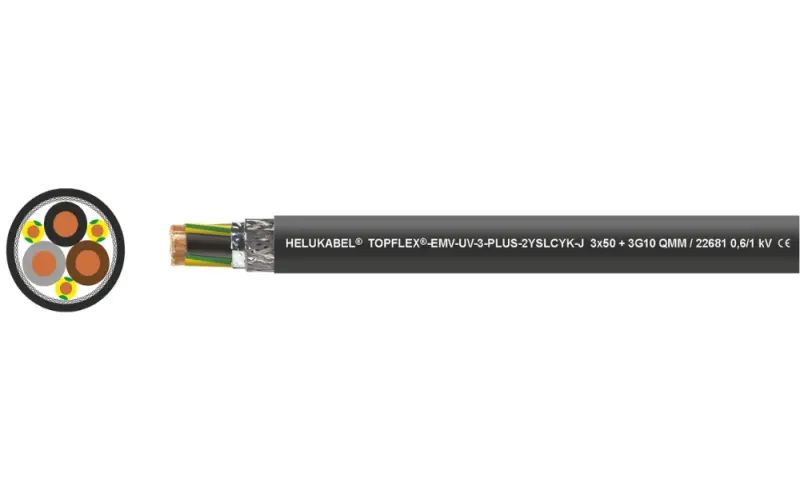

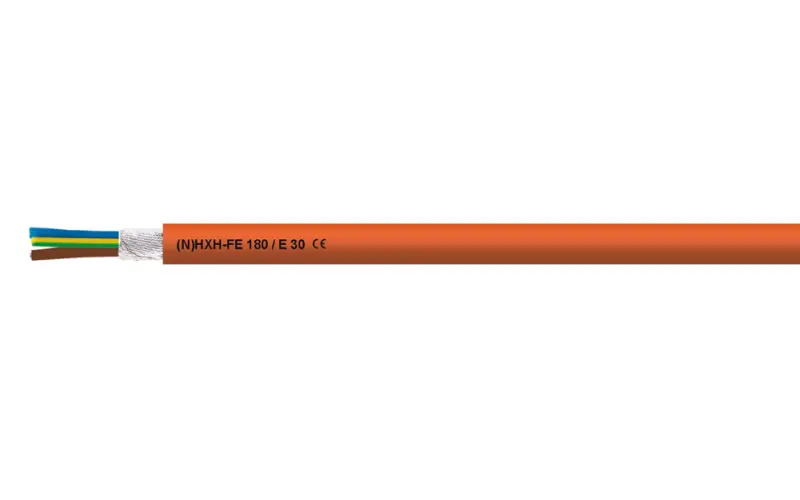


Servo cable is also three-phase cable, because a servo motor runs on three-phase AC from its drive. Unlike standard power cable, servo cable needs good screening and often has to flex continuously. Learn moreabout what a servo motor is and the differences between servo cables and motor cables .
Most of the low-voltage ranges above come in multi-core versions for three-phase circuits (for example 4G or 5G). Medium-voltage cable is usually single-core, with three cables making up one circuit.
Contact HELU Vietnam today for consultation on 3-phase cables for infrastructure, energy, and VFD motor projects
9. Frequently Asked Questions
Three-phase cable always has three phase conductors: L1, L2 and L3. Depending on the system, there may also be a neutral (N), a protective earth (PE), or both. So a three-phase circuit can use 3, 4 or 5 wires.
A 4-core three-phase cable has three phase cores plus one core that is either the neutral or the protective earth. A 5-core cable has three phases, a neutral and a separate protective earth, and is used in TN-S systems. 5-core cable is safer because the protective earth carries no working current and is always free to carry fault current to earth.
Yes. Aluminium is lighter and cheaper, so it is often used for large cables on long runs. But aluminium does not conduct as well as copper, so it needs a larger cross-section to carry the same current. When you join aluminium to copper, use bimetallic copper–aluminium lugs to prevent galvanic corrosion.
See also: What is aluminum wire ?
The price depends mainly on the conductor material (copper or aluminium), the cross-section and core count, the insulation (PVC or XLPE), and the sheath and armour. Extra features such as fire resistance, screening and halogen-free materials, plus standards and certification, also change the price. On top of that, the price of copper cables moves with the copper market. For a quote on a specific cable, contact HELU.